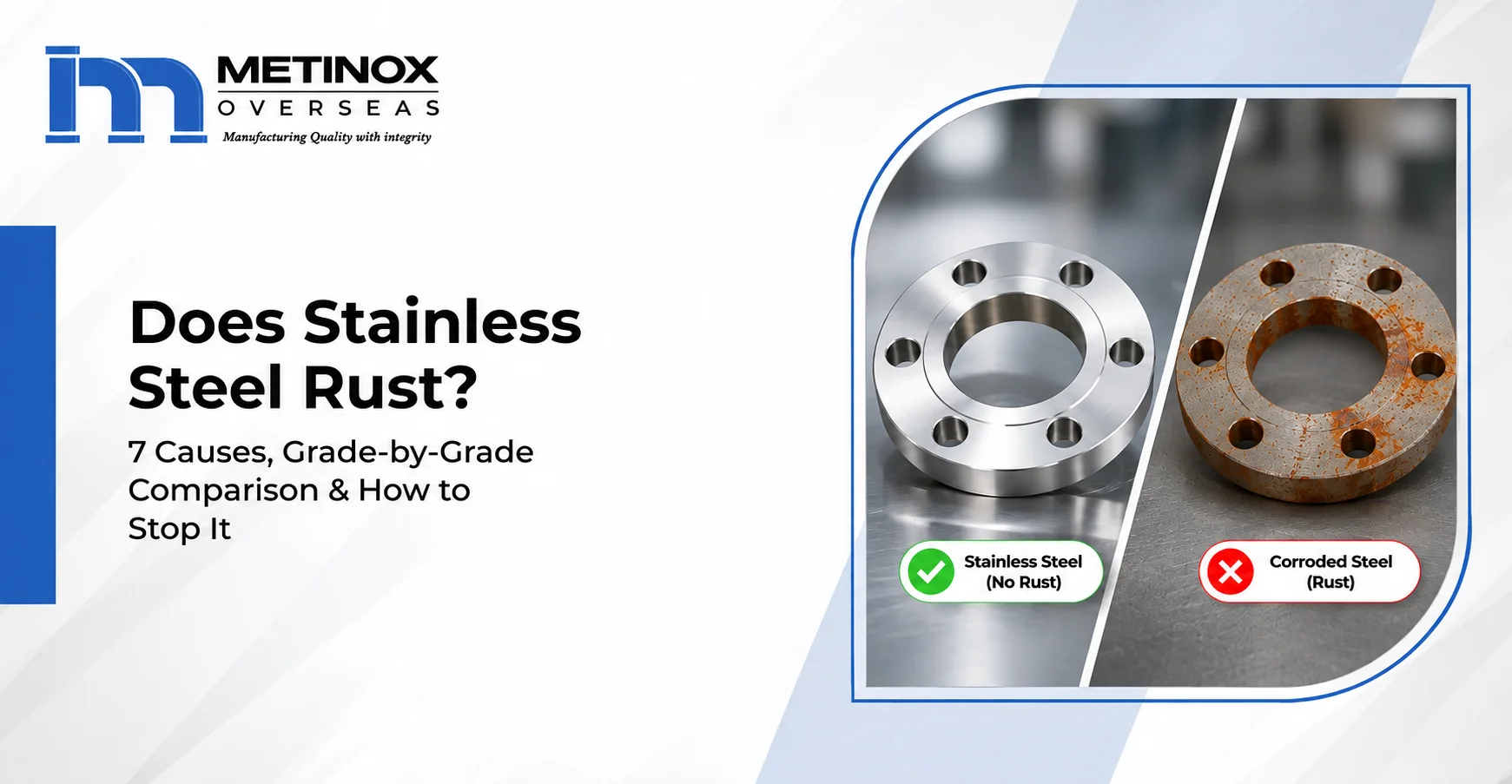
Yes, stainless steel can corrode. The name is somewhat misleading. It resists rust, but it isn't rustproof, and that catches a lot of people out. A 304 handrail on a seafront may be covered in orange spots within a year, while the same grade in a dairy plant looks good after decades. That's not luck. The protection comes from a very thin layer of chromium oxide that normally repairs itself when scratched. But salt, stray iron particles, heat from welding, trapped moisture or the wrong grade can eat that layer away faster than it can heal. Rust comes next. If you're near the sea, choose 316. The molybdenum content is what keeps that handrail clean.
This guide covers the seven reasons stainless steel rusts, how the main grades compare, and what to do when rust appears. As fastener suppliers, Metinox Overseas also looks at bolts and screws, since threads are often where rust starts.
How Stainless Steel Resists Rust: The Chromium Passive Layer
What the Passive Layer Is
Stainless steel is steel with minimum 10.5% chromium content. The chromium reacts with oxygen and forms a chromium oxide coat on the surface. The coat is only some nanometers thick, so it is totally invisible and firmly adheres to the metal. If the layer is scratched, it heals if any oxygen is present to fill the wound. This self-healing feature is why stainless steel is resistant to corrosion in clean kitchens, dry workshops, and food processing plants.
When the Passive Layer Breaks Down
The film needs two things: oxygen and a clean surface. Take either away and it stops repairing itself. Chlorides punch holes in it. Iron particles sitting on top of it rust and stain the steel beneath. Tight crevices starve it of oxygen, and weld heat strips chromium out of the metal beside the weld. None of this is rare, which is why the honest answer to can stainless steel rust is yes, under the right conditions..
Does Steel Rust? Stainless Steel vs Carbon Steel
Plain carbon steel rusts whenever iron meets oxygen and moisture. The iron oxide it forms is loose and flaky, so it falls away and exposes fresh metal underneath, and the rust keeps spreading. Stainless steel forms a different oxide, chromium oxide, that stays put and protects what is below it. The table shows the difference.
Metal |
Oxide that forms |
What happens next |
|---|---|---|
Carbon steel |
Iron oxide (rust) |
Flakes off, exposes fresh metal and the rust spreads |
Stainless steel, film intact |
Chromium oxide |
Stays bonded, blocks oxygen, no rust |
Stainless steel, film damaged |
Local iron oxide |
Rust spots or pits form where the film failed |
Why Would Stainless Steel Rust? 7 Real Causes
If you're wondering why would stainless steel rust when it's built to resist it, the cause is almost always one of these seven.
Chloride Attack: clean, accurate, with the fix.
Chloride Attack (Salt, Seawater, Pool Chlorine)
Chlorides are the biggest enemy. Sea spray, de icing salt, pool chemicals and some bleach based cleaners all carry them, and they break through the passive film at tiny points. The attack goes down instead of across, so you get pits with rust coloured stains around them. Grade 304 has no molybdenum and is the usual victim. The fix is to move up to 316 or a duplex grade and to rinse salt off regularly.
Iron Contamination from Tools and Handling
Most of those who think of rusty stainless simply think of rusty iron covered in stainless. Iron dust may have come from steel wool, carbon steel brushes, exceeding wobbly racks, and even hoisting chains. All of this can be left on the surface creating stains and pitting. To avoid this, one must use those tools made of stainless, keep carbon steel tools out of use, and perform pickling and passivating technique after fabrication. The free iron test such as the ferroxyl test referenced in ASTM A380 allows one to check for the presence of iron on the surface.
Weld Heat Damage (Sensitisation)
At the temperature range of approximately 425 to 815 degrees Celsius, chromium joins forces with carbon and migrates toward grain boundary. In the vicinity of the weld, the steel, therefore, becomes chromium deficient and rusts sooner than the surrounding weld material. In order to deal with this problem, it is advised to pursue the usage of low carbon steels such as 304L or 316L or stabilized steels such as 321 along with effective corrosion protectors (the weld must be pickled).
Crevices and Stagnant Moisture
Under washers, inside threads, beneath gaskets and between overlapping plates, water sits and the oxygen runs out. With no oxygen the film can't repair, and the liquid inside the crevice often becomes more aggressive than the water outside. Design joints to drain, seal crevices where you can, and don't let water stand.
Contact with Other Metals (Galvanic Corrosion)
When two different metals touch in a wet joint, the less noble one corrodes. Stainless is the noble partner, so carbon steel, zinc or aluminium next to it gives way first, and the rust stain it leaves can make the stainless look like it's rusting. Separate dissimilar metals with plastic washers or sleeves, and avoid fastening carbon steel parts to large stainless surfaces in wet conditions.
Wrong Grade for the Environment
A grade that works in a dry kitchen can fail on a coastal jetty. Grade 201 is meant for indoor use and rusts outdoors, 304 struggles with salt, and 316 is the usual minimum near the sea. Plenty of stainless steel rust complaints turn out to be grade selection mistakes. Pick the grade by chloride level, temperature and wetness, using the tables further down.
Lack of Cleaning or Passivation
Salt, dust, fingerprints and fabrication residue sit on the surface and hold moisture against it. Parts that were cut, ground or welded and never passivated start life with a weaker film. Clean to ASTM A380, passivate with citric or nitric acid to ASTM A967, and wash exposed stainless on a schedule.
Is It Really Rust? Rust vs Tea Staining vs Surface Contamination
Not every brown mark is the metal failing. Before you scrap anything, match what you see to the table.
What you see |
What it is |
Does it damage the metal? |
What to do |
|---|---|---|---|
Light brown film, often near the coast |
Tea staining |
No, it is cosmetic |
Clean it, then use a smoother finish or 316 |
Orange spots that wipe off |
Iron contamination |
Can start pits if left |
Clean, then passivate |
Dark pits or rough craters left after cleaning |
Pitting corrosion |
Yes, it keeps deepening |
Upgrade the grade or replace the part |
Blue, brown or straw coloured bands near a weld |
Weld heat tint |
Weakens the film |
Pickle and passivate |
Here's a simple test. Clean the spot with a mild, non abrasive cleaner containing citric acid. If the mark comes off and stays off, it was surface contamination. If pits remain, the metal itself is corroding.
Does 304 Stainless Steel Rust?
Yes, 304 can rust. Grade 304 holds about 18 to 20% chromium and 8 to 10.5% nickel with no molybdenum, which makes it excellent in many places and weak against chlorides. So can 304 stainless steel rust? It can, but only in certain conditions.
Where 304 Performs Well
Indoor use, food and drink equipment, inland outdoor use, architecture away from the coast and general fabrication. In these places the film heals and rust is rare.
Where 304 Fails
Coastal air, chlorinated pool areas, hot brine, de icing salt and welded parts made from standard 304 instead of 304L. In these conditions chlorides win and pitting starts. Move to 316, or to 304L for welded work away from chlorides.
Can Stainless Steel Rust in Water?
Water is not one condition, it is three, and the answer changes with each.
Tap and Fresh Water
Grade 304 is normally fine in clean tap and fresh water. Trouble starts when water sits still in crevices or carries chlorides, as some well water does.
Chlorinated and Pool Water
Chlorine and chloride raise the risk sharply, so use 316 as a minimum. Pool air and splash zones are often harsher than the water itself, so check chloride level, temperature and your cleaning routine.
Seawater and Marine Environments
In sea spray, 316 gives fair service if it's rinsed regularly. Constant immersion needs duplex 2205 or super duplex 2507, and for small parts that must last, nickel alloys such as Inconel 625 pipes and tubes are also used.
Condition |
Minimum grade |
Note |
|---|---|---|
Clean tap water |
304 |
Avoid stagnant crevices |
Chlorinated pool water and air |
316 |
Rinse often; upgrade if chlorides are strong |
Seawater splash and coastal air |
316 |
Rinse and inspect regularly |
Seawater immersion |
2205 or 2507 |
Check temperature and crevices |
Rust Resistance by Grade: 201 vs 304 vs 316 vs 904L vs Duplex
The table compares the grades most buyers choose between. Chromium and molybdenum do the heavy lifting, and the PREN column turns them into a single pitting resistance score.
Grade |
Chromium % |
Nickel % |
Molybdenum % |
Approx. PREN |
Rust resistance |
|---|---|---|---|---|---|
201 |
16 to 18 |
3.5 to 5.5 |
0 |
about 18 to 21 |
Low, indoor use only |
304 |
18 to 20 |
8 to 10.5 |
0 |
about 19 |
Good indoors and inland |
316 |
16 to 18 |
10 to 14 |
2 to 3 |
about 24 |
Very good, coastal and chemical |
904L |
19 to 23 |
23 to 28 |
4 to 5 |
about 35 |
Excellent, severe chemicals |
Duplex 2205 |
22 to 23 |
4.5 to 6.5 |
3 to 3.5 |
about 35 |
Excellent, marine and process |
Super duplex 2507 |
24 to 26 |
6 to 8 |
3 to 5 |
above 40 |
Best for hot chlorides and seawater |
PREN (Pitting Resistance Equivalent Number) = %Cr + 3.3 × %Mo + 16 × %N. The higher the number, the better the resistance to pitting. Values are based on typical ASTM A240 compositions, so always check your mill certificate for the actual figures.
For most buyers, 316 is the practical step up from 304. 904L and the duplex grades cost more, but they earn it in heavy-chloride settings like seawater, offshore and chemical plants.
Not sure which grade fits your setup? Tell us where it's going, how much salt or chloride it will face, and the working temperature, and we'll recommend the right grade.
Metinox Overseas supplies stainless steel pipes in seamless and welded form, along with flanges and bright annealed tubes. Every order comes with EN 10204 3.1 certificates, and PMI and ASTM A262 testing are available on request. For grade-specific details, see our 304/304L, 316/316L, 2205 duplex and 2507 super duplex pipes.
H2: Which Stainless Steel Grade Should You Choose for Your Environment?
Environment |
Grade to start with |
Why |
Indoor and dry, such as kitchens and interiors |
304 |
Good value; 201 only for low cost indoor parts |
Inland outdoor |
304 |
Rain carries few chlorides |
Coastal air |
316 |
Molybdenum resists chlorides |
Pools and chemical plants |
316, then 904L or duplex |
Step up when chlorides are strong |
Seawater immersion |
2205 or 2507 |
Higher pitting resistance |
Food and pharma |
304 or 316L |
Smooth finish, and the L grade resists weld sensitisation |
How to Prevent Stainless Steel from Rusting
At Design Stage
- Choose the grade by chloride level, temperature and wetness.
- Shape joints so water drains and doesn't pool.
- Avoid tight crevices, or seal them.
- Isolate stainless from carbon steel, zinc and aluminium in wet joints.
During Fabrication and Welding
- Use tools and brushes that have only touched stainless.
- Store and cut stainless away from carbon steel.
- Use 304L or 316L for welded parts.
- Pickle weld heat tint as soon as the work is done.
Passivation and Pickling
Pickling removes weld scale and heat tint. Passivation with citric or nitric acid to ASTM A967 leaves a clean, chromium rich surface that rebuilds the film. ASTM A380 covers cleaning and descaling and describes tests for free iron.
Routine Maintenance
- Rinse off salt, especially after storms or de icing.
- Clean with mild detergent and water, then dry standing water.
- Never use steel wool, carbon steel brushes or chloride cleaners.
- Inspect flange joints, supports and welds once a year.
How to Remove Rust from Stainless Steel
Catch it early and surface rust usually comes off. Work gently and follow the order below.
- Rinse the surface with clean water to remove loose salt and dirt.
- Rub a paste of baking soda and water, or a mild stainless cleaner, along the grain with a soft cloth or non abrasive pad.
- For stubborn spots, use a citric acid cleaner for the time on the label, then wipe it off.
- For heavy staining on equipment, have the part pickled and passivated to ASTM A967.
- Rinse thoroughly and dry. Never use steel wool or carbon steel brushes, and never mix bleach with acids.
If pits remain after cleaning, the metal itself is corroding and the part needs a better grade.
Frequently Asked Questions
Yes. Grade 304 can rust in coastal air, chlorinated water, hot brine and de icing salt, and at welds if it is not 304L. For those places use 316 or higher.
Most often it is iron from tools or another metal landing on the surface, or tea staining near the coast. Clean the spot with a citric acid cleaner. If dark pits are left behind, chlorides are attacking the metal and you need a better grade.
It can. Grade 316 handles sea spray and splash with regular rinsing, but constant immersion and warm seawater can pit it. Duplex 2205 or 2507 is the safer choice there.
Surface rust is not toxic to touch, but it shows the protective film has failed in that spot. Clean it before it touches food and find out why it formed. On a structural part, have it checked, because pitting can weaken the section.
Food grade usually means 304 or 316 with a clean, smooth finish. Those grades resist rust well, but chlorides from salt, brine and cleaning chemicals can still attack them, so rinse and dry equipment properly.
Conclusion
Stainless steel doesn't rust while its chromium film is intact, and it does when something breaks that film. Match the grade to the environment, keep carbon steel and chlorides off the surface, and clean and passivate after fabrication. Choose 316 for most coastal and chemical work and duplex for hot chlorides.
Choosing SS products for a wet, salty or chemical environment? Browse our stainless steel pipes. or send us the conditions and we'll recommend a grade. Metinox Overseas has supplied stainless steel products from India.
CTA Button
Related reading: SS 304 vs SS 316: which grade is right for your project, duplex vs super duplex stainless steel and carbon steel vs stainless steel.