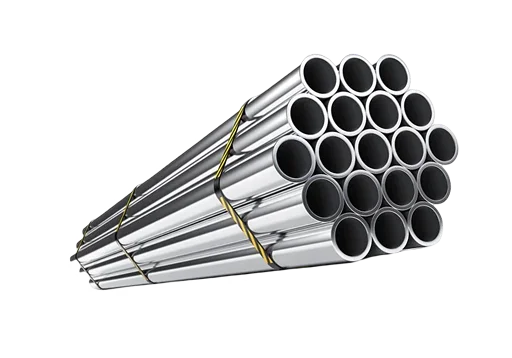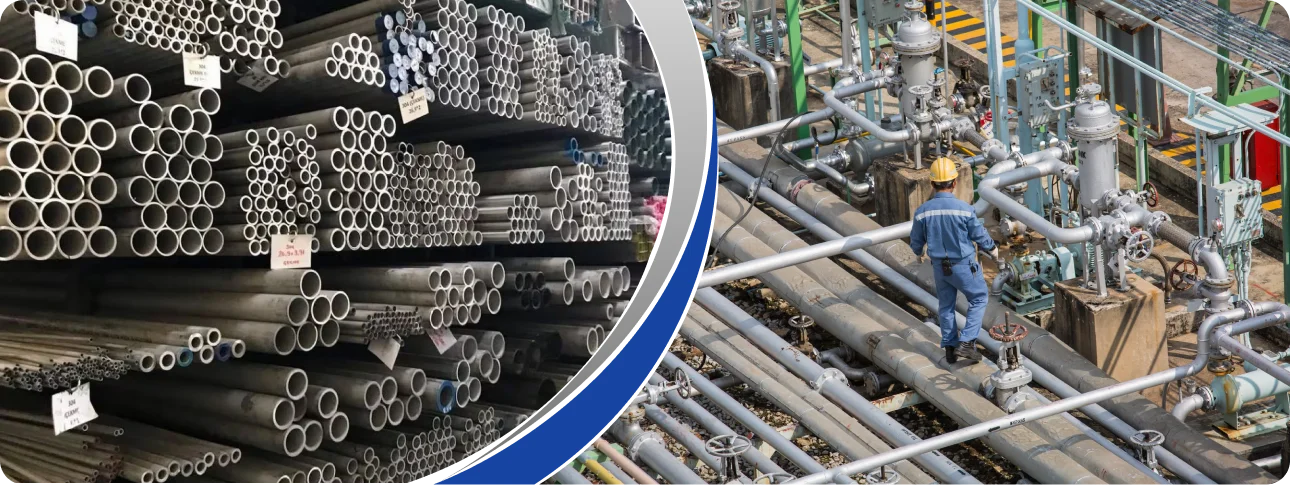
Walk into our Mumbai warehouse and most of what you'll see racked is grade 304. Metinox Overseas is a stainless steel 304 pipes supplier and exporter, and this one grade still makes up the bulk of what leaves our yard, in seamless, welded and EFW form to ASTM A312 TP304. Why? Because for water lines, dairy skids, food plants and general process work, the 18-8 chemistry of UNS S30400 simply does the job, and nobody wants to pay 316 money for it. Each heat ships with its EN 10204 3.1 certificate. One cut length for a Mumbai fabricator or a container bound for Houston, same paperwork either way. If you're still comparing grades, start at our Stainless Steel Pipes page.
One thing worth settling before you ask for a price. Most enquiries just say "304 pipe", but the production route decides the cost, and the gap is not small. Seamless runs dearer and earns it on pressure lines; welded covers most general service at a real saving. We keep both, and our Stainless Steel Seamless Pipes and Stainless Steel Welded Pipes pages break down when each route makes sense.

Table of content
- What Is Stainless Steel 304 Pipe?
- ASTM A312 TP304 Pipe Specifications
- SS 304 Pipe Chemical Composition (UNS S30400)
- 304 Stainless Steel Pipe Mechanical Properties
- SS 304 Pipe Sizes, Schedules & Weight Chart (kg/m)
- ASTM A312 Pipe Tolerances (per ASTM A999)
- Seamless vs Welded vs EFW SS 304 Pipe
- SS 304 vs 304L vs 304H: Picking the Right Pipe
- Where 304 Stainless Steel Pipe Works, and Where It Does Not
- Stainless Steel 304 Pipe Applications
- SS 304 Pipe Testing, Certification & Availability
- Related SS 304 Products
- SS 304 Pipes: Frequently Asked Questions
What Is Stainless Steel 304 Pipe?
Stainless steel 304 is an austenitic chromium-nickel alloy and the most produced stainless grade on earth. Pipe catalogues call it TP304. The UNS system says S30400, Europe says 1.4301 (X5CrNi18-10), Japan says SUS 304. Four names, one 18-8 chemistry. If a drawing quotes any one of them, the others are acceptable equivalents as long as the governing pipe standard is met.
The standard depends on the product form, not the grade. ASTM A312 covers seamless and straight-seam welded pipe for general and high-temperature corrosive service, and that is what most SS 304 process piping is ordered against. A358 is the EFW pressure standard for bigger bores. A778 covers unannealed welded pipe for railing and structural work where nothing is pressurized, and A409 handles large-diameter light-wall pipe. In the annealed state the material is non-magnetic. Bend it or machine it and it picks up a little magnetism, which surprises people, but the grade hardens by cold work rather than heat treatment and that behaviour is normal for the family. Few stainless grades form and weld this easily. That, more than anything, is why 304 dominates general-purpose piping.
ASTM A312 TP304 Pipe Specifications
| Specification | Details |
| Material Grade | Stainless Steel 304 (TP304) |
| UNS Number | S30400 |
| EN / Werkstoff No. | 1.4301 (X5CrNi18-10) · JIS: SUS 304 |
| Standards | ASTM A312 / ASME SA312 (seamless & welded) · ASTM A358 (EFW, pressure) · ASTM A778 (welded, non-pressure) · ASTM A409 (large-diameter welded) |
| Types | Seamless, Welded (ERW), EFW |
| Size Range | Seamless: ½" to 16" NB · Welded/ERW: ½" to 24" NB · EFW: 6" to 48" NB (larger against order) |
| Schedules | SCH 5S, 10S, 40S, 80S per ASME B36.19M; ½" to 8" NB in 10S and 40S ex-stock, heavier walls on request |
| Length | Single random, double random, cut to length |
| Ends | Plain, beveled |
| Finish | Annealed and pickled; polished finishes on request |
All SS 304 pipes are supplied heat treated, dimensionally inspected, and fully traceable to ASTM and ASME requirements.
SS 304 Pipe Chemical Composition (UNS S30400)
| Element | Composition (%) |
| Carbon (C) | 0.08 max |
| Manganese (Mn) | 2.00 max |
| Phosphorus (P) | 0.045 max |
| Sulfur (S) | 0.030 max |
| Silicon (Si) | 1.00 max |
| Chromium (Cr) | 18.0 – 20.0 |
| Nickel (Ni) | 8.0 – 11.0 |
| Iron (Fe) | Balance |
The 18 percent chromium builds the passive oxide film that does the actual corrosion resisting. The nickel holds the structure austenitic, which is what keeps the grade formable and tough right down to cryogenic temperatures. Source: ASTM A312.
304 Stainless Steel Pipe Mechanical Properties
| Property | Value |
| Tensile Strength | 515 MPa (75 ksi) min |
| Yield Strength (0.2% Offset) | 205 MPa (30 ksi) min |
| Elongation | 35% min |
| Hardness (annealed, typical) | ≤ 90 HRB |
| Density | 8.0 g/cm³ |
| Melting Range | 1400 – 1450°C (2552 – 2642°F) |
| Elastic Modulus | 193 GPa |
| Thermal Expansion (0–100°C) | 17.2 × 10⁻⁶/°C |
Minimums per ASTM A312 for TP304. The grade resists scaling to about 870°C in intermittent service and about 925°C continuous. For sustained strength at those temperatures, though, the H variant is the correct call, covered further down this page.
SS 304 Pipe Sizes, Schedules & Weight Chart (kg/m)
SS 304 pipe follows ASME B36.19M dimensions. We stock ½" to 8" NB in SCH 10S and 40S ex-Mumbai; larger sizes come against order, seamless to 16" NB, welded to 24" NB, EFW from 6" up to 48" NB. Weights below are Schedule 40S and approximate, since mill tolerance moves the real number a little. Cut-to-length supply is available, and on project quantities it saves more wastage than most buyers expect.
| NPS (NB) | OD (mm) | Wall, SCH 40S (mm) | Weight (kg/m) |
| ½" | 21.3 | 2.77 | 1.29 |
| ¾" | 26.7 | 2.87 | 1.72 |
| 1" | 33.4 | 3.38 | 2.55 |
| 1½" | 48.3 | 3.68 | 4.12 |
| 2" | 60.3 | 3.91 | 5.54 |
| 3" | 88.9 | 5.49 | 11.49 |
| 4" | 114.3 | 6.02 | 16.36 |
| 6" | 168.3 | 7.11 | 28.77 |
| 8" | 219.1 | 8.18 | 43.31 |
Need a size that is not listed? Send the OD, wall and length and we will confirm availability with the exact unit weight.
ASTM A312 Pipe Tolerances (per ASTM A999)
A312 takes its permissible variations from ASTM A999. These are the numbers your QC will check the pipe against on receipt.
| NPS Range | OD Tolerance | Wall Thickness Tolerance |
| ⅛" to 1½" | +0.4 mm / −0.8 mm | Not more than 12.5% under nominal |
| Over 1½" to 4" | +0.8 mm / −0.8 mm | Not more than 12.5% under nominal |
| Over 4" to 8" | +1.6 mm / −0.8 mm | Not more than 12.5% under nominal |
| Over 8" to 18" | +2.4 mm / −0.8 mm | Not more than 12.5% under nominal |
| Over 18" to 26" | +3.2 mm / −0.8 mm | Not more than 12.5% under nominal |
Seamless vs Welded vs EFW SS 304 Pipe
The grade is identical across all three routes. What changes is how the pipe is made, which sizes are economical, and where each form gets specified.
| Factor | Seamless (A312) | Welded / ERW (A312) | EFW (A358) |
| Production | Hot extruded or cold drawn from solid billet, no weld seam | Formed from strip and welded without filler | Formed from plate, fusion welded with filler |
| Typical sizes | ½" to 16" NB | ½" to 24" NB | 6" NB and above, large diameters |
| Best for | High pressure, critical process lines | General service, cost-sensitive runs | Large-bore pressure service |
| Cost | Highest per meter | Lower than seamless | Economical at large diameters |
| Testing | Hydrostatic or NDE per A312 | Hydrostatic or NDE per A312, weld tested | Radiography per A358 class |
Full specifications for each route sit on our SS 304 Seamless Pipes, SS 304 Welded Pipes and SS 304 EFW Pipes pages. And if you want the plain-language answer to whether seamless is worth the premium on your line, our guide on seamless vs welded stainless steel pipe walks through it.
SS 304 vs 304L vs 304H: Picking the Right Pipe
| Variant | Carbon | When to specify it |
| 304 (S30400) | 0.08% max | General service; the default when neither heavy welding of thick sections nor sustained high temperature applies |
| 304L (S30403) | 0.035% max | Welded assemblies that stay in service as-welded; the low carbon prevents carbide precipitation at the weld |
| 304H (S30409) | 0.04 – 0.10% | Sustained service above roughly 500°C where creep strength governs; the deliberate carbon buys high-temperature strength |
Dual-certified 304/304L material meets the strength of 304 and the carbon limit of 304L in one pipe, and it covers most modern requirements. Detailed pages: SS 304L Pipe and SS 304H Pipe. Weighing 304 against 316 because your line sees chlorides? Our comparison guide SS 304 vs SS 316 settles that decision properly.
Where 304 Stainless Steel Pipe Works, and Where It Does Not
304 earned its position as the default stainless pipe grade honestly. It also gets specified in places it should not be. The short version:
- Excellent in: atmospheric exposure, potable and demineralized water, food, dairy, beverage and pharma lines, mild organic acids, and cryogenic service down to -196°C.
- Watch the weld zone: hold standard 304 between roughly 425°C and 860°C, slow-cooling heavy welds included, and the grain boundaries can sensitize and invite intergranular corrosion. As-welded service belongs to 304L.
- Chlorides are the real enemy: in chloride-bearing media above about 60°C, stress corrosion cracking enters the picture, and coastal or brackish exposure can pit 304 even at ambient temperature.
Chlorides plus heat is where we tell buyers to stop and think. For coastal plants or brackish water, move up to SS 316/316L Pipe for the molybdenum, or to Duplex Steel Pipes when cracking resistance is the thing keeping your engineer up at night. We stock all three families, so we have no reason to push 304 where it does not belong.
Stainless Steel 304 Pipe Applications
- Food, Dairy & Beverage: process and CIP lines where cleanability matters more than exotic chemistry.
- Pharmaceuticals: utility and process piping in plants standardized on austenitic stainless.
- Water & Wastewater Treatment: distribution headers, filtration skids and plant piping in fresh-water service.
- Chemical & Petrochemical: mild chemical duty, utility lines, and off-plot piping where 316 or duplex would be over-specification.
- Oil & Gas and Refining: non-sour utility and instrument-supply lines across upstream and downstream facilities.
- Power & Sugar: condensate, feedwater and general plant piping below the temperatures where 304H or alloy steel takes over.
- Architecture & Structural: handrails, facades and exposed structural pipe, typically to A554 or A778 in polished finish.
SS 304 Pipe Testing, Certification & Availability
Every order leaves with an EN 10204 3.1 mill test certificate, heat-number traceable to ASTM A312. Need 3.2? Third-party witnessed certification through BV, SGS or TUV can be arranged at order stage. Pipes are hydrostatically tested or NDE examined per A312, and PMI checks and intergranular corrosion testing to ASTM A262 are done on request. Dimensions follow ASME B36.19M and the tolerance table above. Metinox Overseas is an ISO 9001 and PED certified company, supplying material approved to the procurement standards of SABIC, ADNOC, KNPC, EIL, IOCL and BPCL; the full program sits on our Quality Policy page. We supply across India from Mumbai stock and export to the USA, Europe and the Middle East. Standard stock sizes dispatch in 7 to 14 working days. Non-stock sizes usually take 4 to 6 weeks.
Related SS 304 Products
- SS 304 Seamless Pipes – ASTM A312 TP304 seamless, for pressure and critical service
- SS 304 Welded Pipes – cost-effective welded pipe for general service
- SS 304 EFW Pipes – large-diameter fusion welded pipe to ASTM A358
- SS 304 Tubes – tube sizes for heat exchanger, instrumentation and structural use
- SS 304L Pipe – low-carbon variant for as-welded service
- SS 304H Pipe – high-carbon variant for elevated-temperature strength
- SS 316/316L Pipe – the molybdenum upgrade for chloride and marine service
- SS 304 Flanges – matching flanges in the same grade
- SS 304 Pipe Fittings – buttweld fittings to ASTM A403 WP304
SS 304 Pipes: Frequently Asked Questions
Carbon, nothing else. 304 allows up to 0.08 percent, 304L caps it at 0.035. That lower carbon stops carbide precipitation at the weld, so 304L is the pick for assemblies that go into service as-welded. In practice most mills now roll dual-certified 304/304L, which meets both requirements in one pipe.
ASTM A312 (ASME SA312) is the main one, covering seamless and welded pipe for general and high-temperature corrosive service. A358 covers EFW pipe for pressure service in larger bores, A778 covers unannealed welded pipe for non-pressure work, and A409 covers large-diameter light-wall pipe.
We would not recommend it. Chlorides in seawater and coastal air pit 304, and above roughly 60 degrees C chloride stress corrosion cracking enters the picture. Specify 316/316L for the molybdenum, or a duplex grade where cracking resistance is the governing requirement.
In the annealed condition, no, or close enough to no. Cold bending or machining induces slight magnetism and that is normal for an austenitic grade, not a sign of wrong material. If there is any doubt about chemistry, a PMI test settles it in minutes.
An EN 10204 3.1 mill test certificate comes standard with every order, with heat-number traceability to ASTM A312. Dimensional reports are supplied on request, and 3.2 third-party witnessed certification through BV, SGS or TUV can be arranged for project orders.
Enquire Now
Get pricing within 24 hours!