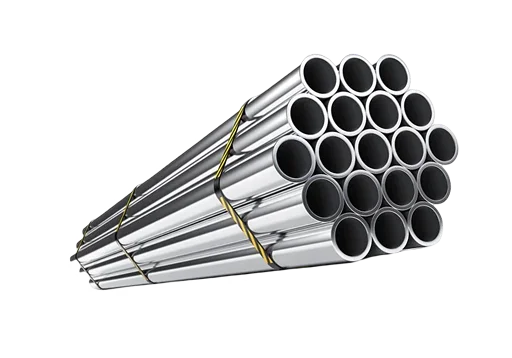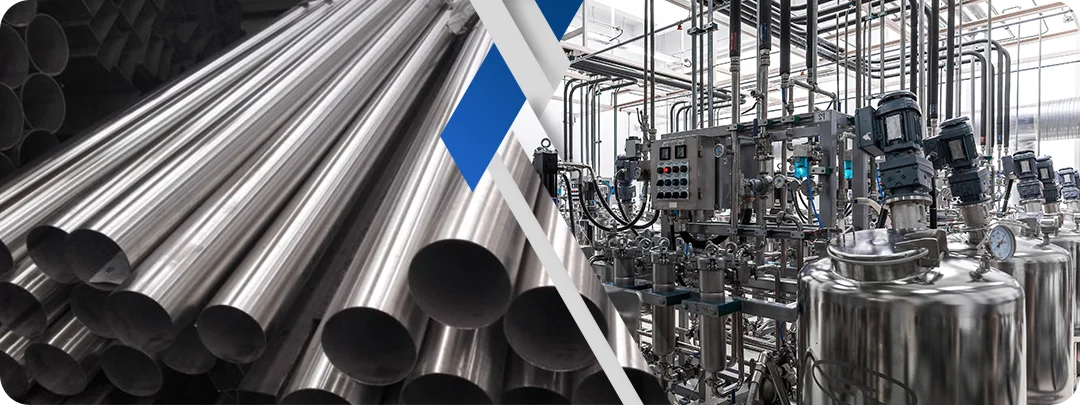
Add two to three percent molybdenum to grade 304 and you get 316, the tube the chemical and coastal industries run on. Metinox Overseas supplies stainless steel 316/316L tube to ASTM A213 and A269, TP316 and TP316L, in straight lengths, U-bends and bright annealed finish, with 3.1 certification and export lanes to the USA, the Middle East and Africa. That molybdenum is the difference between a tube that pits in chlorides and one that does not, which is why 316 is specified wherever the water or the process carries chloride, from a coastal exchanger to a CIP circuit. The full tube family and the chloride ladder sit at Stainless Steel Tubes.
Its pipe sibling, for NB-and-schedule process lines rather than OD-and-wall exchanger duty, is SS 316/316L Seamless Pipes. And where the chloride load defeats even 316, the step up is Super Duplex Steel Tubes. This page covers 316 specifically in tube form.
Request a Quote on SS 316/316L Tube →
Table of content
- The Molybdenum Difference, in Tube Form
- 316 vs 316L Tube: The Weld-Decay Decision
- SS 316/316L Tube Chemistry & Mechanical Properties
- 316L Tube Sizes, BWG & Forms
- Where 316 Tube Stops: The Chloride Limit
- SS 316/316L Tube Applications & Export to USA, Middle East & Africa
- Explore Related Ranges
- Stainless Steel 316/316L Tube: Frequently Asked Questions
The Molybdenum Difference, in Tube Form
Grade 304 and 316 look identical and behave identically until chlorides arrive, and then the 2 to 3 percent molybdenum in 316 changes everything: it lifts the pitting resistance equivalent from about 19 to about 24, which is the margin that keeps an exchanger tube alive in chlorinated, brackish or coastal water. In fresh water 304 is the better money and 316 is an over-spend; the moment chlorides enter, 316 earns its premium. The full comparison is in our guide on SS 304 versus SS 316, and the grade below is on our SS 304 Tubes page.
316 vs 316L Tube: The Weld-Decay Decision
The L is the carbon, and in tube it matters most at the tube-to-tubesheet joint. Standard 316 allows up to 0.08 percent carbon, which can precipitate as chromium carbides during welding and sensitize the heat affected zone, opening it to intergranular attack. 316L caps carbon at 0.035 percent and removes that risk, so any tube welded into service and left as-welded, which is nearly every exchanger bundle, should be 316L. Dual 316/316L certified tube meets the strength of 316 and the carbon limit of 316L in one product, and it is the standard order for exactly this reason.
SS 316/316L Tube Chemistry & Mechanical Properties
| Element / Property | TP316 | TP316L |
|---|---|---|
| Carbon | 0.08% max | 0.035% max |
| Chromium | 16.0 – 18.0% | 16.0 – 18.0% |
| Nickel | 10.0 – 14.0% | 10.0 – 14.0% |
| Molybdenum | 2.0 – 3.0% | 2.0 – 3.0% |
| Tensile min | 515 MPa | 485 MPa |
| Yield min | 205 MPa | 170 MPa |
Limits per ASTM A213 / A269. The molybdenum band is the working difference from 304; the carbon band is the working difference between 316 and 316L.
316L Tube Sizes, BWG & Forms
Common exchanger and instrument sizes ex-stock, walls in BWG and millimetres: OD 6.35 to 50.8 mm in 20, 18 and 16 BWG, with the envelope running to 101.6 mm OD and 6 mm wall against order. Forms include straight lengths, U-bends formed to drawing with radii from 1.5 times OD and stress relieved on request, bright annealed tube for instrument lines, and A270 sanitary tube with polished bore for food and pharma. Send the bundle drawing for a row-by-row quote.
Where 316 Tube Stops: The Chloride Limit
316 is not immune to chlorides, only more resistant than 304. In seawater it still pits, and above roughly 60 degrees C in chloride-bearing water it becomes vulnerable to stress corrosion cracking like any austenitic grade. For seawater condensers, desalination and high-chloride brine the answer is super duplex tube with its PREN above 40. The full chloride ladder, comparing every grade by water, is on the tube hub.
SS 316/316L Tube Applications & Export to USA, Middle East & Africa
- Chemical & Petrochemical: exchanger and process tube in chloride-bearing streams, Gulf and Indian plant.
- Food, Dairy & Pharma: A270 sanitary tube for product-contact and aggressive CIP.
- Coastal Power & Desalination: exchanger tube within 316's chloride limit, Middle East lane.
- Instrumentation: bright annealed 316L for impulse and analytical lines.
Every order ships with an EN 10204 3.1 certificate; see Quality Policy. Consolidations run from Mumbai to the USA, the Middle East and Africa, crated per bundle and end-capped per Packing and Dispatch. Ex-stock dispatches in 7 to 14 working days.
Explore Related Ranges
- Stainless Steel Tubes – the tube hub with the chloride ladder and PREN
- SS 316/316L Seamless Pipes – the pipe sibling for process lines
- Super Duplex Steel Tubes – the seawater step up
- SS 304 Tubes – the grade below for fresh water
Stainless Steel 316/316L Tube: Frequently Asked Questions
Carbon. 316 allows up to 0.08 percent, 316L caps it at 0.035. The lower carbon prevents chromium carbide precipitation during welding, so 316L is the correct choice for tube welded into service and left as-welded, which includes almost every heat exchanger bundle. Dual 316/316L tube satisfies both in one product.
The molybdenum. 316 carries 2 to 3 percent molybdenum that 304 lacks, lifting the pitting resistance equivalent from about 19 to about 24 and keeping the tube alive in chlorinated, brackish and coastal water. In fresh water 304 is the better value; the moment chlorides arrive, 316 earns its premium.
Not reliably. 316 is more chloride-resistant than 304 but still pits in seawater and becomes vulnerable to stress corrosion cracking above about 60 degrees C in chloride-bearing water. For seawater condensers and desalination, super duplex tube with a PREN above 40 is the correct specification.
Yes. U-bends are formed to drawing with radii from 1.5 times OD and stress relieved on request for exchanger bundles, and A270 sanitary tube with a polished bore is supplied for food, dairy and pharma product-contact lines. Send the drawing or the CIP requirement and we will quote it.
Yes, crated per bundle and end-capped from Mumbai with the 3.1 documentation. Chemical exchanger work across all three regions, Middle East coastal power, and sanitary tube for food and pharma are the regular lanes.
Enquire Now
Get pricing within 24 hours!