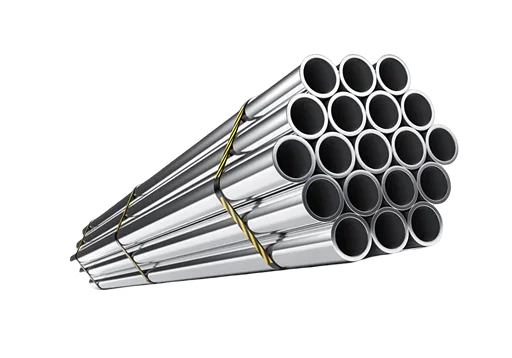
Stainless steel is simply an iron alloy distinguished from carbon steel by having a small amount of carbon and containing at least 10.5 % of chromium. The presence of the chromium element that reacts with the oxygen creates the oxidized passive layer on the steel surface and makes it corrosion resistant. Note that no actual surface coat is applied; the layers of oxides are part of the internal composition of stainless steel. Hence, the oxide layer is regenerated as soon as the surface is damaged.
Not all stainless steel behaves the same way, though. Below, we explain what it’s made of, how it’s produced, the main types and grades, and where each one is used.
Request a Quote for Stainless Steel Pipe
What Is Stainless Steel Made Of?
Stainless steel is mostly iron, with a small amount of carbon and at least 10.5% chromium. Most grades also contain other elements, such as nickel, molybdenum, manganese, nitrogen, titanium or niobium. Each one is added for a reason: better corrosion resistance, more strength, easier welding or better performance at high temperatures.
Role of Chromium, Nickel and Molybdenum
Chromium is the one essential ingredient. Without enough of it, the metal is just ordinary steel.
Nickel gives grades like 304 and 316 their austenitic structure. This makes the steel tougher, easier to bend and form, and non-magnetic in its annealed state.
Molybdenum improves resistance to pitting and crevice corrosion caused by chlorides, such as salt water. That’s why 316, which contains molybdenum, lasts much longer than 304 in marine and chemical environments. Grade 317 has even more molybdenum for harsher conditions.
How Much Chromium Is in Stainless Steel?
Most grades contain well above the 10.5% minimum. Grades 304 and 316 have around 18% chromium. Heat-resistant grades such as 310 go up to about 25%, which helps them resist scaling and oxidation at temperatures above 1,000°C.
Properties of Stainless Steel
Beyond corrosion resistance, stainless steel is valued for its strength to weight ratio, its hygienic, easily cleaned surface, its appearance, and its ability to perform at both very high and very low temperatures depending on the grade. These properties are not identical across the whole family, which is exactly why there are more than a hundred different grades rather than one universal stainless steel.
Is Stainless Steel Rust Proof?
Not entirely, but it comes close under normal conditions. Stainless steel resists rust far better than carbon steel because of its passive chromium oxide layer, but that resistance can still be overwhelmed by prolonged exposure to chlorides, strong acids, or a grade that is simply not suited to the environment it is placed in. Choosing a grade with enough chromium and, where needed, enough molybdenum for the specific environment is what keeps stainless steel rust free in practice.
Is Stainless Steel Magnetic?
It depends on the type. Austenitic grades such as 304 and 316, the most common types in general use, are generally not magnetic in their annealed state. Ferritic, martensitic and duplex grades, on the other hand, are magnetic. A simple magnet test can give a rough first indication of which family a piece of stainless steel belongs to, though it is not a substitute for checking the actual grade.
Types of Stainless Steel
Stainless steel grades are generally grouped into four main families, based on their internal crystal structure.
Austenitic Stainless Steel
The largest and most widely used family, including grades like 304, 316, 317, 321 and 347. Austenitic grades are generally not magnetic, offer excellent corrosion resistance and formability, and cover the majority of food, chemical, marine and architectural applications.
Ferritic Stainless Steel
Magnetic grades with good corrosion resistance and lower nickel content, which generally makes them less expensive than austenitic grades. Commonly used in automotive exhaust systems, appliances and some structural applications where extreme corrosion resistance is not required.
Martensitic Stainless Steel
Magnetic grades, such as 410, that can be hardened by heat treatment, trading some corrosion resistance for strength and hardness. Commonly used for blades, shafts, fasteners and pump parts where mechanical strength matters more than chemical resistance.
Duplex Stainless Steel
A mixed microstructure, roughly half austenitic and half ferritic, which combines the strength of one family with the toughness and corrosion resistance of the other. Duplex grades typically offer close to twice the yield strength of standard austenitic grades. For a full comparison of duplex grades, see our Duplex Stainless Steel Grades guide, covering 2205 and 2507.
Stainless Steel Grades
The table below summarises seven of the most commonly specified stainless steel grades. For full chemical composition, mechanical properties and a detailed comparison of 304, 304L, 316, 316L, 321 and 347, see our Stainless Steel Pipe Grades Chart.
| Grade | Key Benefit | Best Use |
|---|---|---|
| 304 | Good all round corrosion resistance at a lower cost | Kitchen equipment, food processing, storage tanks |
| 316 | Molybdenum gives better resistance to salt and chemicals | Marine, chemical and pharma equipment |
| 317 | More molybdenum than 316, so better resistance to pitting | Chemical plants, pulp and paper mills |
| 321 | Titanium added, so it holds up after welding and heat | Heat exchangers, exhaust systems |
| 347 | Niobium added, strong at high temperature | Refineries, high temperature piping |
| 310 | High chromium and nickel, handles very high heat | Furnaces, heat treatment equipment |
| 410 | Hard and can be heat treated | Blades, shafts, pump parts |
How Is Stainless Steel Made?
Production starts by melting scrap steel, iron, chromium and nickel in an electric arc furnace. This usually takes several hours per batch.
The molten metal then goes through AOD or VOD refining to lower its carbon content without losing chromium. This step matters because excess carbon can react with chromium during welding and weaken corrosion resistance near the weld. It’s also why low-carbon “L” grades, like 304L and 316L, are used for heavily welded parts.
Once the chemistry matches the target grade, the steel is cast into slabs, blooms or billets. These are then hot rolled or cold rolled into plate, sheet, bar or stainless steel pipes.
Finally, the steel is pickled to remove the surface scale left by hot working. This leaves a clean surface where the protective chromium oxide layer can form properly. The product is then finished and cut to length.
What Is Stainless Steel Used For?
Stainless steel is used wherever corrosion resistance, hygiene, strength or appearance matter enough to justify the cost over carbon steel. In homes, it shows up as cutlery, sinks, cookware and appliances. In towns and buildings, it is used for architectural facades, handrails, lift fittings and street furniture. In industry, where most of our own customers operate, it is used for pipe, fittings, pressure vessels, heat exchangers and tanks across food and pharmaceutical processing, chemical plants, marine and offshore equipment, and oil and gas infrastructure. For pipe specifically, the right grade, size and schedule for a given application is covered in our Stainless Steel Pipe Grades Chart and Stainless Steel Pipe Weight Chart.
Stainless Steel vs Carbon Steel
The table below gives a quick comparison. For a full breakdown, including mechanical properties, cost drivers, and a decision framework for choosing between the two, see our dedicated guide.
| Factor | Carbon Steel | Stainless Steel |
|---|---|---|
| Chromium content | None added | Minimum 10.5%, forming a protective oxide layer |
| Corrosion resistance | Low without coating or galvanising | High, resists rust without a coating |
| Typical cost | Lower | Higher, due to chromium and alloying content |
| Typical use | Structural steel, general piping, construction | Food, chemical, marine and architectural applications |
For the complete comparison, see Stainless Steel vs Carbon Steel: Differences, Properties and Applications.
Advantages and Disadvantages of Stainless Steel
Advantages
- Excellent corrosion resistance, in many grades without any coating required.
- Long service life with low maintenance in suitable environments.
- Hygienic, easily cleaned surface, which is why it dominates food and medical equipment.
- Fully recyclable, with many finished products containing a significant proportion of recycled stainless steel.
- Wide range of grades, so performance can be matched closely to the application rather than over or under specifying.
Disadvantages
- Higher upfront cost than carbon steel, driven mainly by chromium and nickel content.
- Lower thermal and electrical conductivity than some other metals, which matters in specific applications.
- Welding requires more care than carbon steel to avoid sensitisation, particularly in standard, non L grade, austenitic steels.
- Not every grade is magnetic, which can be a limitation or an advantage depending on the application.
Stainless Steel FAQs
Yes. Stainless steel is widely used in food contact, medical and pharmaceutical applications precisely because it does not react with most food products or bodily fluids, resists bacterial buildup due to its smooth, easily cleaned surface, and does not leach harmful substances under normal use.
Mainly because of its alloying content. Chromium and nickel, the elements responsible for corrosion resistance and toughness, are significantly more expensive raw materials than the iron and carbon used in plain carbon steel, and stainless steel also requires more controlled melting and finishing than carbon steel does.
In a suitable environment, stainless steel can last for decades with minimal maintenance, since its corrosion resistance does not rely on a coating that can wear away over time. Service life depends heavily on matching the right grade to the environment; a 304 part in a chloride-heavy environment will not last as long as a correctly specified 316 part in the same conditions.
Yes. Grade 304 stainless steel is the standard choice for cookware and food processing equipment, since it resists corrosion from food acids and moisture, does not react with food, and withstands repeated cleaning and sterilisation without degrading.
Conclusion
Stainless steel earns its name from one specific ingredient, chromium at a minimum of 10.5%, and everything else about it, the different families, the more than a hundred grades, the varying resistance to heat and chlorides, follows from how much of that chromium is present and what else has been added alongside it. Once you know which family and which grade an application actually needs, the rest of the specification, size, schedule, finish, mostly falls into place. For pipe and fittings specifically, our Stainless Steel Pipe Grades Chart and Duplex Stainless Steel Grades guides go into the detail this overview does not.