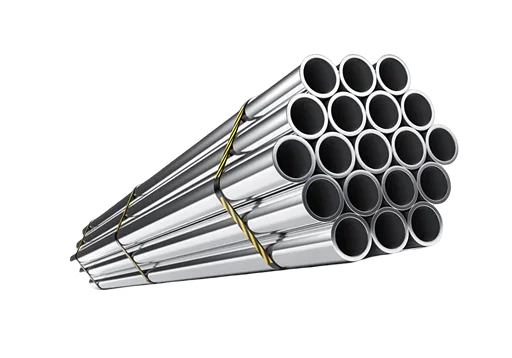
317 & 317L stainless steel pipe contains 3 to 4% molybdenum (about one percentage point more than 316); the alloy is composed of 18 to 20% chromium and 11 to 15% nickel. Due to the greater presence of molybdenum, resistance to corrosive environments is achieved especially with chloride brines, scrubber liquids, and hot acidic liquids, all where grade 316 is limited. 317L pipe holds carbon at 0.035% or less, so welding does not need subsequent annealing. You still get 515 MPa tensile strength and scaling resistance to around 870 °C. Metinox Overseas supplies supply both grades from Mumbai to ASTM A312, seamless or welded, alongside its stainless steel pipes range.

Table of content
- SS 317 vs 317L Pipe: What Is the Difference?
- 317 Stainless Steel Pipe Specifications
- ASTM 317 Stainless Steel Pipe Chemistry
- SS 317 & 317L Pipe Mechanical Properties
- What Are the Physical Properties of SS 317 & 317L Pipe?
- SS 317 Pipe Available Sizes and Dimensions
- Aplication of 317 & 317L Stainless Steel Piping
- Equivalent Grades for 317 and 317L SS Pipe
- Frequently Asked Questions
SS 317 vs 317L Pipe: What Is the Difference?
The two grades share the same chromium, nickel and molybdenum ranges. Carbon is the only line that separates them, and it decides how the pipe behaves after welding.
| Point of comparison | 317 (UNS S31700) | 317L (UNS S31703) |
| Carbon, max | 0.08% | 0.035% |
| Weld zone after welding | Can sensitise if held between about 425 and 815 °C | Resists sensitisation in normal welding |
| Post weld anneal for corrosion service | Often required | Usually not required |
| Strength at room temperature | 515 MPa tensile, 205 MPa yield min | 515 MPa tensile, 205 MPa yield min |
| Strength above about 425 °C | Slightly higher, helped by carbon | Slightly lower |
| Typical choice | Unwelded or annealed after fabrication | Welded process piping, the usual default |
| Dual certification | Possible when carbon meets 0.035% and strength meets 317 | Same pipe, marked TP317/TP317L |
Most stock today is melted to the 317L carbon limit and certified as both grades. That is why buyers searching for “317l pipe” and “317 pipe” usually end up with the same material.
Note: specify 317L, or dual certified 317/317L, for welded systems. Keep straight 317 for jobs where the drawing or code calls for it by name.
317 Stainless Steel Pipe Specifications
| Item | Details |
| Seamless and welded pipe | ASTM A312 / ASME SA312 |
| Electric fusion welded large bore pipe | ASTM A358 / ASME SA358 |
| Welded large diameter, annealed or as welded | ASTM A778 (317L) |
| Tolerances and general requirements | ASTM A999 / ASME SA999 |
| Dimension standards | ASME B36.19M (5S to 80S), ASME B36.10M (heavier walls) |
| European equivalents | EN 10216-5 (seamless), EN 10217-7 (welded), 1.4449 / 1.4438 |
| Outside diameter | 1/8” to 24” NPS (10.3 to 610 mm); larger sizes in welded form |
| Wall | Sch 5S, 10S, 40S, 80S, 160 and XXS |
| Lengths | Single random (about 6 m), double random (about 12 m) or cut to length |
| Ends | Plain, bevelled to ASME B16.25, threaded |
| Finish | Pickled and passivated, annealed; bright annealed or polished on request |
| Heat treatment | Solution annealed at 1040 °C min, rapid cool |
| Certification | EN 10204 3.1; 3.2 through a third party |
Note: write “ASTM A312 SS317L seamless” or “ASTM A312 SS317/SS317L welded”, followed by size, schedule, length and ends.
ASTM 317 Stainless Steel Pipe Chemistry
| Element, % | SS 317 (S31700) | SS 317L (S31703) |
| Carbon | 0.08 max | 0.035 max |
| Manganese | 2.00 max | 2.00 max |
| Phosphorus | 0.045 max | 0.045 max |
| Sulphur | 0.030 max | 0.030 max |
| Silicon | 1.00 max | 1.00 max |
| Chromium | 18.0 to 20.0 | 18.0 to 20.0 |
| Nickel | 11.0 to 15.0 | 11.0 to 15.0 |
| Molybdenum | 3.0 to 4.0 | 3.0 to 4.0 |
| Iron | Balance | Balance |
Plate and sheet specifications such as A240 set silicon at 0.75% max, which is why some websites show a different figure.
The pitting resistance equivalent number (PREN = %Cr + 3.3 x %Mo + 16 x %N) is about 28 to 33 for 317L, against about 24 to 26 for 316L. That gap explains most of the grade’s advantage in seawater cooled exchangers and bleach plant liquors.
Note: check carbon first (it tells you whether the pipe can carry the L marking), then molybdenum (it must not fall below 3.0%).
SS 317 & 317L Pipe Mechanical Properties
| Property | SS 317 | SS 317L |
| Tensile strength, min | 515 MPa (75 ksi) | 515 MPa (75 ksi) |
| Yield strength (0.2% offset), min | 205 MPa (30 ksi) | 205 MPa (30 ksi) |
| Elongation in 50 mm, min | 35% longitudinal, 25% transverse | 35% longitudinal, 25% transverse |
| Hardness, max (A240 plate reference) | 95 HRB / 217 HB | 95 HRB / 217 HB |
What Are the Physical Properties of SS 317 & 317L Pipe?
| Property | Value |
| Density | 7.95 to 8.0 g/cm³ (0.287 lb/in³) |
| Modulus of elasticity | 193 to 200 GPa |
| Mean thermal expansion, 20 to 100 °C | 16.5 µm/m·°C |
| Mean thermal expansion, 20 to 500 °C | 18.0 µm/m·°C |
| Thermal conductivity at 100 °C | 14.4 to 16.2 W/m·K |
| Specific heat, 0 to 100 °C | 500 J/kg·K |
| Electrical resistivity at 20 °C | 0.79 µΩ·m |
| Melting range | 1370 to 1400 °C |
| Magnetic response, annealed | Non magnetic; slight after cold work |
Temperature behaviour. Scaling resistance in air is good to about 870 °C in intermittent service and about 925 °C continuous. Long holds between roughly 425 and 860 °C are not advised for corrosion service, because the higher molybdenum makes 317 grades more prone to sigma phase than 316, which costs toughness and corrosion resistance. For sustained pressure service at high temperature, use the allowable stresses in the governing code, not room temperature figures.
Note: design to 205 MPa yield at room temperature, and check code stress tables for any line running above 200 °C.
SS 317 Pipe Available Sizes and Dimensions
Sizes follow ASME B36.19M for the “S” schedules. The outside diameter stays fixed for each NPS; the schedule changes only the wall.
| NPS | DN | OD, mm (in) | Sch 5S, mm | Sch 10S, mm | Sch 40S, mm | Sch 80S, mm |
| 1/8 | 6 | 10.3 (0.406) | n/a | 1.24 | 1.73 | 2.41 |
| 1/4 | 8 | 13.7 (0.539) | n/a | 1.65 | 2.24 | 3.02 |
| 3/8 | 10 | 17.1 (0.673) | n/a | 1.65 | 2.31 | 3.20 |
| 1/2 | 15 | 21.3 (0.839) | 1.65 | 2.11 | 2.77 | 3.73 |
| 3/4 | 20 | 26.7 (1.051) | 1.65 | 2.11 | 2.87 | 3.91 |
| 1 | 25 | 33.4 (1.315) | 1.65 | 2.77 | 3.38 | 4.55 |
| 1 1/4 | 32 | 42.2 (1.661) | 1.65 | 2.77 | 3.56 | 4.85 |
| 1 1/2 | 40 | 48.3 (1.902) | 1.65 | 2.77 | 3.68 | 5.08 |
| 2 | 50 | 60.3 (2.374) | 1.65 | 2.77 | 3.91 | 5.54 |
| 2 1/2 | 65 | 73.0 (2.874) | 2.11 | 3.05 | 5.16 | 7.01 |
| 3 | 80 | 88.9 (3.500) | 2.11 | 3.05 | 5.49 | 7.62 |
| 3 1/2 | 90 | 101.6 (4.000) | 2.11 | 3.05 | 5.74 | 8.08 |
| 4 | 100 | 114.3 (4.500) | 2.11 | 3.05 | 6.02 | 8.56 |
| 5 | 125 | 141.3 (5.563) | 2.77 | 3.40 | 6.55 | 9.53 |
| 6 | 150 | 168.3 (6.626) | 2.77 | 3.40 | 7.11 | 10.97 |
| 8 | 200 | 219.1 (8.626) | 2.77 | 3.76 | 8.18 | 12.70 |
| 10 | 250 | 273.0 (10.748) | 3.40 | 4.19 | 9.27 | 12.70 |
| 12 | 300 | 323.8 (12.748) | 3.96 | 4.57 | 9.53 | 12.70 |
| 14 | 350 | 355.6 (14.000) | 3.96 | 4.78 | 9.53 | 12.70 |
| 16 | 400 | 406.4 (16.000) | 4.19 | 4.78 | 9.53 | 12.70 |
| 18 | 450 | 457.0 (17.992) | 4.19 | 4.78 | 9.53 | 12.70 |
| 20 | 500 | 508.0 (20.000) | 4.78 | 5.54 | 9.53 | 12.70 |
| 24 | 600 | 610.0 (24.016) | 5.54 | 6.35 | 9.53 | 12.70 |
Note: give NPS and schedule, or OD x wall in millimetres. Avoid naming the size in nominal inches alone.
Aplication of 317 & 317L Stainless Steel Piping
317L earns its place where 316L starts to pit and a nickel alloy would be too expensive.
- Flue gas desulphurisation. Scrubber piping that carries chlorides and sulphur acids.
- Pulp and paper. Bleach plant lines exposed to chlorine dioxide and chlorides.
- Chemical and petrochemical plants. Acetic, phosphoric and dilute sulphuric acid service, and condensers.
- Power generation. Condenser tubing and cooling water lines with brackish water.
- Textile and dye works. Hot acid dyeing liquors.
- Food and pharmaceutical processing. Brines and acidic products where 316L is marginal.
- Ink and pigment production. Corrosive pigment slurries.
For still harsher chloride service, compare it with 316L pipe at the lower end and duplex grades at the higher end.
Equivalent Grades for 317 and 317L SS Pipe
| Standard | 317 | 317L |
| UNS | S31700 | S31703 |
| AISI | 317 | 317L |
| EN / Werkstoff | 1.4449 | 1.4438 |
| EN name | X3CrNiMo18-12-3 | X2CrNiMo18-15-4 |
| JIS | SUS 317 | SUS 317L |
| BS | 317S16 | 317S12 |
| AFNOR | n/a | Z3CND19-15-04 |
EN grades are close equivalents, not exact matches. The EN chemistry ranges differ slightly; check before you substitute one standard for another.
Request a quote
Frequently Asked Questions
Carbon. 317 allows up to 0.08% carbon and 317L up to 0.035%, so 317L resists weld zone sensitisation and is the usual choice for welded piping; the other alloys are the same.
For corrosion, yes. 317L carries 3 to 4% molybdenum against 2 to 3% in 316L, which raises its pitting resistance in chlorides and acids. It also costs more, so it is chosen where 316L is not enough.
ASTM A312 / ASME SA312 covers seamless and welded TP317 and TP317L pipe. Large bore electric fusion welded pipe is covered by ASTM A358.
Seamless and welded pipe is available from NPS 1/8 to 24 in schedules 5S, 10S, 40S, 80S, 160 and XXS, with larger diameters in welded form.
It is priced per kilogram, per metre or per length, based on alloy surcharges, size, wall, form, testing and delivery terms. Send your full requirement for a current quote.
No, not in the annealed condition. Cold working can make it slightly magnetic.
About 5.51 kg per metre (3.70 lb/ft), using a density of 7.95 g/cm³.
Enquire Now
Get pricing within 24 hours!