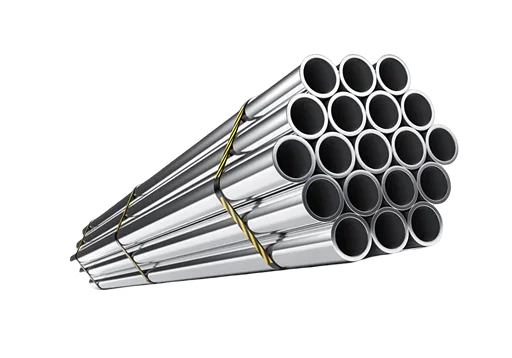
Stainless steel 347 pipes does one thing that 304 and 316 cannot - it stays stable after welding. The difference is niobium. Niobium ties up the carbon before chromium can react with it, so the pipe holds its corrosion resistance even after passing through the sensitisation range repeatedly. The H grade takes this further. A higher carbon minimum and a coarser grain structure give 347H the creep strength that standard 347 lacks above 540 °C - which is why superheater headers and refinery heater coils are almost always specified in 347H rather than plain 347. Both grades are made to ASTM A312 and meet the same room-temperature minimums of 515 MPa tensile and 205 MPa yield. Metinox Overseas, based in Mumbai, supplies both grades - seamless, welded and EFW alongside its stainless steel pipes.

Table of Contents
Difference Between SS 347 and SS 347H
| Point | SS 347 | SS 347H |
|---|---|---|
| Carbon | 0.08% max | 0.04 to 0.10% |
| Niobium | 10 x C min, 1.10% max | 8 x C min, 1.10% max |
| Grain size rule | None | ASTM No. 7 or coarser |
| Solution anneal (A312) | 1040 °C min | 1095 °C min cold finished, 1050 °C min hot finished |
| Strength at room temperature | 515 / 205 MPa | 515 / 205 MPa |
| Creep strength above about 540 °C | Lower | Higher |
| Best for | Welded hot service, exhausts, expansion joints, hydroprocessing lines | Superheaters, reheaters, steam headers, refinery heater coils |
| Dual certification | Possible when carbon is 0.04 to 0.08%, niobium meets 10 x C, and the 347H anneal and grain size are met | Same pipe marked TP347/TP347H |
The number to remember: for a dual certified pipe, carbon must sit between 0.04 and 0.08%.
Types of Stainless Steel 321/321H Pipes
347/347H Seamless Pipe
Pierced from solid billet with no longitudinal seam. The preferred choice for high-pressure and elevated-temperature service to ASTM A312.
347/347H Welded Pipe
Strip-formed with a fused seam and no filler metal. Cost-effective across the full NPS range for general hot-service piping to ASTM A312.
347/347H ERW Pipe
Seam closed by electric resistance without filler addition. Well suited to moderate-pressure process lines, ducting and structural applications.
347/347H EFW Pipe
Plate-formed and arc-welded with filler metal permitted under ASTM A358. The standard route for large-diameter and heavy-wall 347H piping.
Application of 347/347h Stainless Steel Pipe
- Refining: hydrocracker and hydrotreater reactor effluent lines, fired heater coils, transfer lines
- Power: superheater and reheater piping and headers in 347H
- Petrochemical: high temperature process lines that are shut down and cleaned often
- Aerospace and engines: exhaust manifolds, collector rings and ducting
- Thermal processing: expansion joints, bellows and thermal oxidiser ducting
- Chemical: welded equipment that cannot be annealed after fabrication
For lower alloy cost in dry steam service, compare 304H pipe.
Frequently Asked Questions
Carbon. 347 allows up to 0.08% carbon, while 347H must carry 0.04 to 0.10% with a coarse grain size, which gives more creep strength above about 540 °C. The niobium minimum is 10 x C for 347 and 8 x C for 347H.
Yes. It welds well with ER347 or E347 filler because niobium carries across the arc. Thick 347H sections need care to avoid reheat cracking in high temperature service.
Seamless pipe has no longitudinal seam and carries full allowable stress in pressure calculations. Welded A312 pipe has an autogenous seam with no filler metal - same chemistry, but rated at 85% of the seamless pressure at the same size and schedule. For diameters above NPS 24 or very heavy walls, EFW under ASTM A358 is the standard alternative.
Carbon 0.08% max, chromium 17 to 19%, nickel 9 to 13%, niobium at least 10 times the carbon up to 1.10%, manganese 2.00% max and silicon 1.00% max, to ASTM A312.
When the diameter exceeds NPS 24 or the wall is too heavy for strip-formed production. A358 Class 1 pipe is 100% radiographed and qualifies for full joint efficiency - the standard choice for large-bore 347H superheater headers and refinery transfer lines.
Welded lines that run hot: refinery hydroprocessing and heater piping, boiler superheaters and reheaters, exhaust systems, expansion joints and chemical equipment that cannot be annealed after welding.
ASTM A312 / ASME SA312 grade TP347H, UNS S34709, for seamless and welded pipe. Large diameter EFW pipe is made to ASTM A358.
About 5.51 kg per metre (3.70 lb/ft) for the nominal 60.3 x 3.91 mm size at a density of 7.96 g/cm³.
Related Stainless Steel Products
Enquire Now
Get pricing within 24 hours!