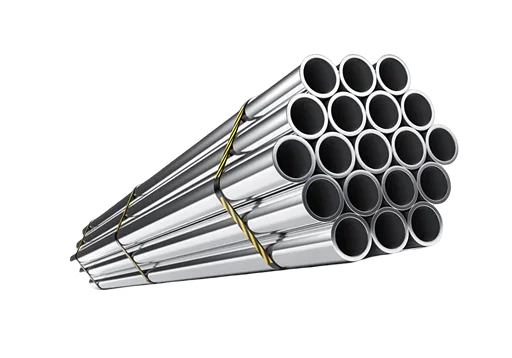
Stainless steel 321 pipe is basically stainless steel 304 with the addition of titanium. Titanium is held at five times the carbon plus nitrogen content or more, so it takes the carbon before chromium can. Hence, the pipe maintains its resistance to corrosion even after being welded and is used for long spans at temperatures between 425° C and 815° C, where common 304 can be subject to sensitization. SS 321H contains 0.04 to 0.10% carbon for improved creep strength in boiler, superheater, and refinery heater lines. The two grades guarantee a minimum of 515 MPa in tensile and 205 MPa in yield according to ASTM A312. Metinox Overseas, based in Mumbai, supplies both grades - seamless, welded and EFW alongside its stainless steel pipes.

Table of content
SS 321 vs 321H vs 304 Pipe: Which Grade Do I Need?
| Point | 304 (S30400) | 321 (S32100) | 321H (S32109) |
|---|---|---|---|
| Carbon | 0.08% max | 0.08% max | 0.04 to 0.10% |
| Titanium | None | 5 x (C + N) min, 0.70% max | 4 x (C + N) min, 0.70% max |
| Grain size rule | None | None | ASTM No. 7 or coarser |
| Weld zone after 425 to 815 °C exposure | Sensitises | Stays resistant | Stays resistant |
| Creep strength above about 540 °C | Moderate | Moderate | Higher |
| Typical lines | General process | Welded hot service, exhausts, expansion joints | Superheaters, reheaters, refinery heaters |
Note: dual certified 321/321H pipe is common, but only when carbon lands between 0.04 and 0.08% and titanium meets both formulas.
Types of Stainless Steel 321/321H Pipes
321 & 321H Seamless Pipe
No weld seam, drawn from solid billet. Ideal for high-pressure boiler lines, superheater headers and critical high-temperature service.
321 & 321H Welded Pipe
Formed from strip with a fused longitudinal seam. Suitable for exhaust systems, expansion joints and cyclic high-temperature process lines.
321 & 321H ERW Pipe
Electric resistance welded with no filler metal. Used in general process piping, ducting and moderate-pressure hot service lines.
321 & 321H EFW Pipe (ASTM A358)
Plate-formed and fusion welded for large-bore applications. Preferred for refinery headers, power plant steam lines and oversized high-temperature piping.
Industrial Application of 321 Stainless Steel Pipe
- Power: superheater and reheater lines, headers and boiler piping
- Refining: fired heater coils, hydrotreater and reformer piping, flare lines
- Petrochemical: hot process lines that are cleaned or shut down often
- Aerospace and engines: exhaust manifolds, collector rings and ducting
- Thermal processing: expansion joints, bellows and thermal oxidiser ducting
- Chemical: welded lines carrying hot dilute acids where 304 sensitises
Stainless Steel 321 Pipe FAQs
Carbon. 321 allows up to 0.08% carbon, while 321H must carry 0.04 to 0.10% and a coarse grain size, which gives better creep strength above about 540 °C. The titanium rule is also slightly different.
ASTM A312 / ASME SA312 covers seamless and welded TP321 and TP321H pipe. Large diameter electric fusion welded pipe is made to ASTM A358.
A312 covers seamless and welded pipe up to NPS 24. Beyond that, A358 is the right standard - it covers large diameter EFW pipe formed from plate and seam-welded. For power and refinery service, this is the preferred choice.
Standard sizes run from 10.3 mm OD (NPS 1/8) to 610 mm OD (NPS 24), with walls from 1.24 mm (Sch 10S) up to 33.32 mm (Sch 160 at NPS 12). Larger diameters are made as EFW pipe.
About 16.22 kg per metre (10.90 lb/ft), using a density of 7.92 g/cm³ and the nominal 114.3 x 6.02 mm size.
Seamless pipe is drawn from solid billet with no weld seam. Welded pipe is formed from strip and joined along one seam. For most 321 service, welded works well because titanium prevents sensitisation of the weld zone. Seamless is specified on high-pressure lines, boiler piping, and wherever the design code mandates it.
It usually is not. Titanium is lost across the welding arc, so ER347 filler, stabilised with niobium, is the normal choice for 321 pipe.
Yes, for welded lines that pass through 425 to 815 °C. Titanium stops chromium carbides forming, so 321 keeps its corrosion resistance where 304 would sensitise.
An EN 10204 3.1 certificate showing heat analysis including titanium, carbon and nitrogen, mechanical test results, heat treatment, the hydrostatic or eddy current test and, for 321H, grain size.
Enquire Now
Get pricing within 24 hours!