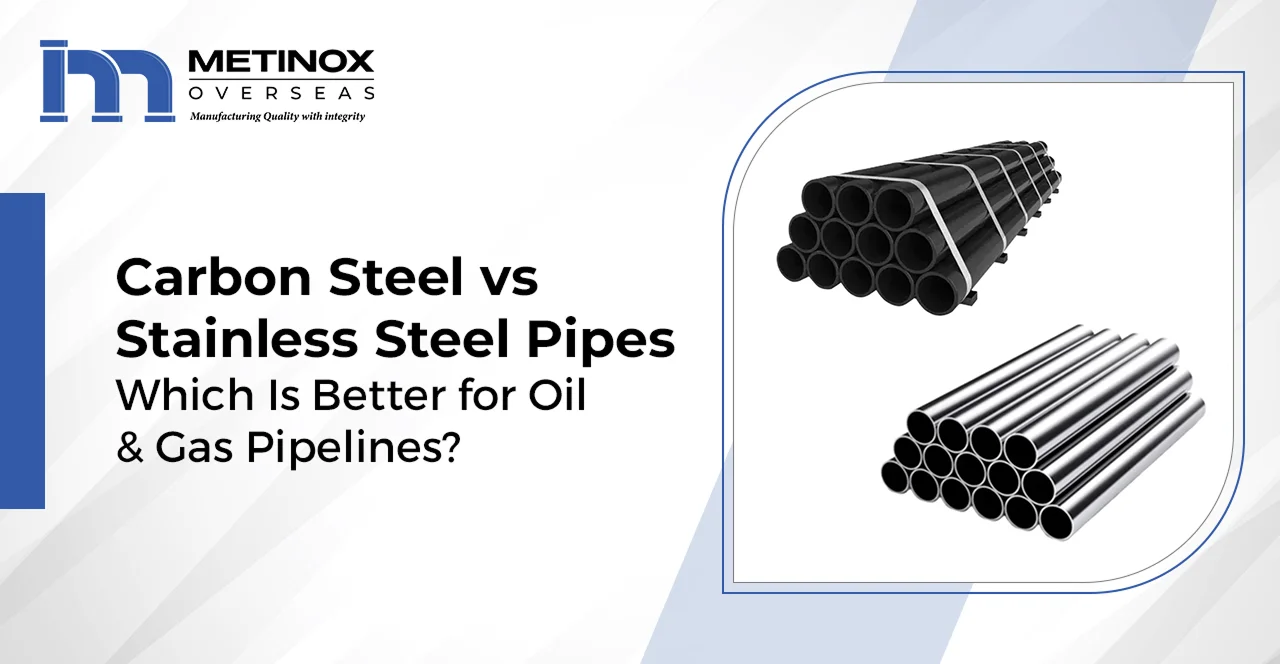
Carbon Steel vs Stainless Steel Pipes – Which Is Better for Oil & Gas Pipelines?
Material selection for oil and gas pipelines is one of the most consequential engineering decisions in any upstream, midstream, or downstream project. The choice between carbon steel and stainless steel pipes affects capital cost, operational reliability, maintenance requirements, and the total lifecycle cost of the piping system. Both materials have well-established track records in the industry — but they perform optimally in very different service conditions.
Metinox Overseas manufactures and exports both carbon steel and stainless steel pipes to oil and gas projects globally. Our carbon steel range — including API 5L X-series pipes and ASTM A106 Gr. B pipes — is available at our Carbon Steel Pipes & Tubes page. Our stainless steel pipes range from standard austenitic grades to duplex, super duplex, and nickel alloys at our Stainless Steel Pipes page. We also supply Carbon Steel Flanges and alloy steel pipes including P91 and P22 grades at our Alloy Steel Pipes page.
Understanding Carbon Steel Pipes for Oil & Gas
Carbon steel pipes are the backbone of the global oil and gas pipeline network. Their composition — iron with a controlled carbon content of 0.2% to 2.1%, plus trace manganese and silicon — gives them exceptional tensile strength, good weldability, and relatively low cost per unit weight.
Key Standards
- API 5L: The definitive standard for line pipe in oil and gas service. Available in Grade X42, X52, X60, X65, and X70, with PSL1 and PSL2 quality levels for onshore and offshore pipelines.
- ASTM A106 Grade B: Specified for high-temperature service in refineries, power plants, and process piping — see /carbon-steel-astm-a106-gr-b-pipe-manufacturer-supplier/
- ASTM A333 Grade 6: Low-temperature carbon steel pipe for cryogenic and sub-zero service — see /astm-a333-grade-6-low-temperature-carbon-steel-pipe-manufacturer-supplier/
Advantages of Carbon Steel for Pipelines
- High tensile and yield strength — handles the extreme mechanical and pressure loads of long-distance transmission pipelines
- Excellent weldability with standard processes, enabling rapid field fabrication
- Lower material cost than stainless steel — typically one-third to one-fifth of the price per kilogram
- Wide availability in large diameter and heavy wall specifications
Limitations
- Carbon steel corrodes readily in the presence of moisture, oxygen, CO₂, and H₂S without protective coatings or inhibitors
- Requires internal or external corrosion protection (epoxy lining, cathodic protection, inhibitor injection) in most oil and gas service
- Not suitable for highly corrosive process streams carrying acids, chlorides, or aggressive chemicals without additional protection
Understanding Stainless Steel Pipes for Oil & Gas
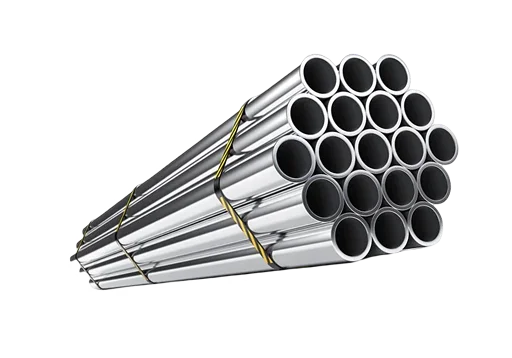
Stainless steel pipes contain a minimum of 10.5% chromium, which forms a self-repairing passive oxide layer on the surface that inherently resists corrosion without additional coatings or treatments. In oil and gas applications, stainless steel is specified for service conditions where carbon steel’s corrosion rate would be unacceptably high or where product purity must be maintained.
Grades Most Commonly Used in O&G
- SS 316L — for offshore topside process piping, umbilicals, and chemical injection lines
- Duplex 2205 — for seawater handling, produced water systems, and moderate-sour service
- Super Duplex 2507/2760 — for high-chloride, subsea, and sour gas environments
- Inconel 625 — for the most aggressive process and downhole environments
Advantages of Stainless Steel for O&G
- Inherent corrosion resistance eliminates the need for internal coatings or chemical inhibitors in most service conditions
- Longer service life in corrosive environments significantly reduces total lifecycle cost despite higher upfront cost
- Duplex and super duplex grades offer high strength combined with corrosion resistance, enabling lighter designs
- Hygienic surface finish is required for some downstream applications
Alloy Steel Pipes: A Middle Ground
For high-temperature and high-pressure service in refineries, power plants, and gas processing facilities, alloy steel (chrome-moly) pipes offer a middle ground — higher temperature resistance than carbon steel without the full cost premium of stainless. Metinox supplies a full range of Alloy Steel Pipes including P1, P5, P9, P11, P22, P91, and P92 grades.
Decision Framework: Which Material to Specify?
Choose Carbon Steel (API 5L / ASTM A106) when:
- The pipeline transports dry natural gas, crude oil, or refined products with low corrosivity
- Budget constraints are critical and an effective corrosion management programme (cathodic protection, inhibitors, coatings) is in place
- Large diameter, long-distance transmission pipelines are required
Choose Stainless or Duplex when:
- The fluid is produced water, seawater, brine, or acidic process condensate
- The application is offshore or subsea where corrosion management is difficult
- Maintenance access is limited and service life of 25+ years without pipe replacement is required
- High H₂S or CO₂ content is present in the process stream (sour service)
Metinox Overseas Product Range for Oil & Gas
- Carbon Steel Pipes & Tubes
- API 5L X-Series Pipes
- ASTM A106 Grade B Pipes
- ASTM A333 Grade 6 Pipes
- Carbon Steel Flanges
- Stainless Steel Pipes
- SS 316L Pipes
- Duplex 2205 Pipes
- Super Duplex 2507 Pipes
- Alloy Steel Pipes (P91 / P22)
Frequently Asked Questions
Initial material cost of stainless steel is 3–5 times higher per kilogram than carbon steel. However, when total lifecycle cost is considered — including corrosion protection, maintenance, and replacement — stainless and duplex grades are often more economical in corrosive service over a 20–30 year asset life.
API 5L is the American Petroleum Institute standard for line pipe. Metinox Overseas supplies API 5L X-series pipes including X42, X52, X60, X65, and X70 in PSL1 and PSL2.
Yes. Metinox Overseas is a single-source supplier for carbon steel, alloy steel, stainless steel, duplex, super duplex, and nickel alloy pipes, tubes, and flanges. This simplifies procurement, ensures consistency of documentation, and reduces lead time for multi-material projects. Contact us to discuss your multi-material project requirement.
Source carbon steel, alloy steel, and stainless steel pipes for oil & gas projects from Metinox Overseas. Browse our Carbon Steel Pipes & Tubes and Stainless Steel Pipes or contact us for a CIF quotation within 24 hours.
Get a Quote