Stainless Steel Pipe Fittings Supplier
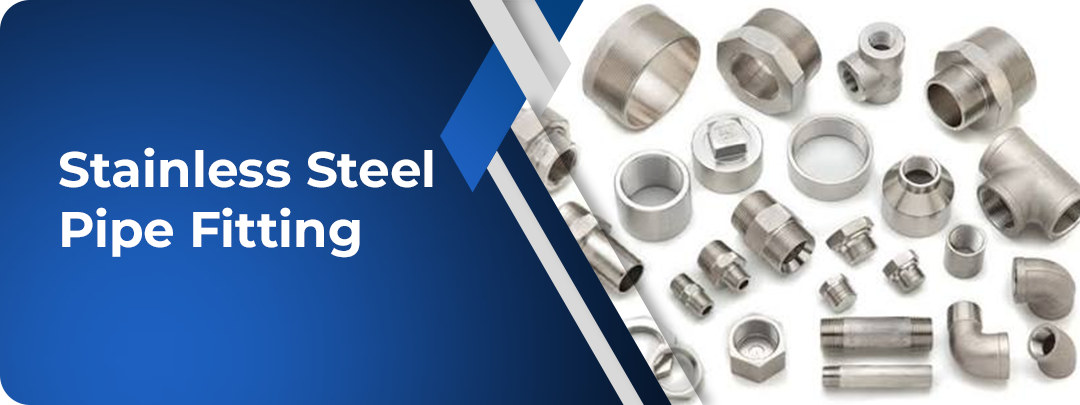
A stainless steel pipe fittings are usually where a process line gives trouble first. The pipe itself tends to hold. It’s the joints that fail. Put in a fitting of the wrong grade, or one with a thin wall or no heat number, and it can still pass inspection, then start leaking a few months into service. Metinox Overseas supplies stainless steel pipe fittings to procurement teams who look for exactly these problems before anything is shipped. Elbows, tees, reducers, caps, couplings, olets: we source them in the grade, schedule and standard shown on your drawings. Our customers include refineries, gas plants, power stations, desalination units and chemical works in India, the GCC and other export markets.

Table of content
- Which Grade of Stainless Steel Pipe Fittings Suits Your Service?
- Stainless Steel Pipe Fittings Specification
- Types of Stainless Steel Pipe Fittings: Elbow, Stainless Steel Tee, Reducer and More
- Chemical Composition of Stainless Steel Pipe Fittings (SS 304 / 316)
- Mechanical Strength of Stainless Steel Buttweld Pipe Fittings
- Stainless Steel Buttweld Pipe Fittings Size Chart (ASME B16.9)
- What Sets the Price of a Stainless Steel Reducer, Tee or Elbow
- Comparing Stainless Steel Pipe Fittings Manufacturers in India: Certificates to Ask For
- Complete the Line: Pipes and Flanges to Match Your Stainless Steel Tee and Reducer
- Buyer Questions on Stainless Steel Pipe Fittings in India and Export Markets
- Ready to Order a Stainless Steel Pipe Fitting?
Which Grade of Stainless Steel Pipe Fittings Suits Your Service?
Stainless steel pipe fittings join, turn, branch, reduce or close a stainless line. The grade is chosen for the fluid and the temperature; the fitting type is chosen for the size and the pressure.
| Grade | Service condition | Typical fitting form |
| 304L | Fresh water, air, mild chemicals | Buttweld, SCH 10S or 40S |
| 316L | Coastal plant, chlorides, gas processing | Buttweld; socket weld below DN 50 |
| 321H or 347H | Sustained 425 to 815 °C | Buttweld, SCH 40S or 80S |
| 904L | Seawater, brine, desalination | Buttweld |
| 316L | Small-bore high-pressure lines | Socket weld Class 3000 or 6000 |
| 316 | Instrument and utility tapping | Threaded Class 3000 |
The final grade is set by your material selection report, not by this table.
Stainless Steel Pipe Fittings Specification
| Feature | Details |
| Product | Stainless steel pipe fittings, buttweld and forged |
| Grades | 304, 304L, 304H, 310S, 316, 316L, 316H, 317L, 321, 321H, 347, 347H, 904L |
| Size range | Buttweld: ½" to 48" NB (DN 15 to DN 1200). Forged: ⅛" to 4" NB (DN 6 to DN 100) |
| Wall schedule | Sch 5S, 10S, 20, 40S, STD, 80S, XS, 160, XXS |
| Pressure class (forged) | Socket weld: Class 3000, 6000, 9000. Threaded: Class 2000, 3000, 6000 |
| Construction | Seamless, welded, or forged and machined |
| End type | Bevelled buttweld (ASME B16.25), socket weld, threaded NPT or BSPT |
| Material standards | ASTM A403 / ASME SA403 (buttweld), ASTM A182 / ASME SA182 (forged) |
| Dimensional standards | ASME B16.9, B16.28, B16.11, MSS SP-43, MSS SP-97, EN 10253-4, DIN 2605 / 2615 / 2616 |
| Surface finish | Pickled and passivated; polished on request |
| Tests offered | PMI, hydrostatic, RT/UT of welds, IGC (ASTM A262 Practice E), hardness, dimensional check |
| Unit weight | Given per fitting, size and schedule at quotation |
| Certificates | EN 10204 3.1; 3.2 with third party witness on request |
Types of Stainless Steel Pipe Fittings: Elbow, Stainless Steel Tee, Reducer and More
| Fitting | What it does | Common forms |
| Elbow | Turns the line by 45°, 90° or 180° | Long radius (1.5D), short radius (1D), 3D and 5D bends |
| Stainless steel tee | Takes a branch off the run at 90° | Equal tee, reducing tee, barred tee for pigging lines |
| Stainless steel reducer | Joins two pipe sizes | Concentric for vertical lines; eccentric, flat side up, on pump suction |
| Cap | Closes a line end or test point | Buttweld or socket weld |
| Stub end | Pairs with a lap joint flange that can rotate for bolt alignment | Long (ASME) and short (MSS) pattern |
| Cross | Four way connection, mostly in fire water and sprinkler headers | Equal and reducing |
| Coupling and union | Joins small bore pipe; a union can be broken without cutting | Full, half, reducing; Class 3000 and 6000 |
| Olet | Branch outlet welded straight onto the header | Weldolet, sockolet, threadolet |
Chemical Composition of Stainless Steel Pipe Fittings (SS 304 / 316)
| Element | 304 / 304L (%) | 316 / 316L (%) | Role in the Fitting |
| Carbon (C) | 0.08 max (L grade: 0.030 max) | 0.08 max (L grade: 0.030 max) | Low carbon limits carbide formation at welds, so weld zones resist corrosion |
| Chromium (Cr) | 18.0 to 20.0 | 16.0 to 18.0 | Forms the passive oxide film that stops rust |
| Nickel (Ni) | 8.0 to 11.0 (L grade: 8.0 to 12.0) | 10.0 to 14.0 | Keeps the structure austenitic, tough and non-magnetic |
| Molybdenum (Mo) | none | 2.00 to 3.00 | Raises resistance to chloride pitting and crevice attack |
| Manganese (Mn) | 2.00 max | 2.00 max | Aids hot working and deoxidation |
| Silicon (Si) | 1.00 max | 1.00 max | Deoxidiser during steelmaking |
| Iron (Fe) | Balance | Balance | Base metal |
Mechanical Strength of Stainless Steel Buttweld Pipe Fittings
| Property | Requirement | What It Means on Site |
| Tensile strength | 515 MPa (75 ksi) min; 485 MPa (70 ksi) min for 304L / 316L | Load the fitting carries before it fractures |
| Yield strength (0.2% offset) | 205 MPa (30 ksi) min; 170 MPa (25 ksi) min for 304L / 316L | Stress level below which the fitting does not permanently deform |
| Elongation | 28% min (longitudinal) | Ductility to absorb thermal cycling and vibration without cracking |
| Hardness | No limit in ASTM A403; 22 HRC max where NACE MR0175 applies | Controls resistance to cracking in sour gas service |
| Service temperature | About −196 °C to +800 °C, depending on grade and design code | Covers cryogenic LNG lines through to hot process piping |
Note: Figures are minimums for SS 304 and 316 under ASTM A403. Other grades have their own values, including 321, 321H, 347 and 904L. Values for ASTM A182 forged fittings may also differ slightly. Use the heat-specific mill test certificate for final acceptance.
Request a Quotation
Stainless Steel Buttweld Pipe Fittings Size Chart (ASME B16.9)
Dimensions in mm, with inches alongside for the nominal size. Tolerances are those of ASME B16.9 for each size band.
| NPS (in) | DN | OD at Bevel | 90° LR Elbow (A) | 45° LR Elbow (B) | Equal Tee (C) | Reducer Length (H) | Cap Length (E) |
| ½ | 15 | 21.3 (0.84) | 38 (1.50) | 16 (0.62) | 25 (1.00) | – | 25 (1.00) |
| ¾ | 20 | 26.7 (1.05) | 38 (1.50) | 19 (0.75) | 29 (1.12) | 38 (1.50) | 25 (1.00) |
| 1 | 25 | 33.4 (1.32) | 38 (1.50) | 22 (0.88) | 38 (1.50) | 51 (2.00) | 38 (1.50) |
| 1¼ | 32 | 42.2 (1.66) | 48 (1.88) | 25 (1.00) | 48 (1.88) | 51 (2.00) | 38 (1.50) |
| 1½ | 40 | 48.3 (1.90) | 57 (2.25) | 29 (1.12) | 57 (2.25) | 64 (2.50) | 38 (1.50) |
| 2 | 50 | 60.3 (2.38) | 76 (3.00) | 35 (1.38) | 64 (2.50) | 76 (3.00) | 38 (1.50) |
| 2½ | 65 | 73.0 (2.88) | 95 (3.75) | 44 (1.75) | 76 (3.00) | 89 (3.50) | 38 (1.50) |
| 3 | 80 | 88.9 (3.50) | 114 (4.50) | 51 (2.00) | 86 (3.38) | 89 (3.50) | 51 (2.00) |
| 4 | 100 | 114.3 (4.50) | 152 (6.00) | 64 (2.50) | 105 (4.12) | 102 (4.00) | 64 (2.50) |
| 5 | 125 | 141.3 (5.56) | 190 (7.50) | 79 (3.12) | 124 (4.88) | 127 (5.00) | 76 (3.00) |
| 6 | 150 | 168.3 (6.63) | 229 (9.00) | 95 (3.75) | 143 (5.62) | 140 (5.50) | 89 (3.50) |
| 8 | 200 | 219.1 (8.63) | 305 (12.00) | 127 (5.00) | 178 (7.00) | 152 (6.00) | 102 (4.00) |
| 10 | 250 | 273.0 (10.75) | 381 (15.00) | 159 (6.25) | 216 (8.50) | 178 (7.00) | 127 (5.00) |
| 12 | 300 | 323.8 (12.75) | 457 (18.00) | 190 (7.50) | 254 (10.00) | 203 (8.00) | 152 (6.00) |
| 14 | 350 | 355.6 (14.00) | 533 (21.00) | 222 (8.75) | 279 (11.00) | 330 (13.00) | 165 (6.50) |
| 16 | 400 | 406.4 (16.00) | 610 (24.00) | 254 (10.00) | 305 (12.00) | 356 (14.00) | 178 (7.00) |
| 18 | 450 | 457.0 (18.00) | 686 (27.00) | 286 (11.25) | 343 (13.50) | 381 (15.00) | 203 (8.00) |
| 20 | 500 | 508.0 (20.00) | 762 (30.00) | 318 (12.50) | 381 (15.00) | 508 (20.00) | 229 (9.00) |
| 24 | 600 | 610.0 (24.00) | 914 (36.00) | 381 (15.00) | 432 (17.00) | 508 (20.00) | 267 (10.50) |
Note: A and B are centre-to-end for elbows, C is centre-to-end for tees, and H is end-to-end for reducers. Cap length E applies to standard wall. Sizes from 26" to 48" and short-radius elbows (ASME B16.9) are quoted on request.
Stainless Steel Pipe Fittings Wall Thickness by Schedule (ASME B36.19M)
| NPS / DN | Sch 10S | Sch 40S | Sch 80S | Sch 160 | XXS |
| ½ / 15 | 2.11 (0.083) | 2.77 (0.109) | 3.73 (0.147) | 4.78 (0.188) | 7.47 (0.294) |
| 1 / 25 | 2.77 (0.109) | 3.38 (0.133) | 4.55 (0.179) | 6.35 (0.250) | 9.09 (0.358) |
| 2 / 50 | 2.77 (0.109) | 3.91 (0.154) | 5.54 (0.218) | 8.74 (0.344) | 11.07 (0.436) |
| 3 / 80 | 3.05 (0.120) | 5.49 (0.216) | 7.62 (0.300) | 11.13 (0.438) | 15.24 (0.600) |
| 4 / 100 | 3.05 (0.120) | 6.02 (0.237) | 8.56 (0.337) | 13.49 (0.531) | 17.12 (0.674) |
| 6 / 150 | 3.40 (0.134) | 7.11 (0.280) | 10.97 (0.432) | 18.26 (0.719) | 21.95 (0.864) |
| 8 / 200 | 3.76 (0.148) | 8.18 (0.322) | 12.70 (0.500) | 23.01 (0.906) | 22.23 (0.875) |
What Sets the Price of a Stainless Steel Reducer, Tee or Elbow
Stainless steel fitting prices track the nickel and molybdenum markets, so we quote each enquiry at current rates instead of publishing a fixed price list. The table shows what moves the figure most.
| Factor | Effect on price | Why |
| Grade | High | 316L costs more than 304L, and 904L costs several times more, because of nickel and molybdenum content |
| Size and wall schedule | High | More metal per piece; Sch 80S and heavier walls raise weight sharply |
| Seamless or welded | Medium | Seamless fittings cost more to make, especially in larger sizes |
| Stock item or mill order | Medium | Mill orders for uncommon sizes carry setup cost and longer lead time |
| Quantity | Medium | Larger quantities per size and grade lower the unit price |
| Certificate level | Low to medium | EN 10204 3.2 needs a third-party witness, which adds cost; 3.1 does not |
| Inspection and testing | Low to medium | Witness tests, PMI, IGC and sour service hardness checks are charged per lot |
| Surface finish | Low | Polishing costs more than standard pickling and passivation |
| Incoterm and port | Varies | CIF and DAP include freight and insurance; EXW and FOB do no |
For a fast quotation, send: grade, governing standard, fitting type, size (DN or NPS), wall schedule or class, quantity, end finish, certification level, inspection requirement, destination port and required date.
Request a Quotation
Comparing Stainless Steel Pipe Fittings Manufacturers in India: Certificates to Ask For
Each fitting should carry the grade, size, schedule, standard and heat number, so it can be traced to its mill test certificate under EN 10204. Metinox supplies EN 10204 3.1 certificates as standard and arranges 3.2 certificates with witness inspection by the agency named on your purchase order.
PMI (positive material identification) is worth requesting on any mixed-grade order. 304L, 316L and 321 look identical in the yard, and only a reading of Cr, Ni, Mo and Ti separates them. PMI by handheld XRF can be carried out before dispatch on request.
Complete the Line: Pipes and Flanges to Match Your Stainless Steel Tee and Reducer
Complete the line in the same grade, from pipe to fitting to flange:
Grade pages with full data for each grade:
Buyer Questions on Stainless Steel Pipe Fittings in India and Export Markets
Yes, within limits. ISO 15156-3 accepts solution-annealed 316L at a maximum of 22 HRC, inside set limits on temperature, chlorides and H2S partial pressure. Outside those limits, a higher alloy is needed.
316L has a maximum carbon of 0.030% against 0.08% for 316. Lower carbon reduces chromium carbide formation in the weld zone, so 316L keeps its corrosion resistance after welding. Many fittings are dual-certified 316/316L.
Buttweld fittings follow ASTM A403 for material and ASME B16.9 for dimensions. Forged socket weld and threaded fittings follow ASTM A182 for material and ASME B16.11 for dimensions and pressure class.
Certificate level and inspection agency are confirmed at quotation. State 3.1 or 3.2 and the agency you require in your enquiry.
Send the checklist in the pricing section above, or attach your line list or MTO. A complete enquiry gets a complete quote on the first reply.
Ready to Order a Stainless Steel Pipe Fitting?
Send your line list or material take-off with grades, sizes, schedules and quantities. State the certificate level, any inspection or sour service requirement, your Incoterm and the destination port. A complete enquiry gets a complete quote on the first reply.
Request a Quotation
Enquire Now
Get pricing within 24 hours!