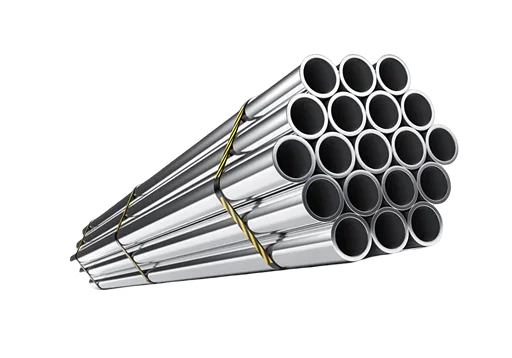
Stainless steel 321 tube is chosen when a line runs hot enough to damage 304. Between about 425°C and 815°C, 304 can form chromium carbides at its grain boundaries and lose corrosion resistance. 321 avoids this because titanium binds the carbon first, leaving the chromium free to protect the steel. 321H has higher carbon (0.04–0.10%) for better creep strength, and is the pick for lines running above about 525°C for long periods.
Metinox Overseas, based in Mumbai, makes SS 321 and 321H seamless and welded tubes to ASTM A213, A249 and A269, for heaters, boilers, exhaust systems and heat exchangers. Send us your size, wall and quantity, and we’ll quote the right grade and form.
Ready with your size and quantity? Request a quote for stainless steel 321 tubes.

Table of Contents
Stainless steel 321 and 321H tube specification
| Specification | Detail |
|---|---|
|
Standards |
ASTM A213 and ASME SA213 for seamless tube, ASTM A249 and ASME SA249 for welded tube, ASTM A269 for tubing for general service |
|
Grades and UNS |
321, S32100. 321H, S32109 |
|
Types |
Seamless, welded and EFW |
|
Seamless tube size |
OD 10.3 mm to 610 mm |
|
Welded tube size |
OD 10.3mm to 914 mm |
|
Wall thickness |
0.4 mm to 12.7 mm |
|
Length |
Single random, double random or cut length |
|
Condition and finish |
Solution annealed and pickled, or bright annealed |
|
Tolerances |
Per ASTM A1016 |
|
Certificates |
EN 10204 3.1, with 3.2 on request |
Where SS 321/321H Tube Is Used
Heat exchangers and boilers are covered above. Beyond them, buyers of stainless steel 321 tubing usually want it for lines that run hot and cycle often.
- Exhaust and flue systems. Hot gas and repeated heating and cooling suit the stabilised grade.
- Refinery and petrochemical heaters. Tubes see long hours at high temperature, which is where 321H is chosen.
- Furnace parts. Radiant and convection sections cycle through the sensitising range.
- Chemical process lines running hot. Acidic fluids at high temperature need the corrosion resistance to hold.
If chlorides or acids are the bigger problem, look at our duplex tube or super duplex tube pages. For instrument lines, see our instrumentation tubes.
Frequently Asked Questions
Both are titanium stabilised stainless steel with 17 to 19 percent chromium and 9 to 12 percent nickel. The difference is carbon, which is 0.08 max in 321 and 0.04 to 0.10 percent in 321H. The extra carbon gives 321H better strength in sustained service above about 525 degrees C.
321 carries titanium of at least 5 times carbon plus nitrogen, and 321H carries at least 4 times carbon plus nitrogen. For both grades the upper limit is 0.70 percent. The titanium ties up carbon so chromium carbides do not form when the tube sits in the 425 to 850 degrees C range.
No. 321H is stabilised with titanium, the same as 321. Niobium is the stabiliser in grade 347, so check which grade your drawing names.
S32100 is the UNS number for 321 and S32109 is the number for 321H. They share the same base chemistry and differ mainly in carbon. Use the number your specification names when you order.
It is made both ways. SS 321 seamless tubes suit heat exchangers, boilers and high pressure lines. Stainless steel 321 welded tubes suit process, flue and exhaust lines and cost less.
EFW stands for electric fusion welded. Stainless steel 321/321H EFW tubes are formed from rolled plate, which lets them reach larger diameters than strip welded tube. We quote EFW tube by outside diameter and wall on enquiry.
Yes. Steel 321/321H heat exchanger tubes are common in power, refinery and petrochemical plants because they hold up through repeated heating and cooling. Seamless tube to ASTM A213 is the usual choice for pressure duty.
Both grades have a minimum tensile strength of 515 MPa, a minimum yield of 205 MPa and a minimum elongation of 35 percent. Maximum hardness is 90 HRB or 192 HBW. These are minimums from ASTM A213, not typical test values.
321 is chosen for the 425 to 850 degrees C range, where plain 304 loses corrosion resistance because chromium carbides form at the grain boundaries. The titanium in 321 stops that from happening.
Seamless tube follows the A213 range of about 3.2 mm to 127 mm OD, and welded tube starts at about 6.35 mm OD. EFW tube covers larger bores, from about 150 mm OD. Wall runs from about 0.4 mm to 12.7 mm. Send us your OD, wall and length and we will confirm.
316L has molybdenum, so it resists chlorides better at normal temperatures. 321 is the better pick for lines that go through repeated heating and cooling, because titanium protects it in the 425 to 850 degrees C range. If the fluid is salty and hot, look at our duplex tube or super duplex tube pages.
Annealed 321 is non magnetic. Cold work such as bending or drawing can make it slightly magnetic, which is normal and does not mean the grade is wrong.
Request a Quote for Stainless Steel 321 Tube
Tell us the grade, form, OD, wall, length and quantity, and we will respond with the right 321 or 321H tube for your line. You can also browse all of our stainless steel tubes.
Questions about a grade, size or standard? Contact our team.
Enquire Now
Get pricing within 24 hours!