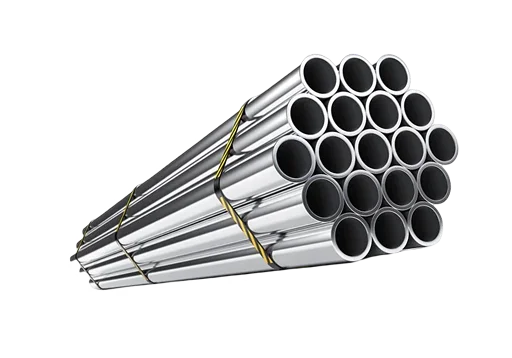
Brass is copper with zinc in it, and almost everything that matters about a brass tube follows from how much zinc. Metinox Overseas is a brass pipes and tubes manufacturer and supplier in Mumbai, covering ASTM B135 seamless brass tube, B43 red brass pipe and B111 condenser tube across the alloy range from red brass to admiralty, naval and dezincification resistant grades, shipping to plumbing, power and marine buyers across India, the USA, the Middle East and Africa with 3.1 certification on every lot. Machinable, formable, solderable and cheaper than pure copper, brass earns its place; it also has two specific failure modes that this page will not hide from you. The full catalogue sits under Pipes & Tubes.
A note on where to look next, because brass and copper overlap. If your question is which condenser alloy suits your cooling water and what flow velocity it will tolerate, that decision lives on our Copper Pipes & Tubes page, where the water-by-alloy ladder and the velocity limits are set out in full. This page answers the other half: what zinc does to an alloy, why brass fails when it fails, and how the inhibited grades prevent it.

Table of content
- The Zinc Ladder: How Brass Alloys Are Organized
- Brass Alloys We Supply
- The Brass Pipe & Tube Standards Map
- Dezincification: The Failure Mode That Defines Brass
- Inhibited and DZR Brass Tube
- Lead, Potable Water and the US Lead-Free Rule
- Season Cracking: Brass Tube and Ammonia
- Brass Pipe & Tube Applications
- Brass Testing, Certification & Export to USA, Middle East & Africa
- Explore Related Ranges
- Brass Pipes & Tubes: Frequently Asked Questions
The Zinc Ladder: How Brass Alloys Are Organized
Every brass on this page is a point on one scale. Read the ladder once and the alloy names stop being arbitrary.
| Zinc content | Structure | What rises | What falls |
|---|---|---|---|
| Up to about 15% (red brass) | Single phase alpha | Corrosion resistance, solderability, colour warmth | Strength, machinability |
| Around 30% (cartridge brass) | Single phase alpha | Ductility, the best deep-drawing behaviour in the family | Dezincification resistance begins to matter |
| Around 35% (yellow brass) | Alpha, near the boundary | Strength, cold workability, economy | Corrosion margin |
| Around 40% (Muntz metal) | Two phase alpha-beta | Strength, hot workability, price advantage | Dezincification resistance drops sharply |
Two consequences run through the rest of this page. Zinc is cheaper than copper, so higher-zinc brasses cost less and that is a real commercial reason they exist. And zinc is the element that leaves during dezincification, so the same ladder that lowers price also raises risk. Alloys above roughly 15 percent zinc are susceptible, and the two-phase alpha-beta brasses at the top of the ladder are the most vulnerable of all.
The Brass Pipe & Tube Standards Map
- ASTM B135: seamless brass tube, round, square and rectangular, covering the alloy range from C23000 through C28000 to C44300. Tempers are designated light-drawn H55 for tube that must stay bendable, drawn H58 for general purpose, and hard-drawn H80 where stiffness and strength lead. State the temper in the enquiry; it changes the product as much as the alloy does.
- ASTM B43: seamless red brass pipe in standard pipe sizes, the plumbing and general-service pipe standard.
- ASTM B111: copper and copper alloy condenser tube, the standard that governs admiralty and aluminium brass exchanger bundles.
- ASTM B587: welded brass tube, where the economics of welded construction suit the duty.
- EN 12449 and EN 12164 / 12165: the European tube and rod standards, supplied against order, and the family the DZR designations CW602N and CZ132 come from.
Dezincification: The Failure Mode That Defines Brass
This is the mechanism every brass specification is quietly written around, so it deserves plain language. In dezincification, zinc leaves the alloy selectively while the copper stays behind, and what remains looks like brass from outside but is a porous, weak, copper-rich sponge. The corrosion continues beneath the first layer, replacing sound metal with that porous structure until it penetrates the wall, at which point the component leaks, blocks or fails structurally. It shows up in two forms: a broad uniform layer, and a localized plug that drills through the wall in one spot while everything around it looks perfect, which is why a visual inspection is not a test.
Susceptibility follows the zinc ladder exactly. Below about 15 percent zinc the risk is low; above it the alloy is vulnerable, and the two-phase alpha-beta brasses such as Muntz metal are the worst affected because the zinc-rich beta phase dissolves preferentially. Hot, stagnant, chloride-bearing or low-alkalinity water accelerates all of it, which is why the failures cluster in hot water services, recirculating systems and dead legs rather than in fast-flowing cold mains.
Where the water is aggressive enough to defeat even inhibited brass, the honest answer is a different family: super duplex or the cupronickel grades on the copper page. We stock both, so the recommendation follows the water.
Inhibited and DZR Brass Tube
Inhibition is the metallurgical fix and it is well proven. Small additions of arsenic, typically in the range of 0.02 to 0.25 percent, give alpha brasses high resistance to dezincification at normal operating temperatures, and adding tin up to around 1.5 percent improves it further, which is exactly the recipe behind admiralty brass and the naval brasses. Antimony and phosphorus serve the same inhibiting role in some grades. Alongside inhibition, controlled composition and heat treatment produce the DZR grades, CW602N and CZ132 in European designations, engineered so the microstructure itself resists selective leaching.
The useful part for a buyer is that this is testable, not a claim. Dezincification resistance is verified to ASTM B858, ISO 6509 or EN 12449 by exposing a specimen to copper chloride solution under controlled conditions and measuring how deep the attack penetrates, with a maximum depth in the region of 200 micrometres as the usual DZR classification criterion. If your water chemistry is aggressive, ask for the test on the certificate rather than the word on the datasheet.
Lead, Potable Water and the US Lead-Free Rule
Free-machining brasses contain lead deliberately, because lead is what lets the alloy cut cleanly and hold a thread. That is entirely fine in an engineering component and entirely unacceptable in a drinking water line, and the United States draws the line numerically: for pipe, fittings and fixtures in contact with potable water, lead-free means a weighted average lead content of not more than 0.25 percent across the wetted surfaces, with product compliance normally demonstrated through NSF/ANSI 61 and NSF/ANSI 372 certification. Several other markets apply comparable schemes, WRAS in the United Kingdom and DVGW in Germany among them.
The practical rule for ordering: if the line carries drinking water, specify a lead-free or DZR grade and say so in the enquiry, and if the component is a machined engineering part with no potable contact, leaded brass such as C33200 remains the sensible, economical choice. Confusing the two costs either a failed compliance audit or a needlessly expensive machining bill, and both are avoidable in one sentence on the purchase order.
Season Cracking: Brass Tube and Ammonia
Brass has a second, less famous failure mode and it is faster than the first. Under residual tensile stress, in the presence of ammonia, amines or ammonium compounds, high-zinc brasses crack. The old name is season cracking, from cartridge cases that split during storage in humid Indian conditions, and the mechanism has not changed since: the stress from forming or drawing does not need to be external, it only needs to be locked in. That rules brass out of several fertilizer, refrigeration and refinery positions where ammonia is present, and it makes stress relief annealing after forming a genuine engineering requirement rather than a nicety on tube that will see those atmospheres.
Where ammonia is unavoidable, cupronickel and pure copper on the Copper Pipes & Tubes page handle it far better, and Titanium Pipes & Tubes are immune to stress corrosion cracking in the media that trouble brass.
Brass Pipe & Tube Applications
- Plumbing & Building Services: red brass pipe and DZR tube for water services, a steady lane across African and Gulf construction and a compliance-driven one in the USA.
- Power & Desalination Condensers: admiralty brass bundles to B111, still widely specified in Middle East plant.
- Marine & Offshore: naval brass hardware and service lines where the tin addition earns its keep.
- HVAC & Refrigeration: brass tube in coils, headers and fittings, subject to the ammonia caution above.
- General Engineering & Machining: leaded brass tube for turned components, valves and instrument bodies.
- Architectural & Decorative: yellow brass tube for railings, fittings and interiors where the colour is the specification.
Brass Testing, Certification & Export to USA, Middle East & Africa
Tube is supplied to the chemistry, temper and dimensional requirements of its governing standard, with eddy current or hydrostatic testing, expansion and flattening tests per the specification, and dezincification testing to ASTM B858 or ISO 6509 where the grade or the water calls for it. Every order ships with an EN 10204 3.1 mill test certificate, lot traceable, with 3.2 witnessing through BV, SGS or TUV at order stage. Metinox Overseas is an ISO 9001 and PED certified company; the program is on our Quality Policy page. Brass tracks copper and zinc on the LME, so quotations carry a stated validity window rather than an open price. Export consolidations run from Mumbai to the USA, the Middle East and Africa, with condenser tube crated per bundle, coils boxed and ends capped throughout, as described on Packing and Dispatch. Ex-stock dispatches in 7 to 14 working days; made-to-order alloys and DZR grades take 4 to 6 weeks.
Explore Related Ranges
- Copper Pipes & Tubes – the wider copper family, with condenser alloy selection by water and velocity limits
- Super Duplex Steel Tubes – where the water defeats even inhibited brass
- Titanium Pipes & Tubes – immune to the stress corrosion cracking that limits brass
- Stainless Steel Tubes – the austenitic families and the chloride ladder
- Pipes & Tubes – the full catalogue, one level up
Brass Pipes & Tubes: Frequently Asked Questions
Zinc leaves the alloy selectively while copper stays behind, leaving a porous, weak, copper-rich structure that eventually leaks or fails while still looking like brass from outside. Alloys above roughly 15 percent zinc are susceptible, and the two-phase alpha-beta brasses such as Muntz metal are the most vulnerable because the zinc-rich phase dissolves preferentially. Hot, stagnant or chloride-bearing water accelerates it.
Dezincification resistant brass, achieved through inhibiting additions such as arsenic with controlled composition and heat treatment so the microstructure resists selective zinc leaching. It is testable rather than merely claimed: ASTM B858, ISO 6509 and EN 12449 expose a specimen to copper chloride solution and measure penetration depth, with a maximum in the region of 200 micrometres as the usual classification criterion. Ask for the test result on the certificate.
The right brass is. Free-machining brasses contain lead deliberately and do not belong in potable service. In the United States, lead-free means a weighted average lead content of not more than 0.25 percent across wetted surfaces, normally evidenced through NSF/ANSI 61 and 372, with comparable schemes such as WRAS and DVGW elsewhere. Specify a lead-free or DZR grade for drinking water and keep leaded brass for machined components with no potable contact.
It is stress corrosion cracking, historically called season cracking. High-zinc brasses under locked-in tensile stress from forming or drawing will crack when exposed to ammonia, amines or ammonium compounds, and the stress does not have to be external. Stress relief annealing after forming is the mitigation, and where ammonia is unavoidable, cupronickel, pure copper or titanium are the better materials.
Yes, on regular consolidations from Mumbai with condenser tube crated per bundle, coils boxed and every end capped. Middle East condenser and desalination work and African and Gulf plumbing supply are the steady lanes, with US enquiries usually turning on lead-free and DZR compliance, so state the potable requirement in the enquiry and the certification is built into the quote.
Enquire Now
Get pricing within 24 hours!