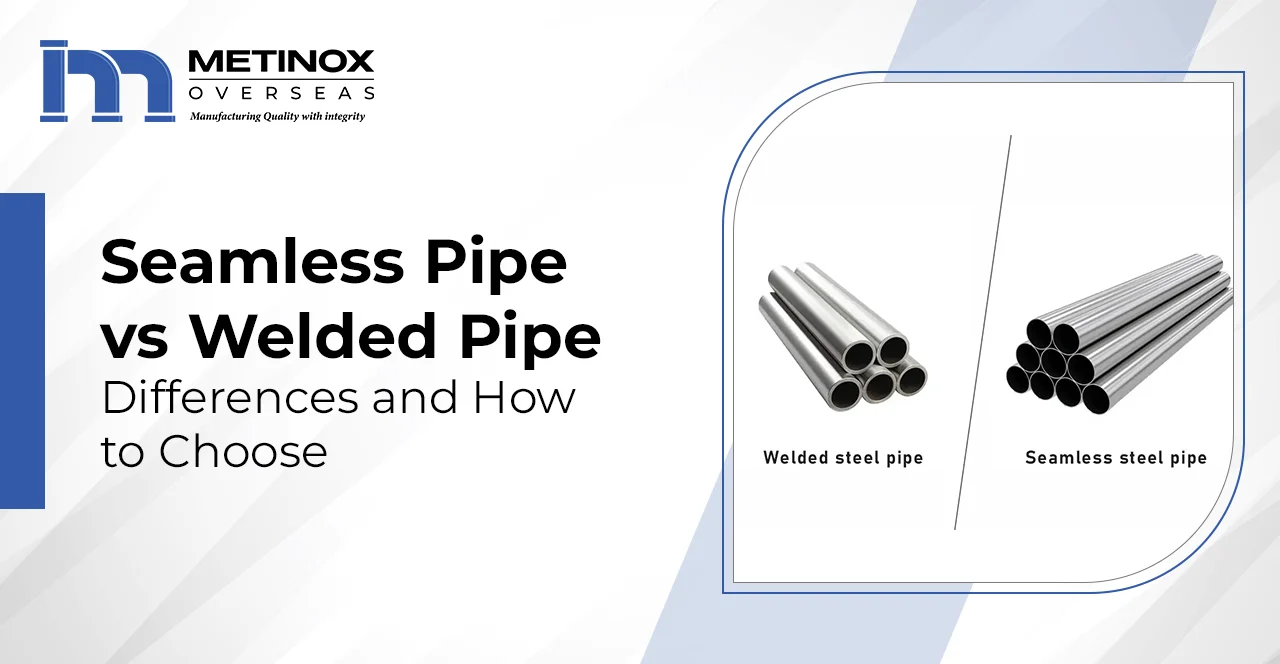
A customer once asked us why a welded stainless steel pipe was rated for lower pressure than a seamless pipe of the same grade and schedule. It’s a fair question, and the answer sits in a design code most buyers never read line by line. Under ASME B31.3, welded pipe carries a weld joint quality factor (Ej) of 0.85 unless the seam is radiographed, against 1.00 for seamless pipe. That single factor cuts the allowable pressure by about 15%.
Get it wrong and you lose money either way. Some buyers pay the seamless premium on a cooling water line that never needed it. Others order welded pipe for a high-pressure header, then find out at design review that the wall isn’t thick enough. Below, we’ve laid out how the two are made, what the standards actually say, and where we’d use each one.
Request a Quote for Seamless or Welded Stainless Steel Pipe
What Is a Seamless Stainless Steel Pipe?
Seamless stainless steel pipe starts as a solid round bar, called a billet. The mill heats it, punches a hole through the middle, and then rolls or extrudes the hollow shell out to size. Smaller pipes get one more step: they’re cold drawn to bring the OD and wall to the exact figure. At no point is anything welded. That’s the whole appeal. With no seam, there’s no weak spot to worry about, so ASME B31.3 gives seamless pipe a weld joint quality factor of 1.00, the full rating with no reduction.
What Is a Welded Stainless Steel Pipe?
A welded stainless steel pipestarts life as flat stainless steel plate or coil, which is rolled into a cylindrical shape and then fusion welded along a single longitudinal seam, commonly by the TIG, plasma or laser welding process depending on the grade and wall thickness. The weld can be made with or without filler metal. Because the finished pipe is formed from gauged, flat stock rather than pierced from a solid billet, welded pipe production is faster and less expensive, and it scales more easily to large diameters and long continuous lengths than seamless manufacturing does.
Seamless vs Welded Pipe Key Differences
The table below compares seamless and welded stainless steel pipe across the factors that actually drive a specification decision.
| Factor | Seamless SS Pipe | Welded Stainless Steel Pipe |
|---|---|---|
| Manufacturing | Pierced and drawn from a solid round billet, no seam | Formed from rolled plate or coil, then fusion welded along the seam |
| Weld joint efficiency (ASME B31.3) | E = 1.00 (no weld, no derating) | E = 0.85 without full radiography, E = 1.00 if the weld is fully radiographed |
| Typical allowable pressure | Highest, for a given grade and wall thickness | Lower unless the weld is fully radiographed to raise E back to 1.00 |
| Relative Cost | Higher, due to the piercing and drawing process | Lower, since coil or plate forming and welding is a faster, cheaper process |
| Length and diameter range | Practically limited, especially in larger diameters and longer continuous lengths | Can be produced in much longer continuous lengths and larger diameters |
| Wall thickness consistency | Can vary slightly around the circumference from the piercing process | Generally more uniform, since it starts from flat, gauged plate or coil |
Is Seamless Pipe Stronger Than Welded Pipe?
Seamless pipe is not stronger as a material, but it carries a higher design pressure rating. Under ASME B31.3, seamless and welded A312 pipe share the same basic allowable stress (S). The difference comes from the longitudinal weld joint quality factor, Ej, which multiplies S in the pressure design equation:
t = PD / 2(SEjW + PY)
Here, t is the required wall thickness, P is the design pressure and D is the outside diameter. W is the weld joint strength reduction factor, and Y is a temperature coefficient.
So a welded pipe isn’t inherently weaker. Its rating is lower only until the weld quality is verified. Specifying 100% radiography brings welded pipe up to the seamless rating, and the combined cost is often still below seamless, especially in larger sizes.
Seamless vs Welded Pipe Cost
Seamless pipe generally costs more per metre than an equivalent welded pipe of the same grade, size and schedule, because piercing and drawing a solid billet is a slower, more material intensive process than rolling and welding flat plate or coil. Welded pipe's lower production cost is the main reason it dominates large diameter and high volume piping, while seamless pipe is reserved for applications where its full, undiscounted pressure rating or its uniform wall properties justify the premium.
Size and Wall Thickness Range
Seamless and welded pipe are not interchangeable across every size, since each process has a practical range where it is most economical.
| Attribute | Seamless SS Pipe | Welded Stainless Steel Pipe |
|---|---|---|
| Common size range | NPS 1/8 inch to about NPS 24 inch, smaller sizes more economical to produce | NPS 1/8 inch up to very large diameters, including structural and process piping well beyond 24 inch |
| Wall thickness | Well suited to thicker walls and higher schedules (Schedule 80, 160 and heavier) | Well suited to thinner, lighter wall schedules (Schedule 5S, 10S) at lower cost |
| Continuous length | Shorter standard mill lengths | Longer continuous lengths achievable, useful for long straight pipeline runs |
Which Is Better, Seamless or Welded Pipe?
Neither is better in every case. Seamless pipe is the right choice where the full pressure rating matters or a specification requires it. Welded pipe is the right choice where cost, large diameter or thin walls matter more, or where 100% radiography can recover the full rating at a lower total cost.
When to Use Seamless Pipe
- High pressure or high temperature service where the full E = 1.00 joint efficiency is required by the design code or the client specification.
- Critical, hard to access, or safety critical lines, including power generation, high pressure steam, and process piping handling hazardous fluids.
- Applications where a thicker wall schedule (Schedule 80, 160 or heavier) is specified and seamless manufacturing suits the wall thickness naturally.
- Projects where the specification explicitly calls for seamless pipe, regardless of cost, for example certain nuclear, aerospace or military standards.
When to Use Welded Pipe
- Large diameter or long continuous runs, where welded manufacturing scales more easily and economically than seamless.
- Lower pressure, less critical service where the default E = 0.85 joint efficiency is acceptable without full radiography.
- Budget sensitive projects, where the lower base cost of welded pipe outweighs the benefit of the full seamless pressure rating.
- Thin wall, lighter schedule applications (Schedule 5S, 10S), where welded pipe is both more available and more cost effective.
ASTM and ASME Standards for Seamless and Welded Pipe
| Standard | Covers |
| ASTM A312 | Seamless and welded austenitic stainless steel pipe (welded pipe made without filler metal) |
| ASTM A358 | Electric fusion welded (EFW) pipe with filler metal, for high-temperature and corrosive service |
| ASTM A409 | Large-diameter welded austenitic pipe, with or without filler metal |
| ASTM A999 | General requirements for alloy and stainless steel pipe, including tolerances |
| ASME B36.19 | Stainless steel pipe dimensions, Sch 5S to 80S |
| ASME B36.10M | Wrought steel pipe dimensions; used for heavier stainless schedules such as Sch 160 and XXS |
| ASME B31.3 | Process piping design code, including weld joint quality factors (Ej) |
How to Identify Seamless and Welded Pipe
- Look for a seam: a welded pipe usually shows a visible or lightly ground longitudinal line along its length where the weld was made. A seamless pipe has no such line anywhere on its surface.
- Mill marking: ASTM A312 pipe is typically stamped with the grade and a process designator, allowing seamless and welded product to be distinguished from the markings alone without cutting the pipe.
- Wall thickness: measuring wall thickness at several points around the circumference can reveal the slight, acceptable variation typical of seamless pipe, versus the more uniform wall typical of welded pipe formed from gauged plate.
- Mill test certificate: every properly supplied pipe should come with an MTC stating the manufacturing process, grade, heat number and test results, which is the most reliable way to confirm seamless versus welded.
Seamless vs Welded Pipe FAQs
Seamless pipe carries a higher default allowable pressure rating under ASME B31.3, since it has a joint efficiency factor of E = 1.00 against E = 0.85 for an as-welded pipe. Once a weld is fully radiographed and passes inspection, that gap closes, since the welded pipe's joint efficiency is then also rated at E = 1.00.
Yes, in almost every case. Piercing and drawing a solid billet is a slower, more material intensive process than rolling and welding flat plate or coil, so seamless pipe generally carries a meaningful cost premium over an equivalent welded pipe of the same grade, size and schedule.
Yes, provided the weld is fully radiographed and passes inspection, which raises its joint efficiency factor back to E = 1.00 under ASME B31.3, matching the seamless rating. Many high pressure specifications accept fully radiographed welded pipe for exactly this reason.
Both can perform well in corrosive service, since corrosion resistance comes mainly from the grade, such as 316 or 316L, rather than from the manufacturing process. The one difference worth noting is that the heat affected zone around a weld can be more prone to sensitisation in standard carbon grades, which is why low carbon L grades are commonly specified for welded pipe in corrosive or chloride bearing environments.
No, a single length of pipe is manufactured by one process or the other, not both. A piping system, however, often mixes seamless and welded pipe across different lines or sections, specifying each according to what that particular section of the system actually requires.
Grade Availability at Metinox Overseas
Metinox Overseas manufactures and supplies both seamless and welded stainless steel pipe across 304, 304L, 316, 316L, 321 and 347. For full grade by grade specifications, see our comparison below, and for the weight of a given size and schedule, use our weight chart.
Stainless Steel Pipe Grades Chart: 304, 304L, 316, 316L, 321 and 347 Compared
Stainless Steel Pipe Weight Chart: Weight Per Meter by Size and Schedule
Conclusion
Choosing between a seamless SS pipe and a welded stainless steel pipe comes down to one real engineering question, not a blanket rule: does this application need the full, undiscounted pressure rating that only seamless pipe or a fully radiographed weld can provide, or can it work within the standard welded rating at a meaningfully lower cost? Match that answer to the grade, size, and schedule your project actually needs, and the rest of the specification follows from there.