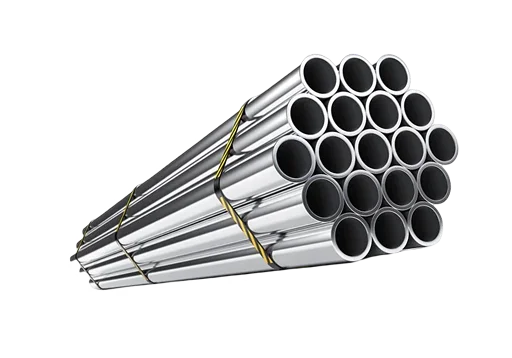
Metinox Overseas manufacturer and supplies 316 stainless steel welded pipes in the form of Electric-Fusion-Welded (EFW) pipe and Electric-Resistance-Welded (ERW) pipe for projects throughout the USA, Middle East and Africa. Welded pipe offers the most economical way to larger diameter and thinner wall, and molybdenum-bearing corrosion resistance for chloride, marine and chemical service is provided by the addition of 316/316L. This page sits under our full stainless steel welded pipes range, and for the grade overview across all forms see the SS 316/316L pipe hub.
The 316L low-carbon variant is the usual choice where the pipe is welded into a system, because low carbon resists sensitisation in the weld zone. We supply both, in sizes from half an inch to 48 inch and above, with the weld tested to the code. Send the size, schedule and quantity and the quote comes back with mill certificates and the regional approvals your project requires.

Table of Contents
- 316 stainless steel welded pipes Specification
- SS UNS 31008 Welded pipes composition
- SS 316 / 316L Welded Pipes Mechanical Properties
- Dimensions & Sizes Stainless Steel 316 / 316L Welded Pipes
- Stainless Steel DIN 1.4436 Welded Tubes Equivalent Grades
- Different Types of Stainless Steel 316 / 316L Welded Pipes
- Applications / Industry Uses of Stainless Steel 316 316L Pipes
- EFW vs ERW Welded Pipe
- 316 vs 316L for Welded Pipe
- Welded vs Seamless 316 Pipe
- Applications Across the USA, Middle East & Africa
- Quality, Testing & Certification
- Frequently Asked Questions (FAQ)
316 stainless steel welded pipes Specification
| Property | Value |
|---|---|
| Grades | TP316, TP316L (and 316Ti to order) |
| UNS | S31600 (316), S31603 (316L) |
| Specifications | ASTM A312 / ASME SA312 (welded), A358 for larger fusion-welded |
| Weld process | EFW (electric fusion welded) and ERW (electric resistance welded) |
| Size range | NPS ½ inch to 48 inch and above |
| Wall / schedule | SCH 5S, 10S, 40S, 80S and heavier; thin-wall available |
| Ends | Plain, bevelled or threaded; single or double random lengths |
| Certification | EN 10204 3.1 mill test certificate, PMI, NACE MR0175 on request |
Different Types of Stainless Steel 316 / 316L Welded Pipes

Stainless 3116 316L Welded Pipes

Stainless 3116 316L Square pipes

Stainless 3116 316L Seamless Pipes

Stainless 3116 316L Round Pipes

Stainless 3116 316L rectangular pipes
Applications / Industry Uses of Stainless Steel 316 / 316L Welded Pipes
The stainless steel 316 / 316L Welded Pipes have a high resistance to corrosion, strength and also can be used in severe environments. They find extensive application in industries.
Chemical Processing
Applied in chemical plants to transport corrosive chemicals, acids and fluids. These pipes provide extended service life, as well as, dependable performance.
Oil & Gas & Petrochemical
It is common in pipelines, refineries and petrochemical plants where pipes are required to handle the high pressure, temperature and corrosive chemicals.
Marine & Offshore
Suited to the marine and coastal setting because of very high saltwater and chloride resistance. Applied in offshore platform, shipbuilding, and seawater systems.
Heat Exchangers & Boilers
Used in heat exchangers, boilers and condensers where good heat transfer and resistance to corrosion is needed.
Food & Pharmaceuticals
Ideally used in food and pharmaceutical industries as they are hygienic, clean and are not prone to contamination.
Water Treatment
Applied in treatment and desalination plants in water as they have the capacity to resist chemical corrosion as well as saline water corrosion.
EFW vs ERW Welded Pipe
The weld process follows the size and the pressure. EFW, electric fusion welded, uses a filler and is the route for larger diameters and heavier walls, with the weld radiographed where the code requires, which is why EFW pipes cover the big-bore end of the range. ERW, electric resistance welded, makes the weld without filler by resistance heating and is the economical choice for smaller diameters and thinner walls. Both are supplied to ASTM A312, and the weld is tested to suit the class of the line. Tell us the size and pressure and the right process follows.
316 vs 316L for Welded Pipe
On a welded pipe the carbon level matters more than usual. Standard 316 can sensitise in the heat-affected zone of a weld, where chromium carbides form at the grain boundaries and leave the steel locally less corrosion-resistant. 316L, the low-carbon variant, holds carbon low enough to avoid this, which is why it is specified for welded fabrication and for any pipe that will be welded into a system. The dual-certified 316/316L grade meets both, so it is the common stock choice. For the full grade comparison see the SS 316/316L pipe hub.
Welded vs Seamless 316 Pipe
Choosing welded is usually a decision already made, and it is the right one for a large share of work: welded 316 pipe is more economical, available in larger diameters and thinner walls, and entirely suitable for lower and moderate-pressure service. Seamless is the choice where the pressure is highest or the service most critical, since it has no weld seam to test, and our stainless steel seamless pipes range covers that end. The trade-off is set out in our note on seamless vs welded stainless pipe, which is worth a look if the specification has not fixed the choice. For most large-diameter 316 lines, welded is the economical and correct answer.
Applications Across the USA, Middle East & Africa
Welded 316/316L pipe goes into the services where its corrosion resistance and larger sizes matter: desalination and water treatment across the Middle East and North Africa, chemical and petrochemical process lines, marine and coastal installations, and food, dairy and pharmaceutical plant. Because it carries molybdenum, it holds up in the chloride-laden and high-temperature conditions common to Gulf and African coastal projects where 304 would pit. It sits alongside our SS 304 welded pipe for less aggressive service and the wider stainless steel pipes range, and we supply it with the approvals and documentation that projects in these regions call for.
Quality, Testing & Certification
Every welded 316/316L pipe carries an EN 10204 3.1 mill test certificate, heat-number traceable, and the weld is tested to the code: radiography or ultrasonic on fusion-welded pipe, eddy-current or hydrostatic testing as the specification requires, with positive material identification confirming the grade. NACE MR0175 documentation for sour service and third-party witness through BV, SGS or TUV are arranged at order stage, in line with our quality policy. Pipe is marked, bundled and protected for export sea freight per our packing & dispatch standard. Send the size, schedule and quantity and the quote comes back with the certification built in.
Send Your Size, Schedule and Quantity →
Looking for Marine-Grade SS 316/316L Welded Pipes?
Choose Metinox Overseas - Your Reliable SS 316/316L Welded Pipe Manufacturer, Supplier & Exporter.
Let us support your demanding projects with quality, precision, and superior corrosion performance.
SS 316/316L Welded Pipes: FAQs
ASTM A312 TP316 and TP316L welded pipe from half an inch to 48 inch and above, in schedules from 5S and 10S through 40S and 80S and heavier, in EFW and ERW forms with thin-wall available. Larger fusion-welded pipe is supplied to A358. If a size or schedule is not listed, ask, because we make to requirement and can source to specification.
Carbon content, which matters on welded pipe. Standard 316 can sensitise in the weld heat-affected zone, where chromium carbides reduce local corrosion resistance. 316L holds carbon low enough to avoid this, so it is the choice for welded fabrication and pipe welded into a system. The dual-certified 316/316L grade meets both specifications and is the common stock choice.
The weld method. EFW, electric fusion welded, uses a filler and suits larger diameters and heavier walls, with the weld radiographed where the code requires. ERW, electric resistance welded, makes the weld without filler and is economical for smaller and thinner pipe. Both are supplied to ASTM A312 with the weld tested to the class of the line.
Welded 316 pipe is more economical and available in larger diameters and thinner walls, and is suitable for lower and moderate-pressure service, which covers a large share of work. Seamless is chosen for the highest-pressure and most critical service, since it has no weld seam. For large-diameter 316 lines, welded is usually the economical and correct choice.
Yes. We manufacture and export 316/316L welded pipe to projects across the USA, the Middle East and Africa, with EN 10204 3.1 mill certificates, weld NDE reports, positive material identification, NACE documentation where required, and export packing for sea freight. The molybdenum-bearing grade suits the chloride and high-temperature conditions common to these regions.
Enquire Now
Get pricing within 24 hours!