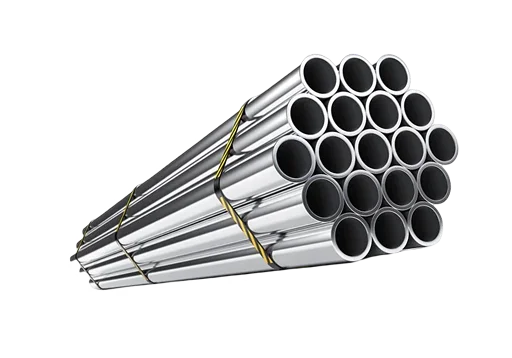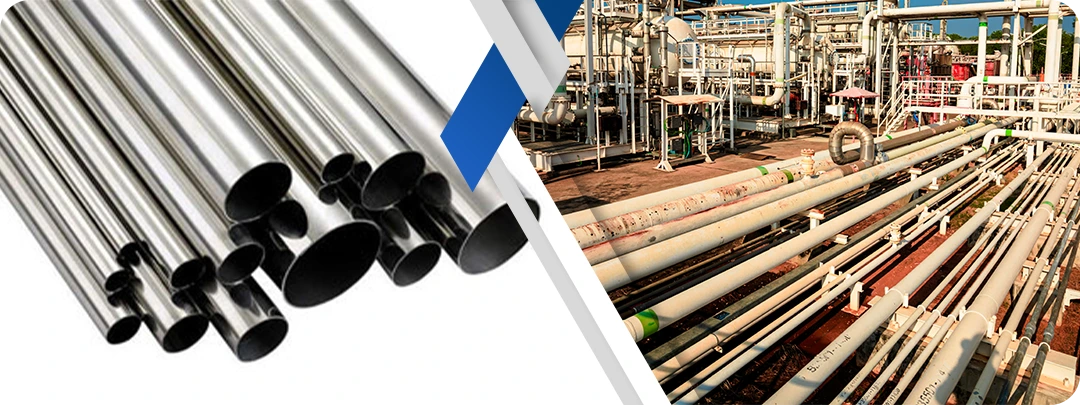
254 SMO is what you specify when chlorides have beaten every cheaper stainless and you still want to avoid nickel-alloy prices. Metinox Overseas supplies 254 SMO pipe to ASTM A312, UNS S31254, seamless and welded, with 3.1 certification and export lanes to the USA, the Middle East and Africa. It is a 6-percent-molybdenum super-austenitic stainless with nitrogen and a little copper, giving it a pitting resistance equivalent around 43 and roughly twice the yield strength of the 300-series, which is why it handles seawater and high-chloride brine that pit even 316 and 904L. It can deliver nickel-alloy and titanium-class chloride performance at a lower price point. The stainless family sits at Stainless Steel Pipes.
The comparison every buyer runs is against 904L, and it turns on chloride versus acid. See our SS 904L Pipe page for the acid side of that decision. Where chlorides run even higher, into full seawater at velocity, the step across is to Super Duplex Steel Tubes. 254 SMO owns the demanding-chloride middle.
Request a Quote on 254 SMO Pipe →
Table of content
- What 254 SMO Is: The 6-Moly Chloride Specialist
- 254 SMO vs 904L: Chloride or Acid?
- 254 SMO Chemistry & Mechanical Properties
- Welding 254 SMO: The Over-Alloyed Filler Rule
- S31254 Standards, Sizes & Forms
- 254 SMO Pipe Applications & Export to USA, Middle East & Africa
- Explore Related Ranges
- 254 SMO Pipe: Frequently Asked Questions
What 254 SMO Is: The 6-Moly Chloride Specialist
The number in the nickname is the molybdenum, and molybdenum is what buys chloride pitting resistance. At around 6 to 6.5 percent Mo, plus 0.18 to 0.22 percent nitrogen that both strengthens the alloy and sharpens its pitting resistance, 254 SMO reaches a PREN of about 43, comfortably past the 40 threshold where open seawater stops winning. The high nickel content gives it strong resistance to chloride stress corrosion cracking, and the low carbon keeps it weldable without sensitization. In halide environments, chloride, bromide and fluoride, it performs in the region where the choice would otherwise be titanium or a nickel alloy, which is exactly where its cost advantage bites.
254 SMO vs 904L: Chloride or Acid?
Both are super-austenitic and buyers confuse them constantly, but they are optimized for opposite enemies. This is the same comparison as on the 904L page, read from the chloride side.
| 254 SMO (S31254) | 904L (N08904) | |
|---|---|---|
| Molybdenum | About 6 to 6.5% | About 4 to 5% |
| Nitrogen | 0.18 to 0.22% (strength + PREN) | Low |
| Copper | 0.5 to 1% | 1 to 2% (deliberate, for acid) |
| PREN | About 43 | About 34 to 36 |
| Best at | High chloride, seawater, pitting resistance | Dilute sulphuric and phosphoric acid |
| Strength | About twice 300-series yield | Standard austenitic level |
The rule: if the main threat is chloride pitting, especially seawater or brine, 254 SMO's 6 percent molybdenum and higher PREN make it the safer choice. If the main threat is reducing acid, especially sulphuric, 904L's copper gives it the edge. Same family, opposite specialisms.
Welding 254 SMO: The Over-Alloyed Filler Rule
One fabrication rule governs 254 SMO and skipping it wastes the alloy. Because the weld metal solidifies with some segregation, a matching filler would leave the weld less corrosion resistant than the base metal, so 254 SMO is welded with an over-alloyed nickel-based filler, typically an Alloy 625 type, which raises the weld metal's molybdenum and nickel enough to match or exceed the base material's chloride resistance. It welds well by the common processes, but with matching filler the weld becomes the weak point in exactly the service the alloy was bought for. Specify the over-alloyed filler and the joint keeps the pipe's PREN.
254 SMO Pipe Applications & Export to USA, Middle East & Africa
- Seawater & Desalination: cooling systems, MSF evaporator and SWRO service, tube sheets and water boxes, the Middle East's flagship 254 SMO lane.
- Flue Gas Desulphurisation: scrubbers handling acid chlorides, USA and India.
- Offshore Oil & Gas: seawater and high-chloride process piping.
- Pulp & Paper: bleaching plant chloride service.
- Chemical & Pharmaceutical: halide-bearing process streams.
Every order ships with an EN 10204 3.1 certificate; see Quality Policy. Consolidations run from Mumbai to the USA, the Middle East and Africa per Packing and Dispatch. Made to order, typical delivery 4 to 8 weeks.
Explore Related Ranges
Get a Quote →
254 SMO Pipe: Frequently Asked Questions
A 6-percent-molybdenum super-austenitic stainless steel, UNS S31254, built for high-chloride and seawater service. Its molybdenum and nitrogen give it a PREN around 43, past the threshold where seawater pits ordinary stainless, so it is specified for seawater cooling, desalination, FGD scrubbers and offshore chloride piping. 254 SMO is a registered trademark of Outokumpu; the material is UNS S31254.
What they optimize for. 254 SMO carries about 6 percent molybdenum and nitrogen for chloride pitting resistance, PREN around 43. 904L carries deliberate copper for sulphuric and phosphoric acid resistance, PREN around 34 to 36. For chloride and seawater, choose 254 SMO; for reducing acid, choose 904L. Both are super-austenitic stainless steels.
Because the weld metal segregates as it solidifies, a matching filler would leave the weld less corrosion resistant than the pipe. An over-alloyed nickel-based filler, typically an Alloy 625 type, raises the weld's molybdenum and nickel so it matches or exceeds the base metal's chloride resistance. Without it, the weld becomes the failure point in the exact service the alloy was chosen for.
Generally yes, for equivalent chloride performance in many duties. 254 SMO delivers seawater-grade pitting resistance at a super-austenitic stainless price, which is why it is often specified as a cost-effective alternative to titanium or nickel alloys where its PREN of 43 covers the service.
Yes, made to order with 3.1 documentation, PMI on request. Middle East desalination and seawater cooling is the busiest lane, with FGD and offshore work in the USA and the Gulf, shipped from Mumbai.
Enquire Now
Get pricing within 24 hours!