SS 904L Super Austenitic Stainless Steel Flanges Manufacturer & Supplier
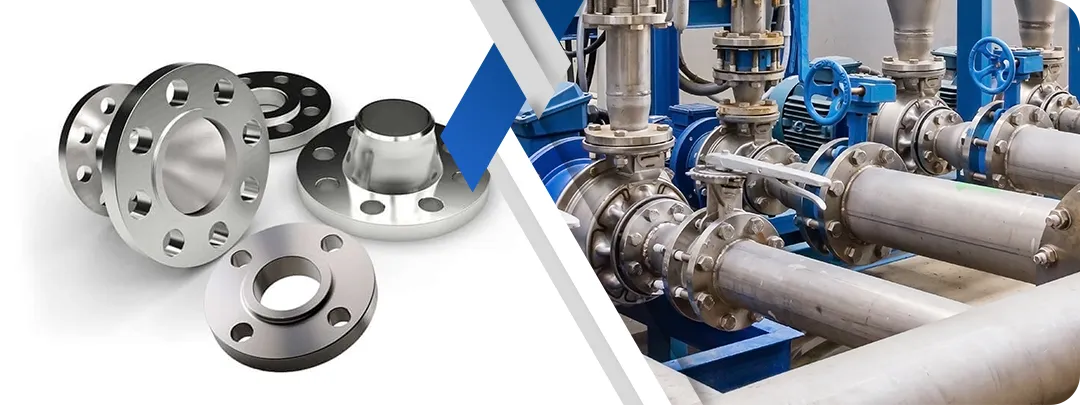
Metinox Overseas is a trusted manufacturer and distributor of SS 904L Stainless Steel Flanges, a super austenitic grade that is specifically designed to be used in very corrosive environments in which extra resistance to pitting, crevice corrosion, and stress corrosion cracking is needed. Our UNS N08904 Forged Flanges are produced using the best possible super austenitic stainless steel with controlled chemical composition with chromium (19.0-23.0%), nickel (23.0-28.0%), molybdenum (4.0-5.0%), and copper (1.0-2.0%) with minimum tensile strength of 490 Mpa and has the best corrosion resistance better than 316L in chloride environments. These Super Austenitic 904L Flanges are uniquely made to suit harsh environments of corrosive service in chemical processing, petrochemical and pharmaceutical service, wood pulp and paper service, oil and gas service, seawater service and acidic service where normal austenitic grades (304L, 316L) would fail.
Combined with molybdenum (4.0-5.0%) and copper (1.0-2.0) additions, the high nickel content (minimum 23%) gives it superior resistance to sulfuric acid, phosphoric acid, acetic acid, formic acid, and corrosion that is caused by chlorides. All our SS 904L Weld Neck Flanges, Slip-On Flanges, Blind Flanges, and Socket Weld Flanges are made in full compliance with ANSI/ASME B16.5 (1/2 to 24 NB) and ASME B16.47 Series A and B (26 to 60 NB) dimensional standards, with pressures of 150 1/2 to 600 26. All flanges are subjected to strict quality tests such as dimensional checks, PMI checks, intergranular corrosion testing, ferrite content testing, and ultrasonic testing as per ASTM A961 standards and are completely traceable and meet ASTM, ASME and NACE standards.

Table of Contents
- SS 904L Flanges Technical Specifications
- SS 904L Equivalent Grades
- SS 904L Chemical Composition
- Mechanical Properties of SS 904L Flanges
- SS 904L Flange Dimensions & Pressure Rating Chart
- Types of SS 904L Flanges Available
- Standard Flange Sizes & Weight Chart
- Is SS 904L Good Quality for Corrosive Service?
- Heat Treatment & Testing Requirements
- SS 904L Stainless Steel Flanges Price List 2026
- Applications of SS 904L Flanges in Industry
- Why Choose SS 904L Flanges from Metinox Overseas?
- SS 904L Flange Delivery Time & CIF Pricing by Country
- Other Types of SS 904L Flanges
- Popular Locations Where We Supply SS 904L Flanges
- Frequently Asked Questions (FAQ)
SS 904L Flanges Technical Specifications
| Feature | Details |
| Specifications | ASTM B564 / ASME SB564 / ASTM A182 / MSS SP-44 |
| Grade | 904L (Super Austenitic Stainless Steel) |
| UNS Number | N08904 |
| EN Number | 1.4539 |
| Werkstoff Nr. | X1NiCrMoCu25-20-5 |
| Dimensional Standards | ANSI/ASME B16.5, B16.47 Series A & B, B16.48, MSS SP-44 |
| Size Range | 1/2" (15 NB) to 60" (1500 NB) |
| Pressure Class | 150#, 300#, 600# (higher classes limited availability) |
| Flange Types | Weld Neck, Slip-On, Blind, Socket Weld, Lap Joint, Threaded, Orifice, Long Weld Neck |
| Flange Face | Raised Face (RF), Flat Face (FF), Ring Type Joint (RTJ), Male & Female, Tongue & Groove |
| Manufacturing Type | Hot Forged, Solution Annealed |
| Heat Treatment | Solution Annealing at 1100-1150-C, Rapid Quenching (Mandatory) |
| Testing | Tensile Test, Hardness Test, PMI Test, IGC Test, Ferrite Test, Ultrasonic Test |
| Inspection | Third Party Inspection by TUV, SGS, Bureau Veritas, Lloyd's, DNV GL, BV, ABS |
| Certifications | EN 10204 3.1B/3.2 MTC, NACE MR0175, PED 2014/68/EU, CE Marked, ASME B31.3 |
SS 904L Equivalent Grades
| STANDARD | USA | GERMANY | EUROPE | JAPAN | FRANCE | UK | CHINA |
|---|---|---|---|---|---|---|---|
| 904L | UNS N08904, ASTM B564, ASME SB564 | 1.4539, X1NiCrMoCu25-20-5 | EN 1.4539 | SUS 890L, NCF 890 | Z2NCDU25-20 | - | 00Cr20Ni25Mo4.5Cu |
SS 904L Chemical Composition
| Element | Composition (%) | Function |
|---|---|---|
| Carbon (C) | 0.020 max | Ultra-low carbon for IGC resistance |
| Manganese (Mn) | 2.00 max | Austenite stabilizer |
| Phosphorus (P) | 0.045 max | Controlled for corrosion resistance |
| Sulfur (S) | 0.035 max | Minimized for corrosion resistance |
| Silicon (Si) | 1.00 max | Deoxidizer |
| Chromium (Cr) | 19.0 - 23.0 | Passivation, general corrosion resistance |
| Nickel (Ni) | 23.0 - 28.0 | Excellent corrosion resistance, austenite stabilization |
| Molybdenum (Mo) | 4.0 - 5.0 | Pitting and crevice corrosion resistance |
| Copper (Cu) | 1.0 - 2.0 | Sulfuric acid resistance |
| Nitrogen (N) | 0.10 max | Strength enhancement |
| Iron (Fe) | Balance | Base metal |
Note: PREN (Pitting Resistance Equivalent Number) = %Cr + 3.3(%Mo) + 16(%N) - 35-37, significantly higher than 316L (PREN - 24-26).
Mechanical Properties of SS 904L Flanges
| Property | Requirement | Testing Standard |
|---|---|---|
| Tensile Strength | 490 MPa (71 ksi) minimum | ASTM A370 |
| Yield Strength (0.2% offset) | 220 MPa (32 ksi) minimum | ASTM A370 |
| Elongation in 2" | 35% minimum | ASTM A370 |
| Hardness (Rockwell B) | 90 HRB max (=217 HB) | ASTM E18 |
| Hardness (Brinell) | =217 HB typical | ASTM E10 |
SS 904L Flange Dimensions & Pressure Rating Chart
Pressure-Temperature Ratings for SS 904L Flanges
| Temperature -F (-C) | Class 150 | Class 300 | Class 600 |
|---|---|---|---|
| -20 to 100 (-29 to 38) | 275 psi | 720 psi | 1440 psi |
| 200 (93) | 238 psi | 620 psi | 1240 psi |
| 300 (149) | 219 psi | 571 psi | 1142 psi |
| 400 (204) | 204 psi | 532 psi | 1065 psi |
| 500 (260) | 193 psi | 503 psi | 1006 psi |
| 600 (316) | 184 psi | 481 psi | 961 psi |
| 650 (343) | 181 psi | 473 psi | 946 psi |
| 700 (371) | 179 psi | 468 psi | 936 psi |
| 750 (399) | 177 psi | 462 psi | 924 psi |
| 800 (427) | 175 psi | 458 psi | 916 psi |
Note: 904L pressure ratings slightly lower than carbon steel due to lower yield strength but adequate for corrosive service applications.
Types of SS 904L Flanges Available
- SS 904L Weld Neck Flanges (WN)
- SS 904L Slip-On Flanges (SO)
- SS 904L Blind Flanges (BL)
- SS 904L Socket Weld Flanges (SW)
- SS 904L Lap Joint Flanges (LJ)
- SS 904L Threaded Flanges (TH)
- SS 904L Orifice Flanges
- SS 904L Long Weld Neck Flanges
- SS 904L Reducing Flanges
- SS 904L Spectacle Blind Flanges
Standard Flange Sizes & Weight Chart
SS 904L Weld Neck Flange Dimensions (ANSI B16.5) - Class 150 Sample
| NPS | Outside Diameter (mm) | Thickness (mm) | Bore (mm) | Hub Dia (mm) | Bolt Circle (mm) | No. of Bolts | Bolt Dia | Approx Weight (kg) |
|---|---|---|---|---|---|---|---|---|
| 1/2" | 90 | 11 | 21 | 35 | 60 | 4 | M12 | 0.48 |
| 1" | 108 | 13 | 33 | 50 | 79 | 4 | M12 | 0.92 |
| 2" | 152 | 16 | 60 | 75 | 121 | 4 | M16 | 1.92 |
| 4" | 229 | 19 | 114 | 127 | 190 | 8 | M16 | 5.75 |
| 6" | 267 | 21 | 168 | 184 | 229 | 8 | M19 | 9.15 |
| 8" | 330 | 24 | 219 | 238 | 286 | 8 | M19 | 15.4 |
| 10" | 406 | 27 | 273 | 305 | 362 | 12 | M22 | 25.5 |
| 12" | 483 | 29 | 324 | 346 | 432 | 12 | M22 | 38.3 |
| 16" | 597 | 32 | 419 | 448 | 546 | 16 | M25 | 68.1 |
| 20" | 699 | 38 | 508 | 559 | 648 | 20 | M25 | 104.0 |
| 24" | 813 | 44 | 610 | 651 | 756 | 20 | M32 | 159.0 |
Is SS 904L Good Quality for Corrosive Service?
Yes, SS 904L is a high-grade super austenitic stainless steel grade which has a high level of corrosion resistance which is much better than standard austenitic grades (304L, 316L, 316Ti) in very corrosive environments. The composition of material, which is high nickel (23-28%), molybdenum (4.0-5.0%), and copper (1.0-2.0%), gives excellent pitting corrosion, crevice corrosion, stress corrosion cracking (SCC), and general corrosion resistance against chloride and acidic environment.
The Pitting Resistance Equivalent Number (PREN) of about 35-37 is much higher than that of 316L of 24-26 and hence it is superior to the resistance against localized corrosion. The large amount of nickel gives it superior resistance to zinafo chloride-induced SCC and molybdenum gives it superior pitting and crevice corrosion resistance. The addition of copper (1.0-2.0%)-uncharacteristic of the stainless steels- radically increases the sulfuric acid resistance and 904L is thus the material of choice in service with sulfuric acid where 316L would fail quickly.
904L exhibits excellent results in: sulfuric acid (through to boiling point in moderate concentrations), phosphoric acid, acetic acid, formic acid, mixed acids, seawater and brackish water, chloride-containing solutions, FGD (Flue Gas Desulfurization) systems and numerous organic acids. The low carbon level (0.020% max) removes the issue of sensitization and offers protection to intergranular corrosion without the necessity of stabilization elements (Ti, Nb).
The material is very strong in mechanical properties and corrosion resistance down to cryogenic temperatures to about 400-C (752-F). Although 904L costs more than 316L (2-3 times) it offers better service life and performance in harsh corrosive conditions and in many applications it removes the use of more exotic alloys such as Alloy 20, Alloy 825 or 6Mo stainless steels (254 SMO). Even more extreme environments can be upgraded to 6Mo super austenitic grades (UNS S31254, N08926) or nickel alloys (Alloy 625, C-276).
Heat Treatment & Testing Requirements
Heat Treatment Requirements
| Process | Parameter | Requirement |
|---|---|---|
| Solution Annealing (Mandatory) | Temperature | 1100-1150-C (2010-2100-F) |
| Holding Time | Adequate soaking based on section thickness | |
| Cooling | Rapid water quenching | |
| Purpose | Dissolve chromium carbides and maximize corrosion resistance | |
| Critical Requirement | Rapid quenching is essential to prevent chromium carbide precipitation; slow cooling is detrimental to corrosion resistance |
Testing & Inspection Requirements
| Test / Inspection | Standard / Requirement | Acceptance / Remarks |
|---|---|---|
| Tensile Testing | ASTM A370 | Yield strength, tensile strength, elongation |
| Hardness Testing | Rockwell B or Brinell | = 90 HRB (= 217 HB) |
| PMI Testing | Positive Material Identification | Verification of Ni, Cr, Mo, Cu content |
| Intergranular Corrosion (IGC) Test | ASTM A262 Practice E | Mandatory for critical service |
| Ferrite Content Measurement | As specified (e.g., Ferritscope) | Typically 0-3% delta ferrite (fully austenitic preferred) |
| Ultrasonic Testing | ASTM A388 | When specified |
| Corrosion Testing | Critical Pitting Temperature (CPT) | When specified for severe environments |
SS 904L Stainless Steel Flanges Price List 2026
| Flange Type | Size Range | Pressure Class | Indicative Price Range (USD/Piece) |
|---|---|---|---|
| Weld Neck (WN) | 1/2" - 2" | 150# | 45 - 125 |
| Weld Neck (WN) | 4" - 8" | 150# | 185 - 750 |
| Weld Neck (WN) | 10" - 24" | 150# | 1,150 - 4,250 |
| Weld Neck (WN) | 1/2" - 2" | 300# | 65 - 185 |
| Weld Neck (WN) | 4" - 8" | 300# | 295 - 1,150 |
| Weld Neck (WN) | 10" - 24" | 300# | 1,680 - 6,200 |
| Weld Neck (WN) | 1/2" - 2" | 600# | 95 - 275 |
| Weld Neck (WN) | 4" - 8" | 600# | 450 - 1,680 |
| Slip-On (SO) | 1/2" - 2" | 150# | 38 - 105 |
| Slip-On (SO) | 4" - 8" | 150# | 155 - 620 |
| Slip-On (SO) | 10" - 24" | 150# | 950 - 3,550 |
| Blind (BL) | 1/2" - 2" | 150# | 35 - 95 |
| Blind (BL) | 4" - 8" | 150# | 165 - 685 |
| Socket Weld (SW) | 1/2" - 2" | 150# - 600# | 52 - 225 |
Note: SS 904L flanges are typically 250-350% higher than 316L and 400-500% higher than carbon steel due to high nickel, molybdenum, and copper content.
Applications of SS 904L Flanges in Industry
Chemical Processing
Sulfuric acid, phosphoric acid, acetic acid, formic acid.
Pulp and Paper
Recovery black liquor, Bleach plants, chlorine dioxide systems, white liquor.
Oil / Gas
Sea water injection systems, manufactured water treatment, sour gas scrubbing systems, FGD.
Petrochemical
Production of Terephthalic acid (PTA/PET), distillation of acetic acid, streams of corrosive process.
Pharmaceutical
Manufacturing API, fermentation, acidic, handling of media, clean-in-place (CIP) systems.
Seawater
Marine, brackish water, offshore platform, seawater desalination, seawater.
Flue Gas Desulfurization
FGD absorber systems, wet scrubbers, acid condensers.
Food Processing
High-chloride food processing, pickling, manufacturing vinegar.
Mining
Hydrometallurgical, acid leaching, heap leach solutions.
Power Generation
FGD systems, cooling sea water, condenser systems.
Why Choose SS 904L Flanges from Metinox Overseas?
Metinox Overseas manufactures certified SS 904L super austenitic stainless steel flanges with compulsory solution annealing, full chemistry checking and assured corrosive protection against the most challenging corrosive environments all over the world. Our PED and ISO 9001:2015 certified plants guarantee all 904L flanges receive the correct annealing at the temperature of 1100-1150-C and then they are rapidly quenched in water and the heat treatment is recorded.
Each flange is supplied with EN 10204 3.1B or 3.2 Mill Test Certificates with complete chemical analysis (Ni (23-28) Cr (19-23) Mo (4.0-5.0) and Cu (1.0-2.0)) being precisely checked, tensile test, hardness values =217 HB, ferrite content measurement and compliance statements. We offer compulsory IGC testing ASTM A262 Practice E to critical corrosive service, PMI testing by XRF spectroscopy to verify super austenitic composition and CPT (Critical Pitting Temperature) testing on demand.
NABL-certified laboratory: our laboratory offers full scope of corrosion testing such as intergranular corrosion testing, measurement of ferrite content, microscopy test to ensure that no harmful phases are present and CPT in chloride solution. We have certified reference materials that are verified against chemicals.
Our technical team has extensive experience with the supply of 904L flanges in sulfuric acid facilities, in FGD facilities, in seawater systems, and in the corrosive chemical processing industry worldwide, and is therefore well-informed to guide customers on the selection of 904L versus 316L versus Alloy 20 versus 6Mo material, welding procedures with AWS A5.9 ER385 (904L filler) or ERNiCrMo-3 (Alloy 625), corrosion testing needs per ASTM. Providing nitrogen based service applications to chemical processors, pulp and paper mills, oil and gas operators, pharmaceutical companies, and marine in more than 60 countries supplying high quality assurance with reliable delivery of premium quality nitrogen based service applications demanded by customers in mission critical service applications.
SS 904L Flange Delivery Time & CIF Pricing by Country
| Destination Region | Major Ports / Cities | Estimated Delivery Time | Typical CIF Terms |
|---|---|---|---|
| Middle East (GCC) | Dubai, Dammam, Doha, Muscat | 12-16 Days | CIF Dubai / CIF Dammam |
| Europe | Rotterdam, Hamburg, Antwerp | 26-32 Days | CIF Rotterdam / CIF Hamburg |
| USA & Canada | Houston, New York, Los Angeles | 32-40 Days | CIF Houston / CIF New York |
| Southeast Asia | Singapore, Port Klang, Manila | 16-22 Days | CIF Singapore / CIF Port Klang |
| Africa | Lagos, Durban, Mombasa | 22-30 Days | CIF Lagos / CIF Durban |
Other Types of SS 904L Flanges
SS 904L Stainless Steel Flanges, UNS N08904 Flanges, 1.4539 Flanges, Super Austenitic 904L Weld Neck Flanges, 904L Slip-On Flanges, 904L Blind Flanges, 904L Socket Weld Flanges, 904L Lap Joint Flanges, 904L Threaded Flanges, 904L RTJ Flanges, 904L Orifice Flanges, 904L Spectacle Blind Flanges.
Popular Locations Where We Supply SS 904L Flanges
ss 904l flanges supplier in singapore, 904l stainless steel flanges suppliers in qatar, uns n08904 flanges suppliers in uae, ss 904l flanges suppliers in chennai, 904l weld neck flanges in mumbai, 904l blind flanges in delhi, super austenitic 904l flanges exporter, 904l flanges price list.
People Also Search For
ss 904l stainless steel flanges manufacturer, uns n08904 flanges supplier, 1.4539 flanges exporter, 904l weld neck flanges, super austenitic 904l flanges, 904l vs 316l difference, 904l flanges price list 2026, 904l sulfuric acid flanges, 904l seawater flanges.
Looking for High-Quality SS 904L Flanges?
Let us support your projects with quality, precision, and performance.
Frequently Asked Questions (FAQ)
The grade 904L is a hyper austenitic alloy with much more nickel (23-28% vs 10-14%), molybdenum (4-5% vs 2-3) and also copper (1-2%). PREN of 904L is 35-37 vs 24-26 of 316L, which gives much better pitting, crevice and SCC resistance. 904L is 2-3 times more expensive but is necessary in extreme corrosive service where 316L has failed.
Yes, 904L is the better stainless steel to be used in service of sulfuric acid because of the copper (1-2%). It has great resistance to sulfuric acid in all concentration levels up to boiling point in moderate concentrations. Applied extensively in the sulfuric acid plants where the 316L would easily rot.
Solution annealing at 1100-1150-C and then rapid water quenching is of necessity. This breaks down chromium carbides and gives maximum resistance to corrosion. Sensitization is avoided by ultra-low carbon (0.020% maximum). The slow cooling process is unfavorable and lowering the resistance to corrosion.
AWS A5.9 ER385 (equivalent to 904L composition) or ERNiCrMo-3 (Alloy 625 filler). GTAW was used in preference in root passes, GMAW in fill. No preheat required. No requirement of post-weld heat treatment because of ultra-low carbon. Keep interpass temperature to less than 150-C so as to avoid sensitization.
Yes, 904L has very good seawater, brackish water, chloride-containing environment. High PREN (35-37) means that it can resist pitting and crevice corrosion. Commonly applied in seawater injection, desalination, offshore platforms and marine applications where pitting occurs on 316L.
Both are super austenitic corrosive service grades with 904L having a higher molybdenum (4-5% vs 2-3%), copper (1-2%), pitting resistance and sulfuric acid resistance. Alloy 20 contains more chromium (20% vs 19-23%) and is stabilized with niobium, is used primarily in chloride and sulfuric acid; Alloy 20 in mixed acids.
ASTM A262 Practice E IGC (Intergranular Corrosion) testing is used to commonly test critical corrosive service to determine that it has been properly heat treated and not sensitized. Though the lowest possible carbon content (0.020% maximum) is the least risk, after fabrication, the corrosion resistance is confirmed by testing.
Can operate up to about 400-C (752-F) continuously to be resistant to corrosion. Incorporation of crusts of chromium carbide can happen at temperatures above this level and corrosion resistance can be decreased. In cases of a high temperature, duplex or super duplex stainless steels can be considered.
Yes there is 904L with a very good resistance to the chlorine dioxide (ClO2) that is used in bleaching pulp. This is highly oxidizing chlorine compound and the level of nickel and molybdenum in it makes it resistant. Common in new ECF (Elemental Chlorine-Free) types of bleach plants.
Small quantity of common sizes (1/2 -4" NB, Class 150/300). Made-to-order 8-12 weeks with material purchase (high Ni-Mo-Cu content), forging, solution annealing, rapid quenching, mechanical test, IGC test, and documentation. Categories of expedited service are offered with lead time of 5-6 weeks to serve urgent corrosive services.
Enquire Now
Get pricing within 24 hours!