Nickel 200 Pure Nickel Flanges Manufacturer & Supplier
Metinox Overseas is a pioneer manufacturer and distributor of Nickel 200 Flanges, pure nickel (99.6% minimum) specially designed to be used in the designing of the flanges that do not respond to any corrosion under the reducing environment along with caustic alkalies and the high temperature oxidizing condition. Our UNS N02200 Forged Flanges are produced of high grade commercially pure nickel of controlled chemical composition, which contains nickel and cobalt (99.0% minimum), carbon (0.15% maximum) and negligible alloying elements which provides minimum tensile strength of 380 Mpa, good ductile properties and excellent corrosion resistance both in caustic and reducing as well as neutral conditions. These Pure Nickel 200 Flanges are exceptionally high performance in sodium hydroxide (caustic soda), hydrofluoric acid, elemental fluorine, dry chlorine and hydrogen chloride gases, molten caustic salts and high temperature neutral or reducing atmospheres, where stainless steels fail.
The purity of nickel (at least 99.0% Ni + Co) gives outstanding resistance to corrosion in all concentrations and temperatures by caustic alkalies, thus Nickel 200 is the preferred material used in the process of producing and handling caustic soda. We make our Nickel 200 Weld Neck Flanges, Slip-On Flanges, Blind Flanges, and Socket Weld Flanges with compliance to ANSI/ASME B16.5 (1/2 to 24 NB) and ASME B16.47 Series A and B (26 to 60 NB) dimensional standards and they are available in pressure classes of 150 to 600 pounds. All the flanges are ordered in the annealed form (stress-relieved at 870-1090 o C) and are stringently quality tested in terms of dimensional, PMI, tensile, hardness, and ultrasonic testing as per ASTM B564 requirements.

Table of Contents

- Nickel 200 Flanges Technical Specifications
- Nickel 200 Equivalent Grades
- Nickel 200 Chemical Composition
- Mechanical Properties of Nickel 200 Flanges
- Nickel 200 Flange Dimensions & Pressure Rating Chart
- Types of Nickel 200 Flanges Available
- Standard Flange Sizes & Weight Chart
- Is Nickel 200 Good Quality for Caustic Service?
- Heat Treatment & Testing Requirements
- Nickel 200 Pure Nickel Flanges Price List 2026
- Applications of Nickel 200 Flanges in Industry
- Why Choose Nickel 200 Flanges from Metinox Overseas?
- Nickel 200 Flange Delivery Time & CIF Pricing by Country
- Other Types of Nickel 200 Flanges
- Popular Locations Where We Supply Nickel 200 Flanges
- Frequently Asked Questions (FAQ)
Nickel 200 Flanges Technical Specifications
| Feature | Details |
| Specifications | ASTM B564 / ASME SB564 / ASTM B160 / ASME SB160 / DIN 2.4066 |
| Grade | Nickel 200 (Commercially Pure Nickel) |
| UNS Number | N02200 |
| DIN/EN Number | 2.4066 / NiCu30Fe (similar) |
| Werkstoff Nr. | 2.4066 |
| Dimensional Standards | ANSI/ASME B16.5, B16.47 Series A & B, B16.48, MSS SP-44 |
| Size Range | 1/2" (15 NB) to 60" (1500 NB) |
| Pressure Class | 150#, 300#, 600# (higher classes limited availability) |
| Flange Types | Weld Neck, Slip-On, Blind, Socket Weld, Lap Joint, Threaded, Orifice, Long Weld Neck |
| Flange Face | Raised Face (RF), Flat Face (FF), Ring Type Joint (RTJ), Male & Female, Tongue & Groove |
| Manufacturing Type | Hot Forged, Annealed |
| Heat Treatment | Annealed (Stress-Relieved) at 870-1090-C (Mandatory) |
| Testing | Tensile Test, Hardness Test, PMI Test, Grain Size, Ultrasonic Test |
| Inspection | Third Party Inspection by TUV, SGS, Bureau Veritas, Lloyd's, DNV GL, BV, ABS |
| Certifications | EN 10204 3.1B/3.2 MTC, NACE MR0175, PED 2014/68/EU, CE Marked, ASME B31.3 |
Nickel 200 Equivalent Grades
| STANDARD | USA | GERMANY | EUROPE | FRANCE | UK | RUSSIA | JAPAN |
| Nickel 200 | UNS N02200 ASTM B564 ASME SB564 |
2.4066 NiCu30Fe |
EN 2.4066 | NU-30M | NA11 | ??2 | NW2200 |
Note: Nickel 200 is pure nickel with 0.15% max carbon. Nickel 201 (UNS N02201) is low-carbon version with 0.02% max carbon for improved resistance to graphitization above 315-C.
Nickel 200 Chemical Composition
The detailed composition of this material is given in the following table.
| Element | Composition (%) | Function |
| Nickel + Cobalt (Ni+Co) | 99.0 minimum | Base metal, provides corrosion resistance (Co counted as Ni) |
| Carbon (C) | 0.15 max | Controlled for high-temperature service |
| Manganese (Mn) | 0.35 max | Trace element |
| Iron (Fe) | 0.40 max | Impurity, controlled low |
| Sulfur (S) | 0.010 max | Minimized for hot workability |
| Silicon (Si) | 0.35 max | Trace element |
| Copper (Cu) | 0.25 max | Impurity, controlled low |
Note: Nickel 200 is >99% pure nickel (Ni+Co). Carbon limited to 0.15% max (vs 0.02% max for Nickel 201). Higher carbon acceptable for service below 315-C (600-F).
Mechanical Properties of Nickel 200 Flanges
| Property | Annealed Condition | Testing Standard |
| Tensile Strength | 380 - 550 MPa (55-80 ksi) | ASTM E8 |
| Yield Strength (0.2% offset) | 105 - 275 MPa (15-40 ksi) | ASTM E8 |
| Elongation in 2" | 40% minimum (typically 45-55%) | ASTM E8 |
| Hardness (Rockwell B) | 60-90 HRB (120-180 HB) | ASTM E18 |
| Hardness (Brinell) | 120-180 HB typical | ASTM E10 |
Note: Nickel 200 is soft and ductile in annealed condition, providing excellent formability and cold working characteristics.
Nickel 200 Flange Dimensions & Pressure Rating Chart
Pressure-Temperature Ratings for Nickel 200 Flanges
| Temperature -F (-C) | Class 150 | Class 300 | Class 600 |
|---|---|---|---|
| -20 to 100 (-29 to 38) | 275 psi | 720 psi | 1440 psi |
| 200 (93) | 238 psi | 620 psi | 1240 psi |
| 300 (149) | 219 psi | 571 psi | 1142 psi |
| 400 (204) | 204 psi | 532 psi | 1065 psi |
| 500 (260) | 193 psi | 503 psi | 1006 psi |
| 600 (316) | 184 psi | 481 psi | 961 psi |
Note: Nickel 200 suitable to 315-C (600-F). Above 315-C, use Nickel 201 (low-carbon) to prevent graphitization embrittlement.
Types of Nickel 200 Flanges Available
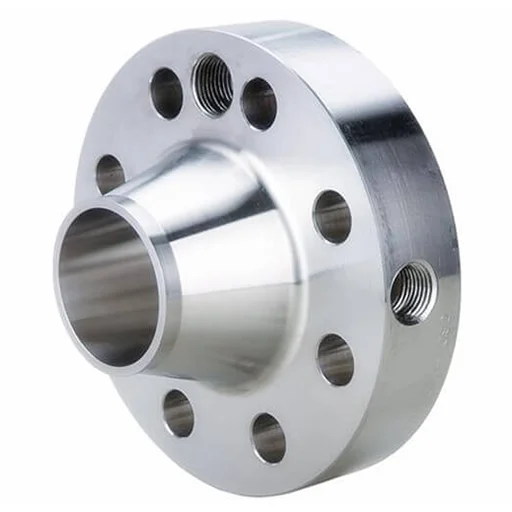
Nickel 200 Orifice Flange
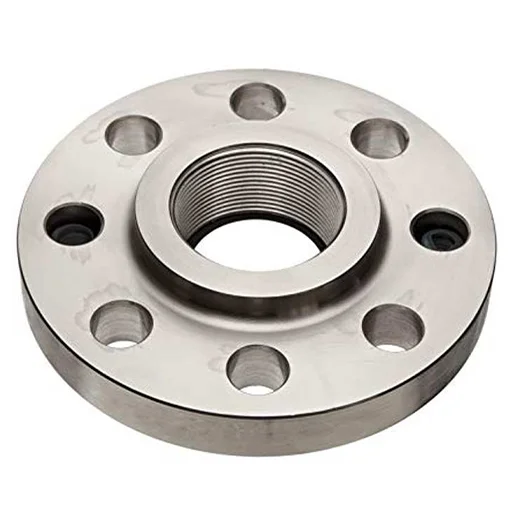
Nickel 200 Threaded Flange
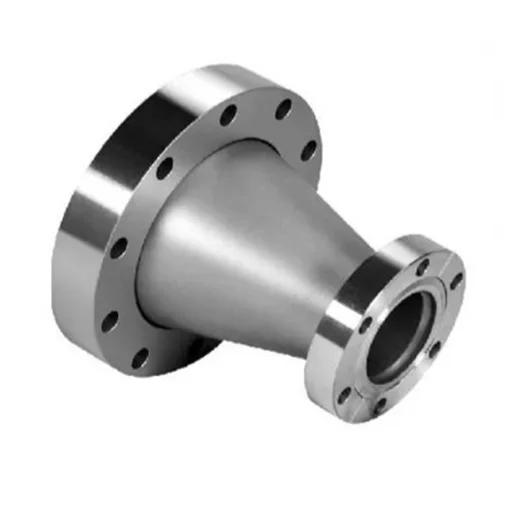
Nickel 200 Reducing Flange
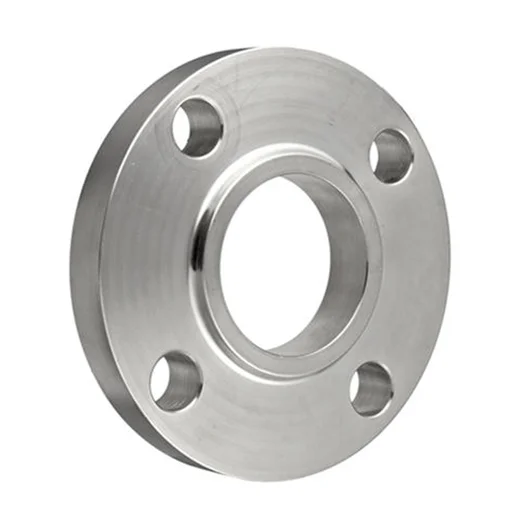
Nickel 200 Lap Joint Flange
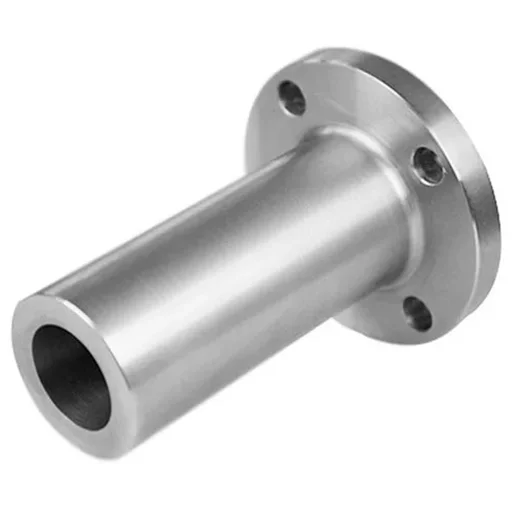
Nickel 200 Long Weld Neck Flange
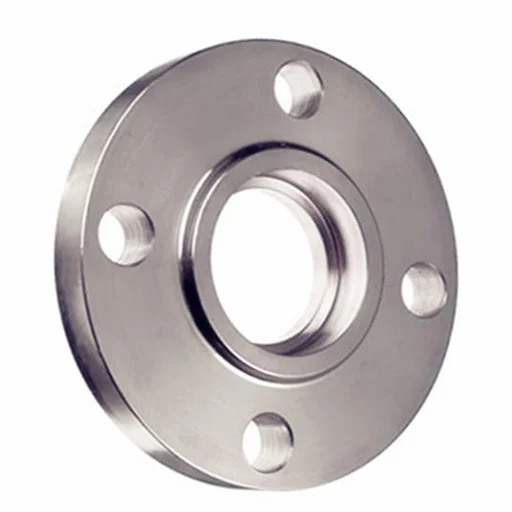
Nickel 200 Socket Weld Flange
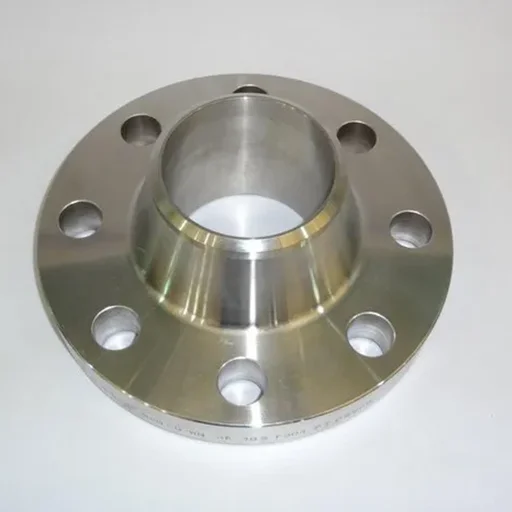
Nickel 200 Weld Neck Flange
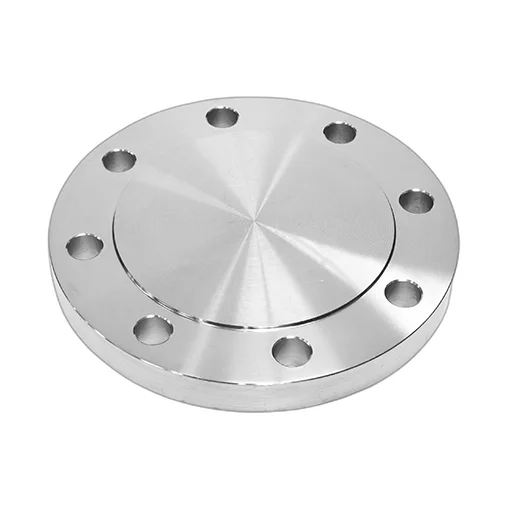
Nickel 200 Blind Flange
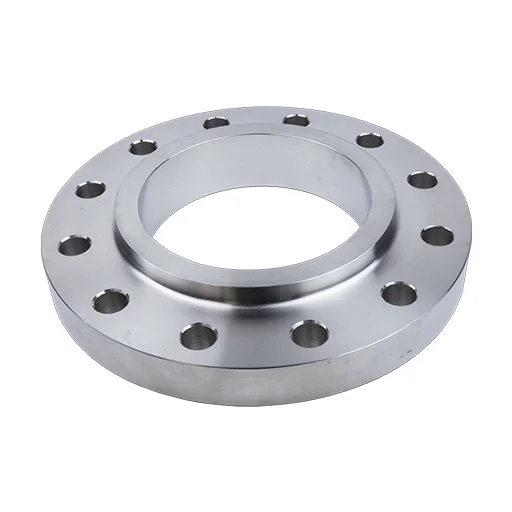
Nickel 200 Slip-On Flange
Standard Flange Sizes & Weight Chart
Nickel 200 Weld Neck Flange Dimensions (ANSI B16.5) - Class 150 Sample
| NPS | Outside Diameter (mm) | Thickness (mm) | Bore (mm) | Hub Dia (mm) | Bolt Circle (mm) | No. of Bolts | Bolt Dia | Approx Weight (kg) |
|---|---|---|---|---|---|---|---|---|
| 1/2" | 90 | 11 | 21 | 35 | 60 | 4 | M12 | 0.52 |
| 1" | 108 | 13 | 33 | 50 | 79 | 4 | M12 | 1.00 |
| 2" | 152 | 16 | 60 | 75 | 121 | 4 | M16 | 2.08 |
| 4" | 229 | 19 | 114 | 127 | 190 | 8 | M16 | 6.25 |
| 6" | 267 | 21 | 168 | 184 | 229 | 8 | M19 | 9.95 |
| 8" | 330 | 24 | 219 | 238 | 286 | 8 | M19 | 16.8 |
| 10" | 406 | 27 | 273 | 305 | 362 | 12 | M22 | 27.8 |
| 12" | 483 | 29 | 324 | 346 | 432 | 12 | M22 | 41.7 |
| 16" | 597 | 32 | 419 | 448 | 546 | 16 | M25 | 74.2 |
| 20" | 699 | 38 | 508 | 559 | 648 | 20 | M25 | 112.0 |
| 24" | 813 | 44 | 610 | 651 | 756 | 20 | M32 | 173.0 |
Note: Density of Nickel 200 is 8.89 g/cm-, slightly denser than stainless steel (7.9-8.0 g/cm-).
Is Nickel 200 Good Quality for Caustic Service?
Yes, the industry-standard material of production and handling of caustic soda (sodium hydroxide) is called Nickel 200, which has superior anticorrosion properties in caustic alkalies of all concentrations and temperatures. The large percent of nickel (not less than 99.0% Ni+Co) is what provides high performance in reducing and neutral operating conditions where stainless steels and other common alloys are rapidly corroded.
The exceptional resistance to sodium hydroxide (NaOH) concentration range between dilute and molten (100%) as well as ambient to 370-C temperature range makes nickel 200 highly vital in chlor-alkali plants, caustic soda production facilities, and in caustic handling systems across the chemical processing industries. The material has low rates of corrosion (<0.1 mm/year) in hot concentrated caustic solutions in which stainless steels would quickly dissolve.
It is also highly resistant to: hydrofluoric acid (all concentrations), elemental fluorine and fluorine compounds, dry chlorine and hydrogen chloride gases (of importance in chlor-alkali industry), reducing acids devoid of oxidizing contaminants, high temperature water and steam (non-oxidizing), molten caustic salts, and neutral or reducing atmospheres at high temperature. Nickel 200 is especially praised to be resistant to stress corrosion cracking in hot caustic solutions, which is a failure mode that occurs with austenitic stainless steels.
The good ductility and formability of Nickel 200 under the annealed state make it easy to obtain complex equipment. Most of the traditional methods of joining can be used with the material which can be hot or cold worked, welded, brazed and joined. Although there are some drawbacks to Nickel 200: not resistant to oxidizing acids (nitric acid, hot sulfuric acid), oxidizing salts, damp halogen gases (wet chlorine rapidly attacks), or ammonia environments above 50o C.
The most important factor that Nickel 200 must take into account is the maximum maximum temperature of service up to 315 C (600 F). At temperatures above 315 o C, carbon in the alloy may be precipitated as graphite at grain boundaries, leading to severe embrittlement which is referred to as graphitization. Nickel 201 (low-carbon, with 0.02 percent maximum carbon) is required to eliminate this phenomenon at service above 315 o C.
Nickel 200 was used in: chlor-alkali plant caustic evaporators and concentrators, caustic soda storage and handling systems, hydrofluoric acid production and handling, fluorine and fluorine compound processing, chemical processing equipment handling caustic or reducing environment, food processing equipment (pure nickel approved to food contact), high temperature furnace components in reducing atmosphere. The material is the best performance in caustic and reducing conditions where its special characteristics would warrant high prices (usually 8-15 times higher than 316L stainless steel).
Heat Treatment & Testing Requirements
Heat Treatment Process (Mandatory):
Annealing (Stress Relief):
- Temperature: 870-1090-C (1600-2000-F)
- Holding Time: Adequate soaking based on thickness
- Cooling: Air cool or water quench (both acceptable)
- Purpose: Stress relief, grain size control, optimize ductility
Note: Nickel 200 supplied in annealed condition. No solution annealing required as material is single-phase FCC (face-centered cubic).
Testing Requirements:
- Tensile Testing: Tensile 380-550 MPa, yield 105-275 MPa, elongation =40%
- Hardness Testing: 60-90 HRB (120-180 HB) typical
- PMI Testing: Verify Ni+Co =99.0%, carbon =0.15%, low Fe, Cu impurities
- Chemical Analysis: Product analysis to confirm pure nickel composition
- Grain Size: ASTM grain size determination when specified
- Ultrasonic Testing: Per ASTM B564 for critical applications
- Hydrostatic Testing: When specified per code requirements
Nickel 200 Pure Nickel Flanges Price List 2026
| Flange Type | Size Range | Pressure Class | Indicative Price Range (USD/Piece) |
|---|---|---|---|
| Weld Neck (WN) | 1/2" - 2" | 150# | $185 - $485 |
| Weld Neck (WN) | 4" - 8" | 150# | $750 - $3,050 |
| Weld Neck (WN) | 10" - 24" | 150# | $4,620 - $16,800 |
| Weld Neck (WN) | 1/2" - 2" | 300# | $275 - $715 |
| Weld Neck (WN) | 4" - 8" | 300# | $1,150 - $4,650 |
| Weld Neck (WN) | 10" - 24" | 300# | $6,800 - $24,500 |
| Weld Neck (WN) | 1/2" - 2" | 600# | $410 - $1,050 |
| Weld Neck (WN) | 4" - 8" | 600# | $1,720 - $6,800 |
| Slip-On (SO) | 1/2" - 2" | 150# | $155 - $405 |
| Slip-On (SO) | 4" - 8" | 150# | $625 - $2,550 |
| Slip-On (SO) | 10" - 24" | 150# | $3,850 - $14,000 |
| Blind (BL) | 1/2" - 2" | 150# | $140 - $370 |
| Blind (BL) | 4" - 8" | 150# | $680 - $2,750 |
| Socket Weld (SW) | 1/2" - 2" | 150# - 600# | $205 - $850 |
Note: Nickel 200 flanges are typically 800-1200% higher than 316L due to high pure nickel content. Prices fluctuate with London Metal Exchange (LME) nickel prices.
Applications of Nickel 200 Flanges in Industry
The Nickel 200 Pure Nickel Flanges are commonly used in many industrial applications, and some of the common industries are given below.
Chlor-Alkali Plants
Caustic soda evaporators, concentrators, caustic storage, chlorine drying towers
Caustic Handling
NaOH production, storage tanks, transfer lines, caustic scrubbers, neutralization systems
Chemical Processing
Hydrofluoric acid production and handling, fluorine gas systems, reducing acid environments
Food Processing
Food-grade equipment, dairy processing, beverage production (pure nickel FDA approved)
Electronics
Semiconductor manufacturing, electroplating, battery production
Aerospace
Rocket engine components, gas turbine parts, high-temperature furnace fixtures
Pharmaceuticals
API manufacturing equipment, process vessels, clean-in-place systems
Salt Production
Salt crystallizers, brine evaporators, salt handling equipment
Soap Manufacturing
Caustic handling in soap production, fat splitting operations
Synthetic Fiber
Rayon production (caustic mercerization), fiber processing with caustic
Why Choose Nickel 200 Flanges from Metinox Overseas?
Metinox Overseas introduces certified Nickel 200 pure nickel flanges with minimum Ni + Co content of 99.0, which is required to be annealed, and is fully traceable and used in demanding caustic environment and reducing environment applications. All Nickel 200 flanges are annealed at 870-1090 C with recorded heat treatment documentation which is certified by ISO 9001:2015.
Each flange comes with EN 10204 3.1B or 3.2 Mill Test Certificates with complete chemical analysis with Ni + Co 99.0 or less, carbon 0.15 or less, Fe 0.40 or less, Cu 0.25 or less verified, tensile property of tensile 380-550 MPa and compliance ASTM B564. We also offer PMI testing through XRF that is used to confirm pure nickel composition, determine grain size when specified and traceability to virgin nickel cathode material.
Our technical team provides professional advice on the selection of Nickel 200 vs Nickel 201 (maximum temperature of 315 C of N02200), welding practice, corrosion resistance information of caustic concentration and temperature, and NACE MR0175 compliance of sour service. Having vast experience in providing Nickel 200 flanges to chlor-alkali plants, caustic producers, and chemical processors throughout the globe, we guarantee high quality of the perfectly required caustic handling requirements.
Supply to the chlor-alkali manufacturers, chemical processors, food and pharmaceutical manufacturers, and specialty chemical plants in more than 60 countries with stable supply even when the nickel market is volatile.
Nickel 200 Flange Delivery Time & CIF Pricing by Country
| Destination Region | Major Ports / Cities | Estimated Delivery Time | Typical CIF Terms |
|---|---|---|---|
| Middle East (GCC) | Dubai, Dammam, Doha | 16-20 Days | CIF Dubai / CIF Dammam |
| Europe | Rotterdam, Hamburg | 30-38 Days | CIF Rotterdam / CIF Hamburg |
| USA & Canada | Houston, New York | 38-48 Days | CIF Houston / CIF New York |
| Southeast Asia | Singapore, Port Klang | 20-28 Days | CIF Singapore / CIF Port Klang |
| Africa | Lagos, Durban | 28-38 Days | CIF Lagos / CIF Durban |
Other Types of Nickel 200 Flanges
Nickel 200 Pure Nickel Flanges, UNS N02200 Flanges, Commercially Pure Nickel Flanges, Nickel 200 Weld Neck Flanges, Nickel 200 Slip-On Flanges, Nickel 200 Blind Flanges, Nickel 200 Socket Weld Flanges, Nickel 200 Caustic Flanges.
Popular Locations Where We Supply Nickel 200 Flanges
nickel 200 flanges supplier in singapore, uns n02200 flanges suppliers in qatar, pure nickel flanges suppliers in uae, nickel 200 flanges suppliers in chennai, nickel 200 weld neck flanges in mumbai, nickel 200 caustic flanges.
People Also Search For
nickel 200 pure nickel flanges manufacturer, uns n02200 flanges supplier, nickel 200 vs nickel 201 difference, nickel 200 caustic flanges, nickel 200 flanges price list 2026, nickel 200 hydrofluoric acid flanges.
Looking for High-Quality Nickel 200 Flanges?
Let us support your projects with quality, precision, and performance.
Frequently Asked Questions (FAQ)
0.15% max carbon Nickel 200; 0.02% max carbon Nickel 201 (low-carbon). Both are 99.0% min Ni+Co. Nickel 200 appropriate to 315degC (600degF); beyond 315degC Nickel 201 should be utilized to inhibit graphitization embrittlement. Below 315deg C, either grade acceptable; Nickel 200 less costly and more easily accessible.
Carbon in Nickel 200 forms at grain boundaries at temperatures going above 315degC (600degF) forming a vicious circle of embrittlement and intergranular fissures. Such graphitization renders the material brittle and liable to failure. Nickel 201 (max carbon 0.02% max) inhibits this effect, which is serviceable to 650degC.
Yes, Nickel 200 offers good service under sodium hydroxide (NaOH) at all dilute levels (0.01M) up to 100 percent molten caustic, and under ambient temperature to 370degC. The rate of corrosion is normally less than 0.1 mm/year in hot concentrated caustic. Chlor-alkali plant industry standard.
No. Nickel 200 NOT oxidizing acid (nitric acid, hot sulfuric acid with oxidizing salts) resistant. Only used in the reduction of acids (hydrofluoric acid) or non-oxidizing. Pure nickel corrodes very fast in oxidizing environments.
filler It is standard matching filler of AWS A5.14 ERNi-1 (commercially pure nickel). GTAW (TIG) favored high quality welds. GMAW (MIG) acceptable. No preheat required. Stress relief Welders recommend post-weld at 870-1090degC to ensure corrosion resistance. Welding Do not oxidize the weld atmospheres.
No, Nickel 200 NOT to be used above 50 deg C or anhydrous ammonia. Ammonia environment practices stress corrosion cracking in nickel. In the case of ammonia service, copper alloys (70-30 Cu-Ni) or carbon steel should be used.
Nickel 200 is a weakly magnetic material at room temperature, but it is non-magnetic at a temperature higher than its Curie temperature (358 deg C/676 deg F). Ferromagnetic but low-coercivity pure nickel. Not generally a consideration of process equipment.
Monel 400 (UNS N04400, 67Ni-30Cu) is a copper-added material which offers superior resistance to hydrofluoric acid, seawater, and sulfuric acid. Nickel 200 of high grade in the caustic service and pure reducing conditions. Monel 400 more general; Nickel 200 best where it is to be used with caustic.
Yes Nickel 200 is a good cold forming annealed alloy. May be cold drawn, spun, stamped or formed. Work becomes moderately hard during cold working. In between cold working, intermediate anneals at 870-1090degC are used to regain the ductility.
low supply owing to expensive nature and specialisation. Made-to-order: 12-16 weeks with the virgin nickel cathode procurement, melting and refining to 99.0 percent min purity, forging, 870 -1090degC annealing, mechanical testing, chemical analysis verification, and documentation. The Lead times depend on the LME nickel market conditions and availability of nickel cathodes in the world.
Enquire Now
Get pricing within 24 hours!