Duplex 2304 Lean Duplex Stainless Steel Flanges Manufacturer & Supplier
Metinox Overseas, one of the market leaders in production and distribution of Duplex 2304 Stainless Steel Flanges is a cost effective lean duplex grade that is specifically designed to operate in moderately corrosive environments where higher-strength and moderate corrosion resistance is necessary and costly 316L austenitic stainless steel is used. Our UNS S32304 Forged Flanges are produced of high quality lean duplex stainless steel of controlled chemical composition with chromium (21.5-24.5%), nickel (3.0-5.5%), molybdenum (0.05-0.60%), and nitrogen (0.05-0.20%) that provides minimum tensile strength of 600 MPa, yield strength of 400 Mpa, and good corrosion resistance with PREN. These Lean Duplex 2304 Flanges are an equal portion of ferritic and austenitic microstructure (40-60% ferrite) which is half as strong as 316L, with the best stress corrosion cracking resistance, and are suitable in the water treatment, chemical processing, architectural, structural components, food processing and moderate chloride environments where 316L offers marginal service but full super duplex grades such as 2507 are overspecified.
The reduced content of nickel (3-5.5% compared to 10-14% in 316L) and low molybdenum (less than 0.6%), as well as higher superior strength (400 Mpa yield compared to 220 Mpa in 316L) and chloride SCC resistance, make 2304 much more cost effective than regular duplex 2205 or super duplex 2507. Our Duplex 2304 Weld Neck Flanges, Slip-On Flanges, Blind Flanges, and Socket Weld Flanges are produced in full conformance with ANSI/ASME B16.5 (1/2 inch through 24 inch NB) and ASME B16.47 Series A and B (26 inch through 60 inch NB) dimensional standards, and in pressure classes of 150-600#. All flanges are annealed at 950-1050degC and then rapidly quenched in water with strict quality checks of dimensional checks, PMI checks, ferrite levels, intergranular corrosion tests and ultrasonic inspections as required in ASTM A961.

Table of Contents
- Duplex 2304 Flanges Technical Specifications
- Duplex 2304 Equivalent Grades
- Duplex 2304 Chemical Composition
- Mechanical Properties of Duplex 2304 Flanges
- Duplex 2304 Flange Dimensions & Pressure Rating Chart
- Types of Duplex 2304 Flanges Available
- Standard Flange Sizes & Weight Chart
- Is Duplex 2304 Good Quality as 316L Alternative?
- Heat Treatment & Testing Requirements
- Duplex 2304 Lean Duplex Flanges Price List 2026
- Applications of Duplex 2304 Flanges in Industry
- Why Choose Duplex 2304 Flanges from Metinox Overseas?
- Duplex 2304 Flange Delivery Time & CIF Pricing by Country
- Other Types of Lean Duplex 2304 Flanges
- Popular Locations Where We Supply Duplex 2304 Flanges
- Frequently Asked Questions (FAQ)
Duplex 2304 Flanges Technical Specifications
| Feature | Details |
| Specifications | ASTM A182 / ASME SA182 / ASTM A240 / ASME SA240 / EN 10222-5 |
| Grade | 2304 (Lean Duplex Stainless Steel) |
| UNS Number | S32304 |
| EN Number | 1.4362 |
| Werkstoff Nr. | X2CrNiN23-4 |
| Dimensional Standards | ANSI/ASME B16.5, B16.47 Series A & B, B16.48, MSS SP-44 |
| Size Range | 1/2" (15 NB) to 60" (1500 NB) |
| Pressure Class | 150#, 300#, 600# (higher classes available on request) |
| Microstructure | Duplex (40-60% Ferrite, Balance Austenite) |
| Flange Types | Weld Neck, Slip-On, Blind, Socket Weld, Lap Joint, Threaded, Orifice, Long Weld Neck |
| Flange Face | Raised Face (RF), Flat Face (FF), Ring Type Joint (RTJ), Male & Female, Tongue & Groove |
| Manufacturing Type | Hot Forged, Solution Annealed & Quenched |
| Heat Treatment | Solution Annealing at 950-1050-C, Rapid Water Quenching (Mandatory) |
| Testing | Tensile, Hardness, PMI, Ferrite Content, IGC, Ultrasonic |
| Inspection | Third Party Inspection by TUV, SGS, Bureau Veritas, Lloyd's, DNV GL, BV, ABS |
| Certifications | EN 10204 3.1B/3.2 MTC, NACE MR0175, PED 2014/68/EU, CE Marked, ASME B31.3 |
Duplex 2304 Equivalent Grades
| STANDARD | USA | GERMANY | EUROPE | SWEDEN | FRANCE | UK | CHINA |
| 2304 | UNS S32304 ASTM A182 |
1.4362 X2CrNiN23-4 |
EN 1.4362 | SAF 2304 | Z3CrNi22.05Az | - | 00Cr23Ni4N |
Duplex 2304 Chemical Composition
The detailed composition of this material is given in the following table.
| Element | Composition (%) | Function |
| Carbon (C) | 0.030 max | Low carbon for corrosion resistance |
| Manganese (Mn) | 2.50 max | Austenite stabilizer |
| Phosphorus (P) | 0.040 max | Controlled for corrosion resistance |
| Sulfur (S) | 0.030 max | Minimized for corrosion resistance |
| Silicon (Si) | 1.00 max | Deoxidizer |
| Chromium (Cr) | 21.5 - 24.5 | Passivation, corrosion resistance |
| Nickel (Ni) | 3.0 - 5.5 | Austenite stabilization, corrosion resistance (lean content) |
| Molybdenum (Mo) | 0.05 - 0.60 | Minimal Mo for cost savings (lean duplex) |
| Nitrogen (N) | 0.05 - 0.20 | Strength, pitting resistance, austenite stabilization |
| Copper (Cu) | 0.05 - 0.60 | Additional corrosion resistance |
| Iron (Fe) | Balance | Base metal |
Note: PREN (Pitting Resistance Equivalent Number) = %Cr + 3.3(%Mo) + 16(%N) - 25-27, higher than 316L (PREN -24) but lower than duplex 2205 (PREN -35). "Lean" refers to low nickel and minimal molybdenum for cost effectiveness.
Mechanical Properties of Duplex 2304 Flanges
The mechanical properties decide the shelflife of the material. The table below gives the information about the mechanical properties of Duplex 2304 Flanges.
| Property | Requirement | Testing Standard |
| Tensile Strength | 600 - 820 MPa (87-119 ksi) | ASTM A370 |
| Yield Strength (0.2% offset) | 400 MPa (58 ksi) minimum | ASTM A370 |
| Elongation in 2" | 25% minimum | ASTM A370 |
| Hardness (Rockwell C) | 28 HRC max (=290 HB) | ASTM E18 |
| Hardness (Brinell) | =290 HB typical | ASTM E10 |
| Ferrite Content | 40 - 60% (balance austenite) | ASTM E562 / Feritscope |
| Impact Energy (Charpy V) | 60 J min at -40-C (when specified) | ASTM A370 |
Note: 2304 provides approximately 80% higher yield strength than 316L (400 MPa vs 220 MPa), enabling significant wall thickness reduction.
Duplex 2304 Flange Dimensions & Pressure Rating Chart
Pressure-Temperature Ratings for Duplex 2304 Flanges
| Temperature -F (-C) | Class 150 | Class 300 | Class 600 |
|---|---|---|---|
| -20 to 100 (-29 to 38) | 285 psi | 740 psi | 1480 psi |
| 200 (93) | 260 psi | 675 psi | 1350 psi |
| 300 (149) | 240 psi | 625 psi | 1250 psi |
| 400 (204) | 220 psi | 575 psi | 1150 psi |
| 500 (260) | 205 psi | 535 psi | 1070 psi |
Note: Maximum recommended service temperature 250-300-C (482-572-F) for long-term corrosion resistance. Higher temperatures risk sigma phase formation.
Types of Duplex 2304 Flanges Available
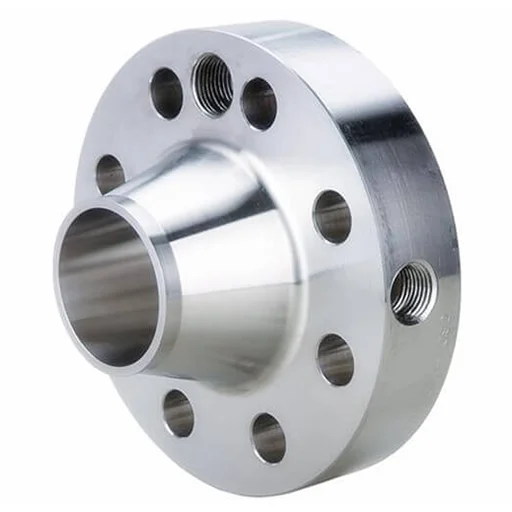
Duplex 2304 Orifice Flange
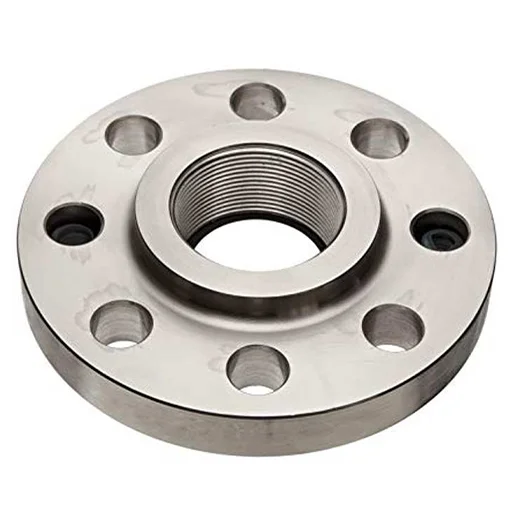
Duplex 2304 Threaded Flange
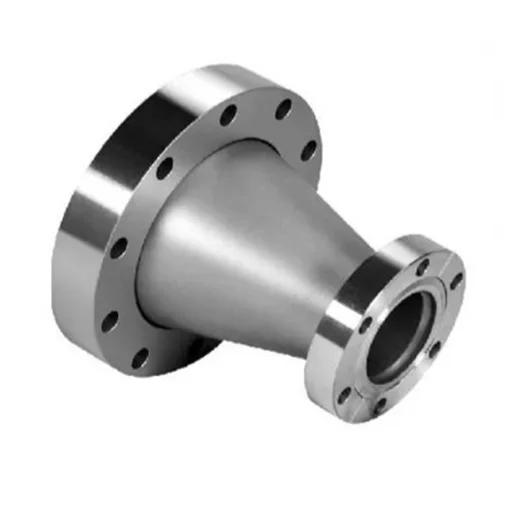
Duplex 2304 Reducing Flange
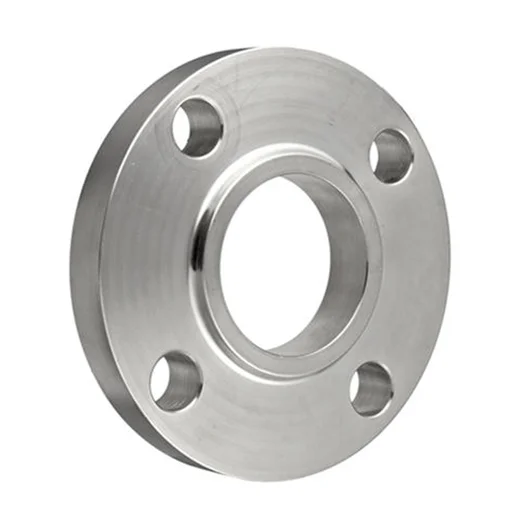
Duplex 2304 Lap Joint Flange
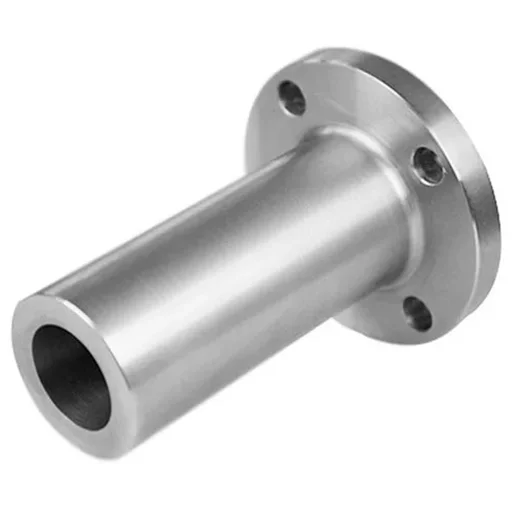
Duplex 2304 Long Weld Neck Flange
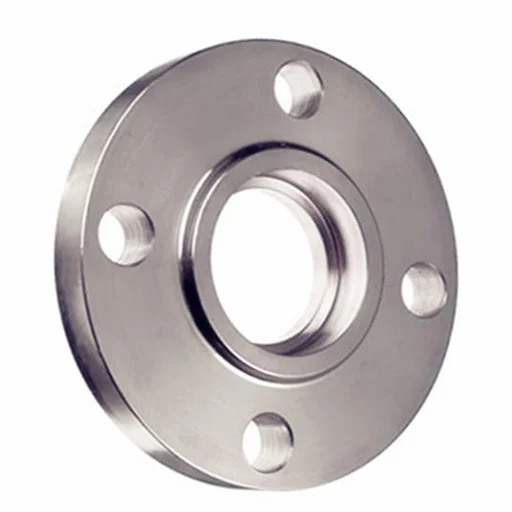
Duplex 2304 Socket Weld Flange
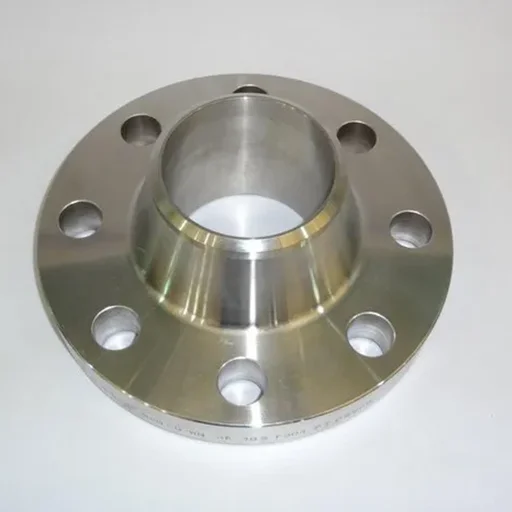
Duplex 2304 Weld Neck Flange
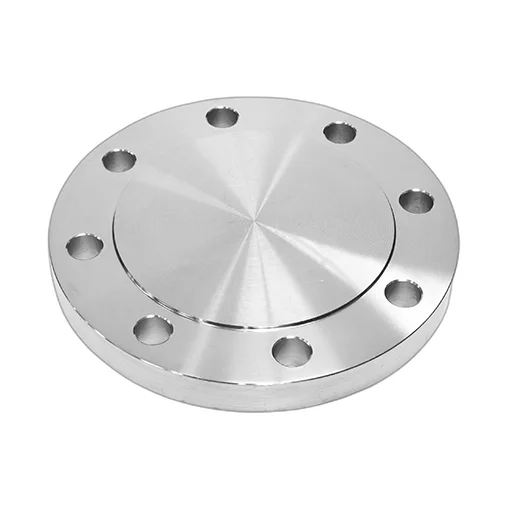
Duplex 2304 Blind Flange
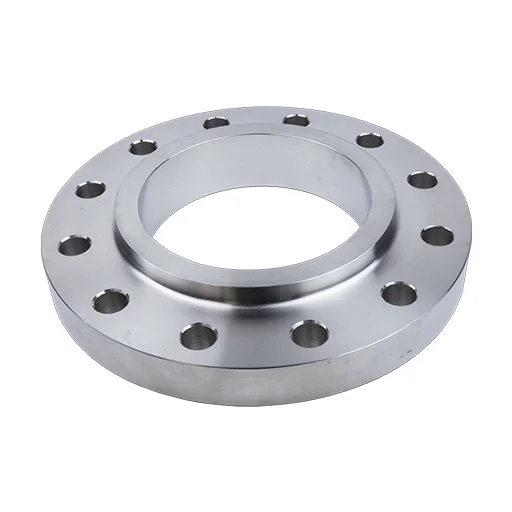
Duplex 2304 Slip-On Flange
Standard Flange Sizes & Weight Chart
Duplex 2304 Weld Neck Flange Dimensions (ANSI B16.5) - Class 150 Sample
| NPS | Outside Diameter (mm) | Thickness (mm) | Bore (mm) | Hub Dia (mm) | Bolt Circle (mm) | No. of Bolts | Bolt Dia | Approx Weight (kg) |
|---|---|---|---|---|---|---|---|---|
| 1/2" | 90 | 11 | 21 | 35 | 60 | 4 | M12 | 0.49 |
| 1" | 108 | 13 | 33 | 50 | 79 | 4 | M12 | 0.95 |
| 2" | 152 | 16 | 60 | 75 | 121 | 4 | M16 | 1.98 |
| 4" | 229 | 19 | 114 | 127 | 190 | 8 | M16 | 5.92 |
| 6" | 267 | 21 | 168 | 184 | 229 | 8 | M19 | 9.42 |
| 8" | 330 | 24 | 219 | 238 | 286 | 8 | M19 | 15.9 |
| 10" | 406 | 27 | 273 | 305 | 362 | 12 | M22 | 26.3 |
| 12" | 483 | 29 | 324 | 346 | 432 | 12 | M22 | 39.5 |
| 16" | 597 | 32 | 419 | 448 | 546 | 16 | M25 | 70.2 |
| 20" | 699 | 38 | 508 | 559 | 648 | 20 | M25 | 107.0 |
| 24" | 813 | 44 | 610 | 651 | 756 | 20 | M32 | 164.0 |
Is Duplex 2304 Good Quality as 316L Alternative?
Yes, Duplex 2304 is a good economical substitute of 316L austenitic stainless steel to use in cases involving higher strength and enhanced chloride stress corrosion cracking resistance where full super duplex characteristics are unwarranted. To denote less nickel content (3-5.5% vs 10-14% of 316L), and less molybdenum content (<0.6%), the term lean duplex is used, which makes 2304 much more economical and with a fixed price compared to high-nickel austenitic grades whose prices are sensitive to the volatile nickel markets.
The important gains of 2304 over 316L are about 80 percent better yield strength (400 MPa versus 220 MPa) and a 30-40 percent decrease in the wall thickness can be made with the same pressure rating. This saving in weight is directly converted to lower material costs, fabrication costs, transportation costs and installations costs- frequently subsidizing the 2304 slightly higher per-kg price. The duplex microstructure offers greater resistance to chloride-induced stress corrosion cracking (SCC), which is a critical failure mode in the austenitic stainless steels in chloride environments beyond 60 o C.
Although the PREN of 2304 of 25-27 is only slightly higher than that of the 316L of 24, the duplex microstructure dramatically increases the SCC resistance and this means that 2304 is an ideal material to work in warm chloride environments where 316L would be prone to crack propagation. The material gives sufficient pitting and crevice corrosion characteristics in moderate chloride levels and temperatures to 60-80 C (sufficient in potable water, brackish water (low salinity), mild chemical processing and most industrial operations).
The upgrade 2304 is described as a cost-effective replacement of 316L to: water treatment plants (potable and wastewater), desalination pretreatment systems, food and beverage processing, pulp and paper (mild chloride streams), architectural and structural uses, moderate chemicals storage tanks, heat exchanger in moderate service and moderate chlorides chemical processing. The material is especially appealing in large fabrications whereby weight reduction saves a lot of project costs.
Limitations of 2304 over higher duplex grades are reduced pitting resistance (CPT 20-30C vs. over 35C 2205 and over 50C 2507), which cannot be used in high-temperature seawater or under harsh chloride conditions. The maximum operating temperature is 250-300 o C to avoid the formation of the sigma phase. Where higher operating temperature over 80 C with PREN in chloride service is needed, upgrade to duplex 2205. In case of extreme offshore or high temperatures over the seawater, super duplex 2507 or 32760 are needed.
2304 gives the best balance between cost and performance when the 316L is marginal, yet full duplex 2205 is overspecified, is a sweet spot of better performance at a reasonable cost, typically 30-50% of the price of 316L yet 20-30% of the cost of duplex 2205.
Heat Treatment & Testing Requirements
Heat Treatment Process (Mandatory):
Solution Annealing:
- Temperature: 950-1050-C (1740-1920-F)
- Holding Time: Adequate soaking based on thickness
- Cooling: Rapid water quenching (critical to prevent embrittlement)
- Purpose: Dissolve chromium carbides, optimize ferrite-austenite balance
- Critical: Rapid cooling through 950-650-C range prevents harmful intermetallic phases.
Testing Requirements:
- Tensile Testing: Yield =400 MPa, tensile 600-820 MPa, elongation =25%
- Hardness Testing: =28 HRC (=290 HB) to verify proper heat treatment
- Ferrite Content: 40-60% measured by Feritscope or metallography
- PMI Testing: Verify Cr (21.5-24.5%), Ni (3-5.5%), Mo (0.05-0.60%), N (0.05-0.20%)
- IGC Testing: Intergranular Corrosion per ASTM A262 when specified
- Impact Testing: Charpy V-notch when specified for low-temperature service
- Ultrasonic Testing: Per ASTM A388 for critical applications
- Metallographic Examination: Verify 40-60% ferrite, proper grain structure
Duplex 2304 Lean Duplex Flanges Price List 2026
| Flange Type | Size Range | Pressure Class | Indicative Price Range (USD/Piece) |
|---|---|---|---|
| Weld Neck (WN) | 1/2" - 2" | 150# | $42 - $115 |
| Weld Neck (WN) | 4" - 8" | 150# | $175 - $720 |
| Weld Neck (WN) | 10" - 24" | 150# | $1,085 - $3,950 |
| Weld Neck (WN) | 1/2" - 2" | 300# | $62 - $175 |
| Weld Neck (WN) | 4" - 8" | 300# | $275 - $1,095 |
| Weld Neck (WN) | 10" - 24" | 300# | $1,580 - $5,750 |
| Weld Neck (WN) | 1/2" - 2" | 600# | $92 - $245 |
| Weld Neck (WN) | 4" - 8" | 600# | $410 - $1,595 |
| Slip-On (SO) | 1/2" - 2" | 150# | $35 - $95 |
| Slip-On (SO) | 4" - 8" | 150# | $145 - $595 |
| Slip-On (SO) | 10" - 24" | 150# | $895 - $3,280 |
| Blind (BL) | 1/2" - 2" | 150# | $32 - $88 |
| Blind (BL) | 4" - 8" | 150# | $158 - $645 |
| Socket Weld (SW) | 1/2" - 2" | 150# - 600# | $48 - $205 |
Note: Duplex 2304 flanges are typically 30-50% higher than 316L but 20-30% lower than duplex 2205 due to lean nickel and minimal molybdenum content.
Applications of Duplex 2304 Flanges in Industry
The Duplex 2304 Lean Duplex Stainless Steel Flanges are commonly used in many industrial applications, and some of the common industries are given below.
Water Treatment
Potable water systems, wastewater treatment, municipal water distribution, water storage tanks
Desalination
Pretreatment systems, low-salinity brackish water, intake piping (ambient temperature)
Food & Beverage
Process piping, storage tanks, breweries, dairy processing, beverage production
Pulp & Paper
White water systems, mild bleach plant sections, paper machine components
Chemical Processing
Moderate chloride environments, organic acid handling, storage tanks for mild chemicals
Architectural
Structural components, cladding, bridge components, pedestrian bridges, facades
Storage Tanks
Above-ground storage for moderate chemicals, water storage, process tanks
Heat Exchangers
Moderate service conditions, brackish water cooling, process heat exchangers
Marine (Moderate)
Ballast tanks, non-critical seawater systems (ambient temperature)
Oil & Gas (Mild)
Produced water (low chloride), storage tanks, process piping in moderate service
Why Choose Duplex 2304 Flanges from Metinox Overseas?
Metinox Overseas provide certified Duplex 2304 lean duplex stainless steel flanges featuring compulsory solution annealing and ensured ferrite equilibrium as well as assured mechanical characteristics that offer an economical substitute of 316L where higher strength and SCC tolerance are needed. Our PED certified and ISO 9001:2015 approved facilities mean that all 2304 flanges receive the appropriate solution annealing at 950-1050 o C and then rapid water quenching.
All flanges are supplied with EN 10204 3.1B Mill Test Certificates with Cr (21.5-24.5%), Ni (3-5.5%), Mo (0.05-0.60%), N (0.05-0.20%) chemical analysis, tensile property (yield =400 MPa and tensile 600-820 MPa) and hardness (= 28 HRC) and ferrite content (40-60% using Feritscope)
Our technical staff provides professional advice on the choice of 2304 vs 316L vs 2205 materials depending on chloride concentration and temperature, welding process with AWS A5.9 ER2209 filler and cost benefit analysis of reduction of the wall thickness. Its clients in the worldwide water treatment facilities, food processors, architectural and chemical plants.
Duplex 2304 Flange Delivery Time & CIF Pricing by Country
| Destination Region | Major Ports / Cities | Estimated Delivery Time | Typical CIF Terms |
|---|---|---|---|
| Middle East (GCC) | Dubai, Dammam, Doha | 12-16 Days | CIF Dubai / CIF Dammam |
| Europe | Rotterdam, Hamburg | 26-32 Days | CIF Rotterdam / CIF Hamburg |
| USA & Canada | Houston, New York | 32-40 Days | CIF Houston / CIF New York |
| Southeast Asia | Singapore, Port Klang | 16-22 Days | CIF Singapore / CIF Port Klang |
| Africa | Lagos, Durban | 22-30 Days | CIF Lagos / CIF Durban |
Other Types of Lean Duplex 2304 Flanges
Duplex 2304 Lean Duplex Flanges, UNS S32304 Flanges, 2304 Weld Neck Flanges, 2304 Slip-On Flanges, 2304 Blind Flanges, 2304 Socket Weld Flanges, 2304 Water Treatment Flanges.
Popular Locations Where We Supply Duplex 2304 Flanges
duplex 2304 flanges supplier in singapore, 2304 lean duplex flanges suppliers in qatar, uns s32304 flanges suppliers in uae, duplex 2304 flanges suppliers in chennai, 2304 weld neck flanges in mumbai.
People Also Search For
duplex 2304 lean duplex flanges manufacturer, uns s32304 flanges supplier, 2304 vs 316l difference, duplex 2304 weld neck flanges, 2304 flanges price list 2026, 2304 vs 2205 comparison.
Looking for High-Quality Duplex 2304 Flanges?
Let us support your projects with quality, precision, and performance.
Frequently Asked Questions (FAQ)
A: 2304 is 80 percent higher yield strength (400 Mpa vs 220 Mpa), has better chloride SCC resistance aided by duplex microstructure and has less nickel content (3-5.5% vs 10-14) making it more cost stable. 2304 costs 30-50 percent more than 316L but allows a reduction in wall thickness by 30-40 percent. PREN similar (25-27 vs 24).
A: "Lean" means less nickel (3-5.5% compared with 6-8% of 2205) and small amounts of molybdenum (less than 0.6% compared with 3% of 2205) and is thus more cost effective without having to compromise duplex properties of high strength and SCC resistance. Economical interconnection between 316L and full duplex 2205.
A: No. 2304 where 316L is marginal in either strength or SCC. Unsuitable: in high temperature acid, harsh pitting conditions that demand PREN exceeding 30, crevice prone geometries in sea water exceeding 60 degree C. 2304 in moderate chloride concentrations and low temperature, below 80 degree C.
A: 250-300 o C (482-572 F) constant service. Any temperature over 300 C causes sigma and chi phase to precipitate making it less tough and less resistant to corrosion. Short trips to 350 o C would be tolerable, but extended treatments would need recovery heat treatment.
A: AWS A5.9 ER2209 (23Cr-9Ni-Mo-N) is commonly used as filler over-alloyed filler offering 2205-equivalent weld metal with better corrosion resistance and increased strength than base 2304. GTAW for root, GMAW for fill. Maintain heat input 0.5-2.5 kJ/mm. No preheat or PWHT required.
A: 30-40 percent decrease that can be achieved through the increase of yield strength by 80 percent (400 Mpa vs 220 Mpa). An example of this is 316L 10mm wall that would be 6-7mm in 2304 with the same pressure rating. The actual reduction is based on design code (ASME B31.3 allowable stresses).
A: Exclusively low-salinity brackish water, provided that it is in ambient temperature (less than 30o C) and upon brief exposure to sea water. Not to be exposed to warm seawater (>40 C) or in continuous seawater service, seawater should be served with duplex 2205 (CPT -35 C) or super duplex 2507 (CPT -50 C).
A: Yes, with NACE MR0175 compliance. Include hardness 35 HRC or less (327 HB or less) 40-60 percentage ferrite product analysis, and HIC test, as in NACE TM0284. 2304 has sufficient H2S resistance of moderate sour service when properly processed.
A: Ferrite, austenite proportion should have 40-60 percent with the best property. Measured magnetically either with calibrated Feritscope (ASTM E1086) or quantitative metallography (ASTM E562). An excessive amount of ferrite or too little does away with performance.
A: Excellent stocking of common sizes (1"-12" NB, Class 150/300). Stock items: 5-7 days ex-works. Upon order: 8-10 weeks with alloy procurement, forging, solution annealing at 950-1050C, water quenching, test (ferrite content, tensile, hardness), and report. Rush 5-6 weeks service.
Enquire Now
Get pricing within 24 hours!