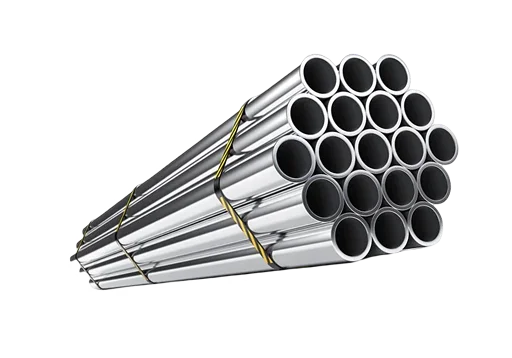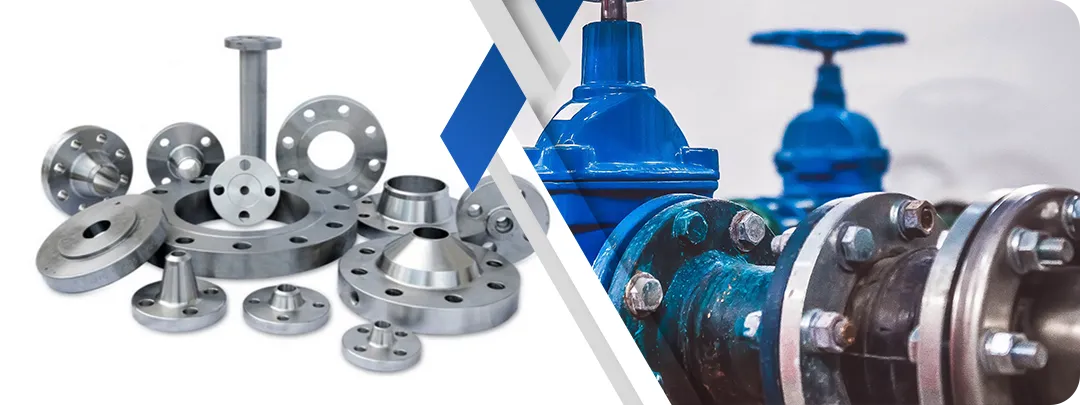
Duplex 2205 Stainless Steel Flanges Manufacturer & Supplier
Metinox Overseas is one of the biggest producers and distributors of Duplex 2205 Stainless Steel Flanges, which is intended to operate in highly corrosive environment with extreme resistance to chloride stress corrosion cracking (SCC), pitting and crevice corrosion as well as high mechanical strength. The material of our ASTM A182 F51 / F60 Forged Flanges is a high quality duplex stainless steel that is balanced in terms of chemical composition (chromium 21.0-23.0%, nickel 4.5-6.5%, molybdenum 2.5-3.5%, nitrogen 0.08-0.20%, controlled ferrite- austenite microstructure 40-60% each phase) for optimal strength, toughness, and corrosion performance. They are Duplex 2205 Flanges (UNS S31803 / S32205) which are the only flanges that are capable of extreme corrosive service in the range of -50 -C (-58 -F) to 300-315 -C (572-600 -F) and can provide the best service in most offshore oil and gas platforms, underwater systems, desalination plants, chemical processing, pulp and paper industries, marine services, and other services that require a greater degree of resistance to chloride-induced corrosion combined with superior mechanical strength.
The balanced dual-phase microstructure of about equal percentage of ferrite (BCC) and austenite (FCC) makes duplex 2205 have twice the yield strength than traditional austenitic stainless steels without compromising toughness and ductility. Molybdenum (3%), high chromium (22%), and nitrogen content provides better resistance to localized corrosion with Pitting Resistance Equivalent Number (PREN) of about 35-38 which is a lot higher than that of 316L (PREN =24-26). ASTM A182 Weld Neck Flanges F51 1/2 to 24 inch and Socket Weld Flanges are manufactured in full ANSI/ASME B16.5 (1/2 to 24 inch NB) and ASME B16.47 Series A and B (26 to 60 inch NB) sizes, and pressure classes of 150 to 2500 pounds. All flanges undergo solution annealing heat treatment at 1020-1100 -C and rapid cooling (water quenching) and extensive quality tests including dimensional inspection, PMI checking, tensile testing, Charpy impact testing, hardness testing, ferrite content densities measurement, intergranular corrosion testing and ultrasonic inspection as specified by ASTM A961.

Table of Contents
- Duplex 2205 Flanges Technical Specifications
- Duplex 2205 Equivalent Grades
- Duplex 2205 Chemical Composition
- Mechanical Properties of Duplex 2205 Flanges
- Duplex 2205 Flange Dimensions & Pressure Rating Chart
- Types of Duplex 2205 Flanges Available
- Standard Flange Sizes & Weight Chart
- Is Duplex 2205 Good Quality for Oil & Gas Applications?
- Heat Treatment & Testing Requirements
- Duplex 2205 Stainless Steel Flanges Price List 2026
- Applications of Duplex 2205 Flanges in Industry
- Why Choose Duplex 2205 Flanges from Metinox Overseas?
- Duplex 2205 Flange Delivery Time & CIF Pricing by Country
- Other Types of Duplex 2205 Flanges
- Popular Locations Where We Supply Duplex 2205 Flanges
- Frequently Asked Questions (FAQ)
Duplex 2205 Flanges Technical Specifications
| Feature | Details |
| Specifications | ASTM A182 / ASME SA182 / MSS SP-44 |
| Grade | F51, F60 (UNS S31803 / S32205) |
| Material Designation | Duplex Stainless Steel 22Cr-5Ni-3Mo-N (Type 2205) |
| UNS Number | S31803 (Standard), S32205 (Enhanced - higher Mo, N) |
| Dimensional Standards | ANSI/ASME B16.5, B16.47 Series A & B, B16.48, MSS SP-44 |
| Size Range | 1/2" (15 NB) to 60" (1500 NB) |
| Pressure Class | 150#, 300#, 400#, 600#, 900#, 1500#, 2500# (B16.5); 75#, 150#, 300#, 400#, 600#, 900# (B16.47) |
| Flange Types | Weld Neck, Slip-On, Blind, Socket Weld, Lap Joint, Threaded, Orifice, Long Weld Neck, Reducing |
| Flange Face | RF, FF, RTJ, Male & Female, Tongue & Groove |
| Manufacturing Type | Hot Forged |
| Microstructure | Balanced Ferrite-Austenite (40-60% each phase) |
| Heat Treatment | Solution Annealed at 1020-1100-C + Rapid Water Quench (Mandatory) |
| Testing | Tensile, Hardness, Impact, PMI, Ferrite Content, IGC, Ultrasonic |
| Inspection | TUV, SGS, Bureau Veritas, Lloyd's, DNV GL, BV, ABS |
| Certifications | EN 10204 3.1B MTC, NACE MR0175 / ISO 15156, PED 2014/68/EU, CE Marked, ASME B31.3 |
Duplex 2205 Equivalent Grades
| Standard | USA | Germany | Europe | Japan | India | UK | China |
| UNS S31803 | ASTM A182 F51 | 1.4462 | X2CrNiMoN22-5-3 | SUS 329J3L | - | 318S13 | 00Cr22Ni5Mo3N |
| UNS S32205 | ASTM A182 F60 | 1.4462 | X2CrNiMoN22-5-3 | SUS 329J3L | - | 318S13 | 00Cr22Ni5Mo3N |
Note: S32205 is the enhanced version with tighter chemistry control (higher Mo, N) for improved corrosion resistance; S31803 is the standard grade.
Duplex 2205 Chemical Composition
The detailed composition of this material is given in the following table.
| Element | S31803 (%) | S32205 (%) | Function |
| Carbon (C) | 0.030 max | 0.030 max | Prevents carbide precipitation |
| Manganese (Mn) | 2.00 max | 2.00 max | Austenite stabilization |
| Phosphorus (P) | 0.030 max | 0.030 max | Corrosion resistance |
| Sulfur (S) | 0.020 max | 0.020 max | Improves ductility |
| Silicon (Si) | 1.00 max | 1.00 max | Deoxidation |
| Chromium (Cr) | 21.0-23.0 | 22.0-23.0 | Corrosion resistance |
| Nickel (Ni) | 4.5-6.5 | 4.5-6.5 | Toughness, phase balance |
| Molybdenum (Mo) | 2.5-3.5 | 3.0-3.5 | Pitting resistance |
| Nitrogen (N) | 0.08-0.20 | 0.14-0.20 | PREN enhancement |
| Iron (Fe) | Balance | Balance | Base metal |
| Copper (Cu) | - | - | Optional acid resistance |
Note: S32205 provides PREN = 35 and superior chloride corrosion resistance.
Mechanical Properties of Duplex 2205 Flanges
The mechanical properties decide the shelflife of the material. The table below gives the information about the mechanical properties of Duplex 2205 Flanges.
| Property | S31803 | S32205 | Testing Standard |
| Tensile Strength | 620-880 MPa (90-128 ksi) | 620-880 MPa (90-128 ksi) | ASTM A370 |
| Yield Strength (0.2%) | 450 MPa (65 ksi) min | 450 MPa (65 ksi) min | ASTM A370 |
| Elongation (2") | 25% min | 25% min | ASTM A370 |
| Hardness (Brinell) | 290 HB max | 290 HB max | ASTM E10 |
| Hardness (Rockwell C) | 32 HRC max | 32 HRC max | ASTM E18 |
| Charpy Impact | 40 J min at -40-C | 40 J min at -40-C | ASTM A370 |
| Ferrite Content | 40-60% | 40-60% | ASTM E562 |
Duplex 2205 Flange Dimensions & Pressure Rating Chart
Pressure-Temperature Ratings for Duplex 2205 Flanges (ASTM A182 F51 / F60)
| Temperature -F (-C) | Class 150 | Class 300 | Class 600 | Class 900 | Class 1500 | Class 2500 |
|---|---|---|---|---|---|---|
| -20 to 100 (-29 to 38) | 285 psi | 740 psi | 1480 psi | 2220 psi | 3705 psi | 6170 psi |
| 200 (93) | 275 psi | 713 psi | 1425 psi | 2138 psi | 3563 psi | 5938 psi |
| 300 (149) | 260 psi | 675 psi | 1350 psi | 2025 psi | 3375 psi | 5625 psi |
| 400 (204) | 245 psi | 635 psi | 1270 psi | 1905 psi | 3175 psi | 5295 psi |
| 500 (260) | 230 psi | 598 psi | 1195 psi | 1793 psi | 2988 psi | 4980 psi |
| 550 (288) | 223 psi | 578 psi | 1155 psi | 1733 psi | 2888 psi | 4813 psi |
| 600 (316) | 210 psi | 545 psi | 1090 psi | 1635 psi | 2725 psi | 4543 psi |
Note: Maximum recommended service temperature is 300-315-C (572-600-F). For higher temperatures, austenitic or super duplex alloys are recommended.
Types of Duplex 2205 Flanges Available
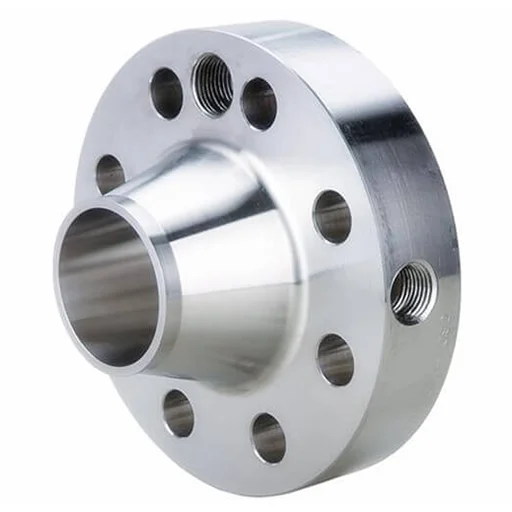
Duplex 2205 Orifice Flange
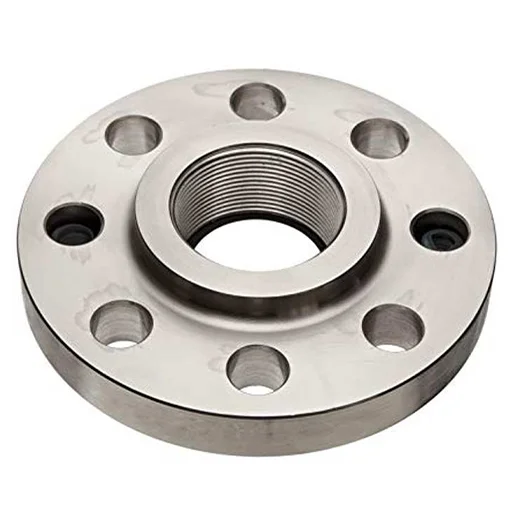
Duplex 2205 Threaded Flange
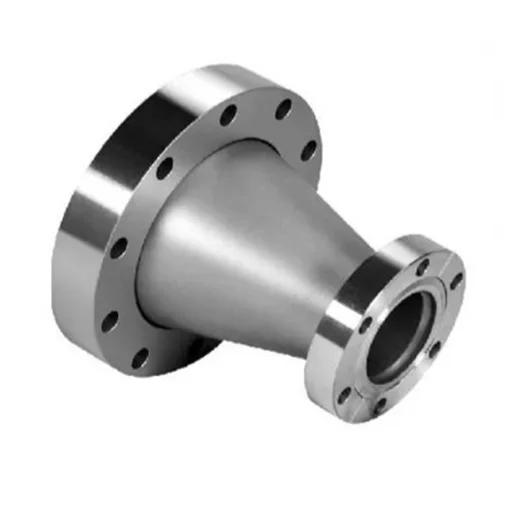
Duplex 2205 Reducing Flange
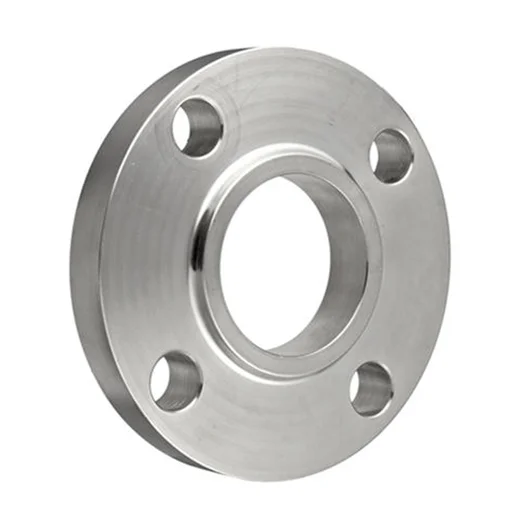
Duplex 2205 Lap Joint Flange
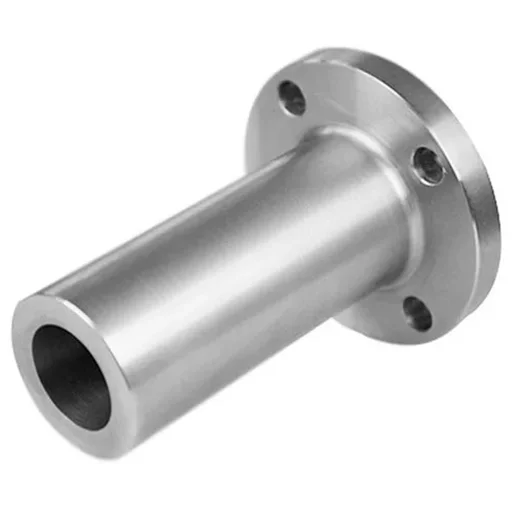
Duplex 2205 Long Weld Neck Flange
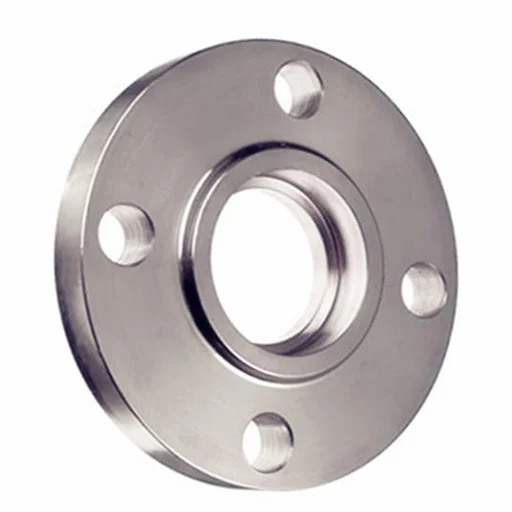
Duplex 2205 Socket Weld Flange
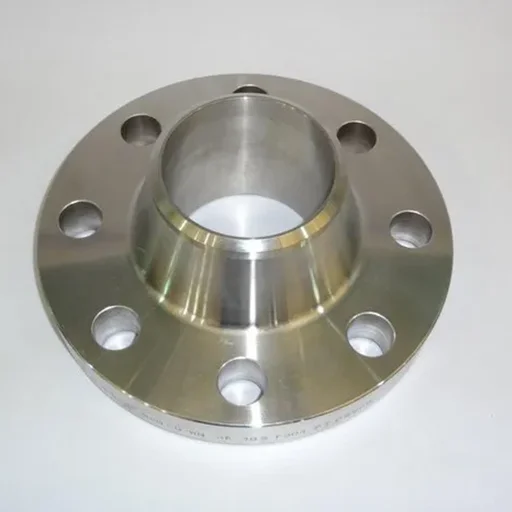
Duplex 2205 Weld Neck Flange
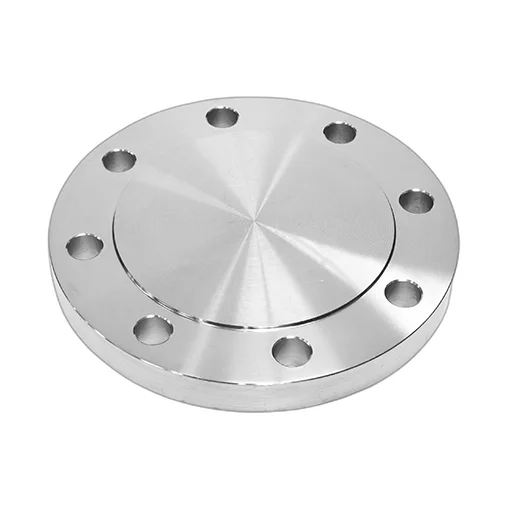
Duplex 2205 Blind Flange
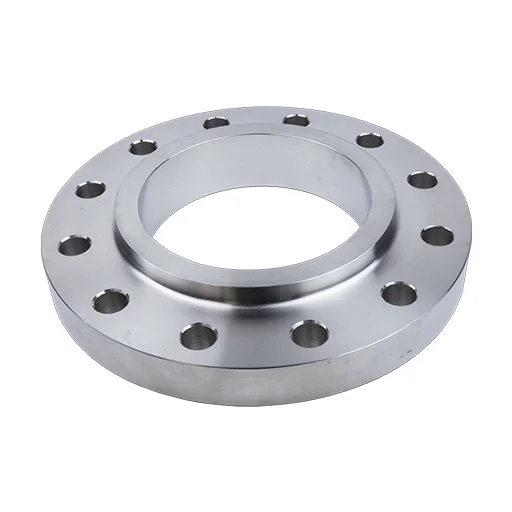
Duplex 2205 Slip-On Flange
Standard Flange Sizes & Weight Chart
Duplex 2205 Weld Neck Flange Dimensions (ANSI ASME B16.5) - Class 600 (Sample)
| NPS | Outside Diameter (mm) | Thickness (mm) | Bore (mm) | Hub Dia (mm) | Bolt Circle (mm) | No. of Bolts | Bolt Dia | Approx. Weight (kg) |
|---|---|---|---|---|---|---|---|---|
| 1/2" | 95 | 16 | 21 | 41 | 66 | 4 | M16 | 0.95 |
| 1" | 124 | 21 | 33 | 57 | 89 | 4 | M19 | 1.95 |
| 2" | 165 | 25 | 60 | 84 | 127 | 8 | M19 | 4.25 |
| 4" | 273 | 32 | 114 | 146 | 216 | 8 | M25 | 13.8 |
| 6" | 356 | 38 | 168 | 210 | 270 | 12 | M25 | 29.5 |
| 8" | 419 | 41 | 219 | 270 | 330 | 12 | M28 | 46.8 |
| 10" | 508 | 48 | 273 | 330 | 403 | 16 | M32 | 80.5 |
| 12" | 559 | 52 | 324 | 381 | 476 | 20 | M32 | 109.0 |
| 16" | 711 | 64 | 419 | 495 | 603 | 20 | M38 | 206.0 |
| 20" | 838 | 70 | 508 | 603 | 724 | 24 | M38 | 318.0 |
| 24" | 991 | 78 | 610 | 705 | 838 | 24 | M45 | 473.0 |
Note: Duplex 2205 density is approximately 7.8 g/cm-, slightly lower than austenitic stainless steel grades (~8.0 g/cm-).
Is Duplex 2205 Good Quality for Oil & Gas Applications?
Yes, Duplex 2205 is the industry-standard workhorse duplex stainless steel for offshore oil and gas, subsea systems, and marine applications, offering an exceptional combination of high strength, superior corrosion resistance, and excellent weldability that has made it the most widely specified duplex grade worldwide. Duplex 2205 was developed in the 1970s-1980s specifically to address the limitations of austenitic stainless steels (such as 316/316L) in chloride-containing environments, and it has become the material of choice for corrosive offshore and subsea applications.
The defining characteristic of duplex 2205 is its balanced dual-phase microstructure consisting of approximately 40-60% ferrite (body-centered cubic) and 40-60% austenite (face-centered cubic). This unique microstructure provides the best attributes of both phases: the ferrite phase contributes high strength and excellent resistance to chloride stress corrosion cracking (SCC), while the austenite phase provides superior toughness, ductility, and resistance to hydrogen embrittlement. The result is a material with approximately twice the yield strength (450 MPa minimum) of austenitic 316L (207 MPa), enabling significant weight reduction in structural applications and higher pressure ratings in piping systems.
The corrosion resistance of duplex 2205 is exceptional, particularly in chloride-containing environments. With 22% chromium, 3% molybdenum, and 0.14-0.20% nitrogen, duplex 2205 achieves a Pitting Resistance Equivalent Number (PREN) of approximately 35-38, calculated as PREN = %Cr + 3.3(%Mo) + 16(%N). This is significantly higher than 316L (PREN ~24-26) and comparable to some super austenitic grades, but with much higher strength. The high PREN provides excellent resistance to pitting corrosion, crevice corrosion, and chloride SCC in seawater, brackish water, and chloride process environments.
Duplex 2205 is specifically designed for use in the most corrosive components of offshore oil and gas facilities: subsea manifolds and pipelines (operating in seawater at depths up to 3000m), topside process piping handling produced fluids with H2S, CO2, and chlorides, seawater injection and firewater systems, heat exchangers and condensers using seawater cooling, offshore platform structural components, umbilicals and flowlines, and desalination plant piping and heat exchangers. It is fully qualified to NACE MR0175/ISO 15156 for sour service applications and is included in ASME B31.3 Process Piping Code with well-established allowable stresses.
The S32205 variant (also designated UNS S32205) represents an enhancement over the original S31803 specification, with tighter control over molybdenum (3.0-3.5% versus 2.5-3.5%) and nitrogen (0.14-0.20% versus 0.08-0.20%) to ensure PREN =35 in all production heats. Many specifications now preferentially call out S32205 for critical applications. However, duplex 2205 has an upper temperature limit of approximately 300-315-C due to the risk of sigma phase precipitation at higher temperatures, which severely degrades toughness and corrosion resistance. For temperatures above 300-C, austenitic grades like 316/316L or high-temperature alloys should be considered. For more severe corrosive environments requiring higher PREN, super duplex grades like 2507 (PREN ~42-43) should be specified.
Heat Treatment Requirements (Mandatory - Strict Control Required)
| Process | Step / Parameter | Requirement | Remarks / Critical Notes |
|---|---|---|---|
| Solution Annealing + Rapid Quenching | Solution Annealing Temperature | 1020-1100-C (1870-2010-F) | Optimal range: 1040-1080-C for balanced ferrite-austenite |
| Holding Time | Adequate soaking | Based on section thickness, typically 5-10 min per 25 mm | |
| Cooling After Annealing | Rapid water quench | Essential to prevent secondary phase precipitation | |
| Critical Cooling Rate | Fast cooling through 1050-650-C | Slow cooling promotes sigma, chi, and chromium nitride precipitation | |
| Critical Requirement | Balanced microstructure control | 40-60% ferrite and 40-60% austenite; ferrite verification mandatory |
Testing & Inspection Requirements (Comprehensive)
| Test / Inspection | Standard / Requirement | Acceptance / Remarks |
|---|---|---|
| Tensile Testing | ASTM A370 | Yield = 65 ksi (450 MPa), Tensile 90-128 ksi, Elongation = 25% |
| Hardness Testing | ASTM E10 / ASTM E18 | = 290 HB or = 32 HRC |
| Charpy Impact Testing | ASTM A370 | Minimum 40 J at -40-C (mandatory for subsea applications) |
| PMI Testing | Positive Material Identification | Verification of Cr, Ni, Mo, N content |
| Ferrite Content | ASTM E562 / Ferritescope | 40-60% ferrite required |
| Intergranular Corrosion | ASTM A262 Practice A / E | Confirms proper heat treatment and no sensitization |
| Ultrasonic Testing | ASTM A388 | Mandatory for critical applications |
| Pitting Resistance | ASTM G48 Method A | Verification of PREN and corrosion resistance |
Duplex 2205 Stainless Steel Flanges Price List 2026
| Flange Type | Size Range | Pressure Class | Indicative Price Range (USD / Piece) |
|---|---|---|---|
| Weld Neck (WN) | 1/2" - 2" | 150# | $52 - $135 |
| Weld Neck (WN) | 4" - 8" | 150# | $215 - $825 |
| Weld Neck (WN) | 10" - 24" | 150# | $1,280 - $4,650 |
| Weld Neck (WN) | 1/2" - 2" | 300# | $75 - $195 |
| Weld Neck (WN) | 4" - 8" | 300# | $325 - $1,180 |
| Weld Neck (WN) | 10" - 24" | 300# | $1,850 - $6,580 |
| Weld Neck (WN) | 1/2" - 2" | 600# | $110 - $285 |
| Weld Neck (WN) | 4" - 8" | 600# | $505 - $1,750 |
| Slip-On (SO) | 1/2" - 2" | 150# | $42 - $110 |
| Slip-On (SO) | 4" - 8" | 150# | $175 - $655 |
| Blind (BL) | 1/2" - 2" | 150# | $38 - $95 |
| Blind (BL) | 4" - 8" | 150# | $185 - $735 |
| Socket Weld (SW) | 1/2" - 2" | 150# - 600# | $58 - $235 |
Note: Duplex 2205 flanges are typically 250-320% higher than A105 carbon steel and 60-85% higher than 316/316L stainless steel due to higher alloy content (Cr, Ni, Mo), controlled forging, mandatory solution annealing, and comprehensive testing.
Applications of Duplex 2205 Flanges in Industry
The Duplex 2205 Stainless Steel Flanges are commonly used in many industrial applications, and some of the common industries are given below.
Offshore Oil & Gas
Subsea manifolds and pipelines, topside process piping, seawater injection systems, produced water handling
Marine & Subsea
Umbilicals, flowlines, risers, subsea equipment operating in seawater environments up to 3000m depth
Desalination
Multi-stage flash (MSF) and reverse osmosis (RO) plants, seawater intake and brine discharge systems
Chemical Processing
Chlorinated organic production, phosphoric acid plants, acetic acid production, aggressive chemical handling
Pulp & Paper
Bleaching systems, digesters, chlorine dioxide generators, kraft pulp mills
Petrochemical
Ethylene glycol production, ammonia synthesis, urea production, fertilizer plants
Heat Exchangers
Seawater-cooled condensers, shell-and-tube exchangers in marine and desalination applications
Wastewater Treatment
Chlorinated effluent systems, brine handling, industrial wastewater processing
Why Choose Duplex 2205 Flanges from Metinox Overseas?
Metinox Overseas has certified Duplex 2205 stainless steel flanges with critical solution annealing and quick quenching, extensive examination such as ferrite content examination and intergranular corrosion examination, and has optimum corrosion defense against offshore oil and gas and ocean use. We have ISO 9001:2015, NACE MR0175/ ISO 15156 and PED certified manufacturing sites all Duplex 2205 flanges are solution annealed at controlled temperatures of 1040- 1080-C with rapid water quenching and full documentation.
All flanges are furnished with EN 10204 3.1B Mill Test Certificates with full chemical analysis of Cr (22.0-23.0%), Mo (3.0-3.5%), N (0.14-0.20%), full tensile, Charpy impact testing (=40J at -40-C), hardness verification (=290 HB), ferrite measurement (40-60%), PREN calculation (=35), intergranular corrosion testing per ASTM A262 confirming proper solution annealing, and complete traceability documentation meeting NACE MR0175/ISO 15156 requirements for sour service qualification.
Our technical department offers professional advice on S31803/ S32205 selection, welding (controlled heat input, no preheat is usually needed, interpass =150-C to achieve ferrite-austenite balance,) corrosion data in seawater and in chlorides, and compliance with NACE MR0175/ ISO 15156 sour service, and the ASME B31.3 Process Piping Code. Our specialized business operations cater to offshore platforms, subsea equipments manufacturers, EPC contractors, desalination plants, and marine activities around the world.
Duplex 2205 Flange Delivery Time & CIF Pricing by Country
| Destination Region | Major Ports / Cities | Estimated Delivery Time | Typical CIF Terms |
|---|---|---|---|
| Middle East (GCC) | Dubai, Dammam, Doha | 14-18 Days | CIF Dubai / CIF Dammam |
| Europe | Rotterdam, Hamburg | 28-35 Days | CIF Rotterdam / CIF Hamburg |
| USA & Canada | Houston, New York | 35-45 Days | CIF Houston / CIF New York |
| Southeast Asia | Singapore, Port Klang | 18-25 Days | CIF Singapore / CIF Port Klang |
| Africa | Lagos, Durban | 25-35 Days | CIF Lagos / CIF Durban |
Other Types of Duplex 2205 Flanges
ASTM A182 F51 Flanges, ASTM A182 F60 Flanges, UNS S31803 Weld Neck Flanges, UNS S32205 Blind Flanges, Duplex 2205 Offshore Flanges, 22Cr-5Ni-3Mo Duplex Flanges, 1.4462 Flanges.
Popular Locations Where We Supply Duplex 2205 Flanges
duplex 2205 flanges manufacturer, duplex stainless steel 2205 flanges supplier, uns s31803 s32205 flanges, astm a182 f51 f60 flanges price, duplex 2205 vs 316l comparison, 2205 flanges for offshore applications.
People Also Search For
duplex 2205 flanges manufacturer, duplex stainless steel 2205 flanges supplier, uns s31803 s32205 flanges, astm a182 f51 f60 flanges price, duplex 2205 vs 316l comparison, 2205 flanges for offshore applications.
Looking for High-Quality Duplex 2205 Flanges?
Let us support your projects with quality, precision, and performance.
Frequently Asked Questions (FAQ)
Duplex 2205 also offers nearly twice the strength in yield (450 MPa vs 207 MPa) as 316L, greater resistance to chloride stress corrosion cracking, and much greater resistance to pitting and crevice corrosion (PREN =35-38 vs =24-26). Nevertheless, 316L is tougher at extreme temperatures and does not have any highest temperature because of sigma phase considerations. Duplex 2205 can be used in high-strength, corrosive up to 300-C.
S32205 is a refined S31803 that has more restrictive chemistry, namely increased molybdenum (3.0-3.5% vs 2.5-3.5%) and nitrogen (0.14-0.20% vs 0.08-0.20%) so that it will yield PREN =35 in all production heats. S32205 offers more uniform corrosion resistance in high duty applications. They both share the same minimum mechanical properties, although S32205 is gaining popularity in off-shore and sub-sea.
It is necessary to quench the solution annealing temperature (1020-1100-C) rapidly in order to avoid the formation of secondary phases in the course of cooling, including sigma phase, chi phase, and chromium nitrides. These stages are very detrimental in terms of toughness and resistance to corrosion. The cooling should not be done too slowly across the critical temperature range (1050-650-C). The rate of cooling is what dictates the ultimate ferrite-austenite balance and characteristics.
Duplex 2205 must be welded under control in order to have balanced ferrite-austenite microstructure (30-70% ferrite can be tolerated in weld metal). Matching filler metals which are AWS A5.9 ER2209 or AWS A5.4 E2209 should be used. There is no preheat that is usually needed. Regulation interpass temperature =150-C to avoid excessive ferrite formation. Heat input of 0.5-2.5 kJ/mm is normally not specified but can be given in cases of thick sections.
Duplex 2205 has a maximum continued service temperature of 300-315-C (572-600-F). Beyond this temperature level sigma and other intermetallic phase precipitation takes place, which has a devastating effect on toughness and corrosion resistance. Also austenitic grades such as 316/316L or higher temperature alloys should be used in applications that need higher temperatures.
Yes, at standard (NACE MR0175/ISO 15156) heat treatment and hardness control, Duplex 2205 is sour service (maximum =290 HB, 32 HRC). It offers an outstanding resistance to sulfide stress cracking (SSC) in the environments with H2S and it finds extensive application in the offshore oil and gas platforms with sour conditions.
Duplex 2205 is tough to about -50-C (-58-F) as indicated by Charpy impact tests. At temperatures below this, the ferrite phase may be made brittle. In cryogenic uses below -50-C austenitic alloys such as 316L or special cryogenic alloys are to be considered. Design temperature also needs impact testing at the design temperature to service at low temperatures.
The percentage of ferrite phase in the duplex microstructure is known as ferrite content. Duplex 2205 of the proper type is supposed to be 40-60% ferrite (complemented with austenite) in order to achieve the best strength, toughness and corrosion resistance. Excessive levels of ferrite make it less tough, less weldable; excessive amounts of ferrite make it less strong, less resistant to stress corrosion cracks. The level of ferrite is confirmed with the help of magnetic techniques (Ferritescope) or metallographic test according to the ASTM E562.
Enquire Now
Get pricing within 24 hours!