ASTM A182 F9 High Chromium Alloy Steel Flanges Manufacturer & Supplier
Metinox Overseas is a major manufacturer and supplier of ASTM A182 F9 Alloy Steel Flanges, which are designed to serve in high temperature services with the exceptional creep strength, oxidation resistance, as well as steam oxidation resistance in power generation and petrochemical industry. Our ASME SA182 F9 Forged Flanges are manufactured using the finest 9% Chromium -1% Molybdenum ferritic alloy steel with controlled chemical composition with chromium (8.00-10.00%), molybdenum (0.85-1.05%), and carbon (0.15% max) that provides minimum tensile strength of 585 MPa and yield strength of 415 Mpa. These 9Cr-1Mo Alloy A182 F9 Flanges are developed to be used in extreme high temperature service -29degC (-20degF) up to 593degC (1100degF) which would suit power plant high temperature steam systems, refinery high temperature hydroprocessing, petrochemical reforming unit, high temperature hydrogen service or those applications that require high creep strength and oxidation resistance that is better than F5 or F22.
The 9 percent chromium content offers an exceptional oxidation and steam oxidation resistance at high temperature and the ferritic microstructure (body-centered cubic) has a high thermal conductivity and lower thermal expansion than austenitic stainless steels, minimizing thermal fatigue in cycling service. We make our ASTM A182 F9 Weld Neck Flanges, Slip-On Flanges, Blind Flanges and Socket Weld Flanges, which are produced to ANSI/ASME B16.5 (1/2 to 24 inch NB) and ASME B16.47 Series A and B (26 to 60 inch NB) dimensional standards and are available in pressure classes of 150 to 2500 lb. All flangles are subjected to optional heat treatment: normalizing and tempering or quenching and tempering, then subjected to stringent quality test, such as dimensional inspection, PMI test, tensile test, hardness test, and ultrasonic test according to ASTM A961 standards.

Table of Contents

- ASTM A182 F9 Flanges Technical Specifications
- ASTM A182 F9 Equivalent Grades
- ASTM A182 F9 Chemical Composition
- Mechanical Properties of ASTM A182 F9 Flanges
- ASTM A182 F9 Flange Dimensions & Pressure Rating Chart
- Types of ASTM A182 F9 Flanges Available
- Standard Flange Sizes & Weight Chart
- Is ASTM A182 F9 Good Quality for High-Temperature Creep Service?
- Heat Treatment & Testing Requirements
- ASTM A182 F9 Alloy Steel Flanges Price List 2026
- Applications of ASTM A182 F9 Flanges in Industry
- Why Choose ASTM A182 F9 Flanges from Metinox Overseas?
- ASTM A182 F9 Flange Delivery Time & CIF Pricing by Country
- Other Types of Alloy Steel A182 F9 Flanges
- Popular Locations Where We Supply ASTM A182 F9 Flanges
- Frequently Asked Questions (FAQ)
ASTM A182 F9 Flanges Technical Specifications
| Feature | Details |
| Specifications | ASTM A182 / ASME SA182 / MSS SP-44 |
| Grade | F9 (9Cr-1Mo Ferritic Alloy Steel) |
| Material Designation | 9Cr-1Mo (9% Chromium - 1% Molybdenum) |
| UNS Number | K90941 |
| Dimensional Standards | ANSI/ASME B16.5, B16.47 Series A & B, B16.48, MSS SP-44 |
| Size Range | 1/2" (15 NB) to 60" (1500 NB) |
| Pressure Class | 150#, 300#, 400#, 600#, 900#, 1500#, 2500# (B16.5); 75#, 150#, 300#, 400#, 600#, 900# (B16.47) |
| Flange Types | Weld Neck, Slip-On, Blind, Socket Weld, Lap Joint, Threaded, Orifice, Long Weld Neck, Reducing |
| Flange Face | Raised Face (RF), Flat Face (FF), Ring Type Joint (RTJ), Male & Female, Tongue & Groove |
| Manufacturing Type | Hot Forged |
| Microstructure | Ferritic (Martensitic after heat treatment) |
| Heat Treatment | Normalized & Tempered, or Quenched & Tempered (Mandatory) |
| Testing | Tensile Test, Hardness Test, PMI Test, Ultrasonic Test, Hydrostatic Test |
| Inspection | Third Party Inspection by TUV, SGS, Bureau Veritas, Lloyd's, DNV GL, BV, ABS |
| Certifications | EN 10204 3.1B MTC, NACE MR0175, PED 2014/68/EU, CE Marked, ASME B31.1, B31.3 |
ASTM A182 F9 Equivalent Grades
| STANDARD | USA | GERMANY | EUROPE | JAPAN | INDIA | UK | CHINA |
| A182 F9 | ASTM A182 F9 ASME SA182 F9 UNS K90941 |
1.7383 | X10CrMoVNb9-1 | X10CrMoVNb9-1 (similar) SCPH2 |
- | - | 10Cr9Mo1VNbN |
Note: F9 is the predecessor to modified 9Cr-1Mo grades F91/F92 with lower strength but easier fabrication.
ASTM A182 F9 Chemical Composition
| Element | Composition (%) | Function |
| Carbon (C) | 0.15 max | Strength, controlled for weldability |
| Manganese (Mn) | 0.30 - 0.60 | Hardenability |
| Phosphorus (P) | 0.040 max | Controlled for toughness |
| Sulfur (S) | 0.040 max | Minimized for ductility |
| Silicon (Si) | 0.25 - 1.00 | Oxidation resistance |
| Chromium (Cr) | 8.00 - 10.00 | Excellent oxidation/corrosion resistance, creep strength |
| Molybdenum (Mo) | 0.85 - 1.05 | Creep strength, high-temperature strength |
Note: F9 is simpler composition than F91 (no vanadium, niobium, or nitrogen additions), making it easier to weld and fabricate but with lower creep strength.
Mechanical Properties of ASTM A182 F9 Flanges
| Property | Requirement | Testing Standard |
| Tensile Strength | 585 MPa (85 ksi) minimum | ASTM A370 |
| Yield Strength (0.2% offset) | 415 MPa (60 ksi) minimum | ASTM A370 |
| Elongation in 2" | 20% minimum | ASTM A370 |
| Reduction of Area | 45% minimum | ASTM A370 |
| Hardness (Brinell) | 192-250 HB (typical after tempering) | ASTM E10 |
Note: F9 has significantly higher strength than F5/F22 due to martensitic microstructure after heat treatment.
ASTM A182 F9 Flange Dimensions & Pressure Rating Chart
Pressure-Temperature Ratings for A182 F9 Flanges
| Temperature -F (-C) | Class 150 | Class 300 | Class 600 | Class 900 | Class 1500 | Class 2500 |
|---|---|---|---|---|---|---|
| -20 to 100 (-29 to 38) | 285 psi | 740 psi | 1480 psi | 2220 psi | 3705 psi | 6170 psi |
| 200 (93) | 285 psi | 740 psi | 1480 psi | 2220 psi | 3705 psi | 6170 psi |
| 400 (204) | 285 psi | 740 psi | 1480 psi | 2220 psi | 3705 psi | 6170 psi |
| 600 (316) | 260 psi | 675 psi | 1350 psi | 2025 psi | 3375 psi | 5625 psi |
| 650 (343) | 230 psi | 655 psi | 1315 psi | 1970 psi | 3280 psi | 5470 psi |
| 700 (371) | 200 psi | 635 psi | 1270 psi | 1900 psi | 3170 psi | 5280 psi |
| 750 (399) | 170 psi | 600 psi | 1200 psi | 1795 psi | 3000 psi | 4995 psi |
| 800 (427) | 140 psi | 550 psi | 1095 psi | 1640 psi | 2735 psi | 4560 psi |
| 850 (454) | 125 psi | 535 psi | 1075 psi | 1610 psi | 2685 psi | 4480 psi |
| 900 (482) | 110 psi | 505 psi | 1010 psi | 1515 psi | 2530 psi | 4215 psi |
| 950 (510) | 95 psi | 485 psi | 970 psi | 1460 psi | 2430 psi | 4045 psi |
| 1000 (538) | 80 psi | 410 psi | 825 psi | 1230 psi | 2055 psi | 3430 psi |
| 1050 (566) | 65 psi | 270 psi | 540 psi | 805 psi | 1345 psi | 2240 psi |
| 1100 (593) | 50 psi | 170 psi | 340 psi | 510 psi | 845 psi | 1410 psi |
Note: F9 maintains better pressure ratings than F22 at temperatures above 500-C due to superior creep strength.
Types of ASTM A182 F9 Flanges Available
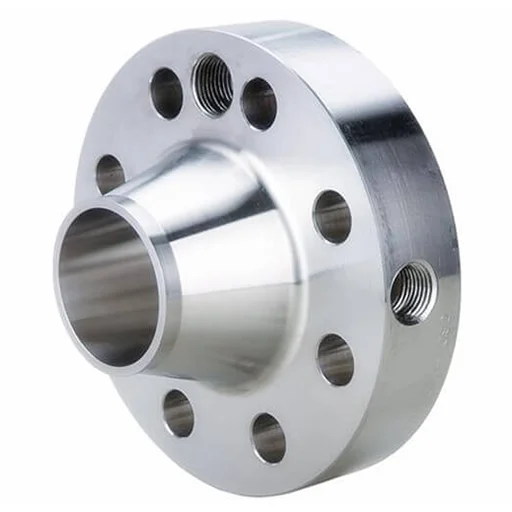
ASTM A182 F9 Orifice Flange
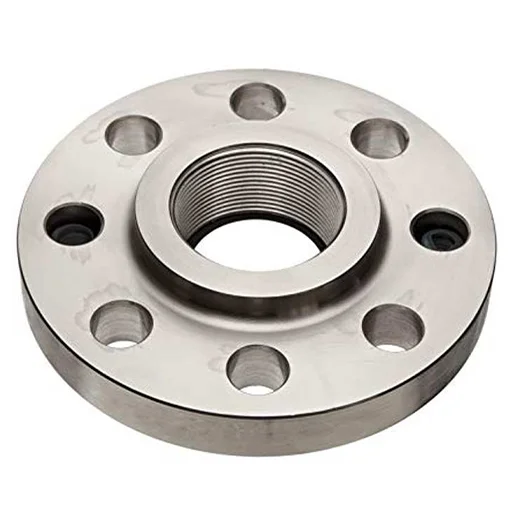
ASTM A182 F9 Threaded Flange
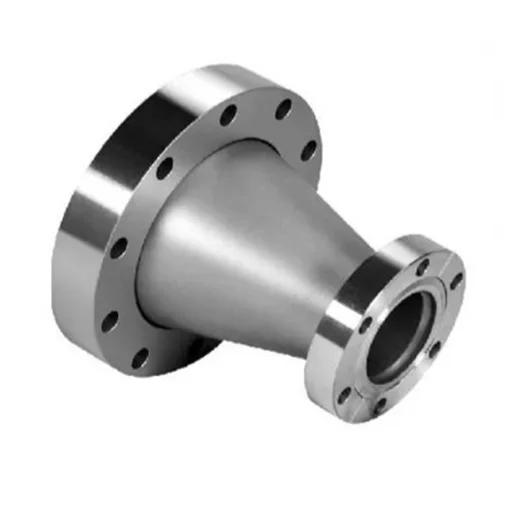
ASTM A182 F9 Reducing Flange
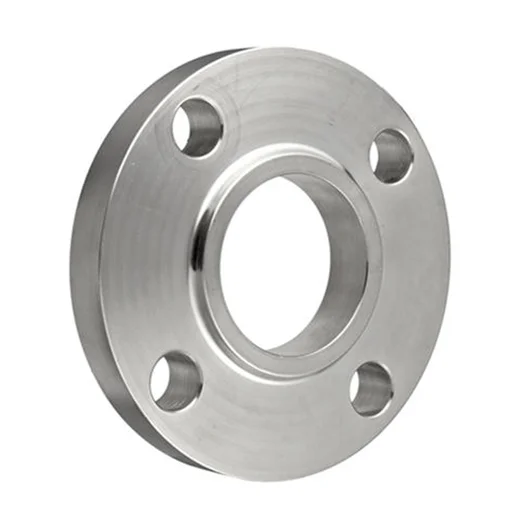
ASTM A182 F9 Lap Joint Flange
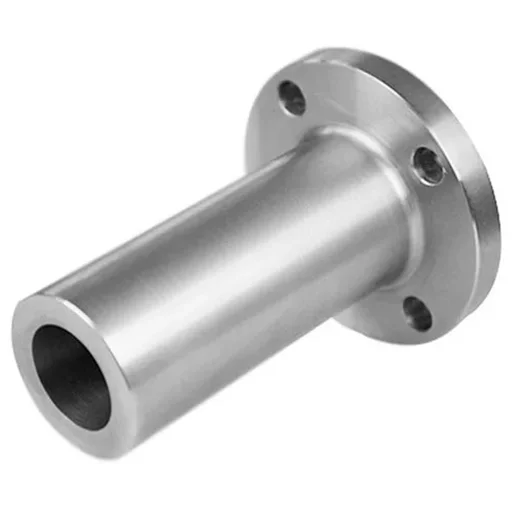
ASTM A182 F9 Long Weld Neck Flange
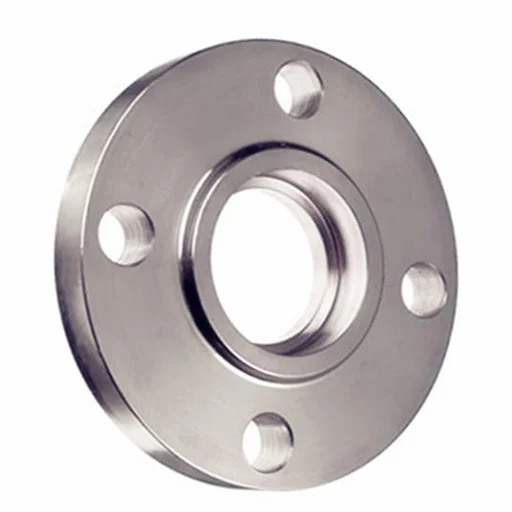
ASTM A182 F9 Socket Weld Flange
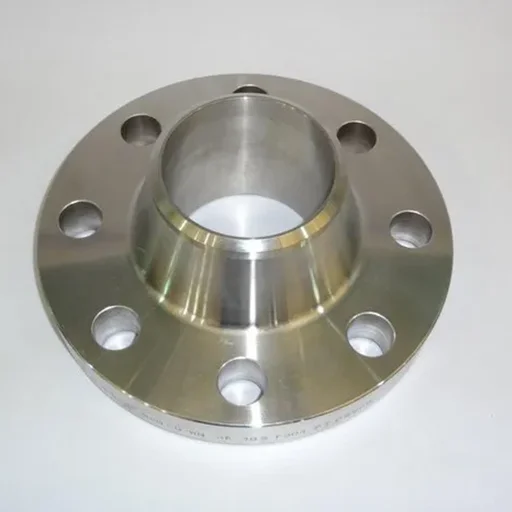
ASTM A182 F9 Weld Neck Flange
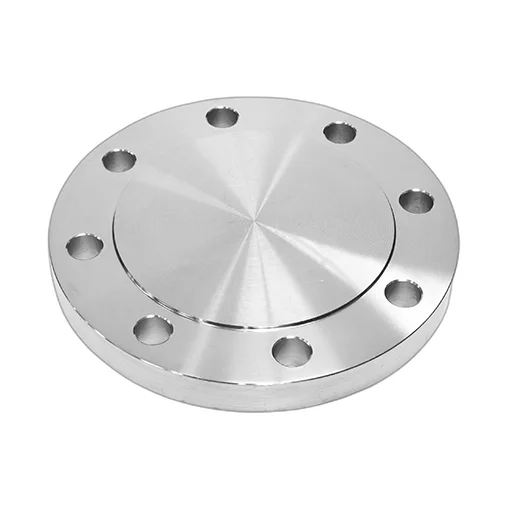
ASTM A182 F9 Blind Flange
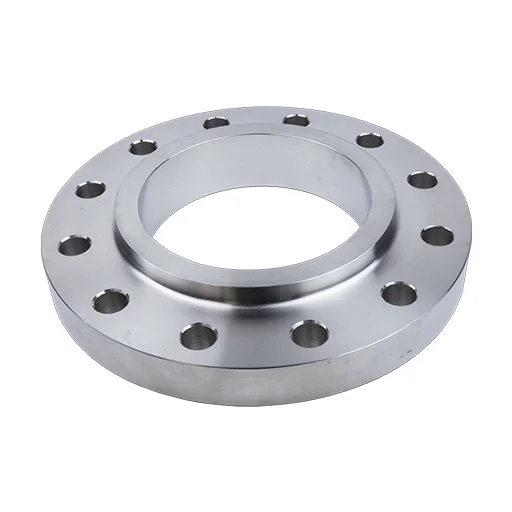
ASTM A182 F9 Slip-On Flange
Standard Flange Sizes & Weight Chart
ASTM A182 F9 Weld Neck Flange Dimensions (ANSI B16.5) - Class 300 Sample
| NPS | Outside Diameter (mm) | Thickness (mm) | Bore (mm) | Hub Dia (mm) | Bolt Circle (mm) | No. of Bolts | Bolt Dia | Approx Weight (kg) |
|---|---|---|---|---|---|---|---|---|
| 1/2" | 95 | 14 | 21 | 38 | 66 | 4 | M12 | 0.68 |
| 1" | 124 | 16 | 33 | 54 | 89 | 4 | M16 | 1.40 |
| 2" | 165 | 19 | 60 | 79 | 127 | 8 | M16 | 2.95 |
| 4" | 254 | 24 | 114 | 137 | 200 | 8 | M19 | 8.95 |
| 6" | 318 | 29 | 168 | 197 | 254 | 12 | M22 | 17.9 |
| 8" | 381 | 32 | 219 | 251 | 305 | 12 | M22 | 29.7 |
| 10" | 445 | 35 | 273 | 320 | 370 | 16 | M25 | 43.7 |
| 12" | 521 | 38 | 324 | 362 | 438 | 20 | M25 | 66.5 |
| 16" | 648 | 46 | 419 | 473 | 560 | 20 | M32 | 120.0 |
| 20" | 775 | 51 | 508 | 584 | 673 | 24 | M32 | 187.0 |
| 24" | 915 | 57 | 610 | 681 | 787 | 24 | M38 | 286.0 |
Is ASTM A182 F9 Good Quality for High-Temperature Creep Service?
Yes, ASTM A182 F9 is a very good choice when the application is high temperature where the creep strength, oxidation resistance and steam oxidation resistance is beyond what F5 or F22 can offer. Its 9% chromium content, which is far greater than that of F5 (5Cr) and F22 (2.25Cr), and its 1% molybdenum and ferritic microstructure both give it the highest possible high-temperature performance in power plants and refineries.
Its high chromium (8-10%) content creates an excellent protection layer through chromium oxide (Cr 2 O 3 ) which has a high level of resistance to oxidation, steam oxidation and sulfidation at high temperature. This renders F9 especially applicable to the service of steam-side in boilers in power plants where the concern of external oxidation and steam oxidation exist. The ferritic microstructure has a high thermal conductivity and low thermal expansion coefficient than austenitic stainless steels and minimizes thermal stress and thermal fatigue in cyclic application.
Increased heat-temperature creep strength F9 of above 500 C is far better than F5 or F22 because of its martensitic microstructure following heat treatment (normalizing and tempering or quenching and tempering). The material has sufficient creep rupture strength at temperatures 538 o C (1000 o F) and at 593 o C (1100 o F) and can be used in the subcritical and supercritical power plants. F9 however has a lower creep strength compared to modified 9Cr-1Mo grades F91 and F92 that have vanadium, nitrogen and niobium to improve creep strength.
F9 is designated to be used in superheater and reheater tubes and headers in power plants where F22 is marginal, hydroprocessing reactor internals in refineries, reforming furnace tubes at high temperature, and high-temperature hydrogen service. It is rated to a service temperature of 593 o C (1100 o F) according to ASME B16.5.
Although F9 has superb high temperature characteristics, in recent power plant construction it has been massively replaced by modified 9Cr-1Mo alloys (F91, F92) which have better creep strength. F9 is however commonly utilized in retrofit and repair projects and is easier to weld than F91/F92. In new high-temperature designs over 540 o C, F91 or F92 should be considered in order to achieve better long-term creep performance.
Heat Treatment & Testing Requirements
Heat Treatment Process
| Step / Parameter | Requirement | Cooling / Remarks |
| Normalizing + Tempering (Standard / Mandatory) | ||
| Normalizing | 1000-1050-C (1830-1920-F) | Cool uniformly in air |
| Tempering | 730-800-C (1350-1470-F) | Adequate holding time, air cool |
| Quenching + Tempering | ||
| Austenitizing | 1000-1050-C | - |
| Quenching | - | Oil quench |
| Tempering | 730-800-C (minimum) | Air cool |
| Microstructure (Target) | ||
| - | Tempered martensite | Ferritic matrix with fine carbides |
| Critical Requirement | ||
| - | Tempering mandatory | Reduces hardness and improves toughness after normalizing or quenching |
Testing & Inspection Requirements
| Test / Inspection | Standard / Requirement | Acceptance / Remarks |
| Tensile Testing | As specified | Yield = 60 ksi, Tensile = 85 ksi, Elongation = 20%, Reduction of Area = 45% |
| Hardness Testing | Brinell hardness | Typically 192-250 HB after tempering |
| PMI Testing | Positive Material Identification | Verification of Cr 8-10% and Mo 0.85-1.05% |
| Chemical Analysis | Product analysis | Confirmation of 9Cr-1Mo composition |
| Ultrasonic Testing | ASTM A388 | When specified for critical applications |
| Hydrostatic Testing | ASTM A961 or MSS SP-44 | As applicable / when specified |
ASTM A182 F9 Alloy Steel Flanges Price List 2026
| Flange Type | Size Range | Pressure Class | Indicative Price Range (USD/Piece) |
|---|---|---|---|
| Weld Neck (WN) | 1/2" - 2" | 150# | $22 - $58 |
| Weld Neck (WN) | 4" - 8" | 150# | $88 - $365 |
| Weld Neck (WN) | 10" - 24" | 150# | $550 - $2,050 |
| Weld Neck (WN) | 1/2" - 2" | 300# | $32 - $82 |
| Weld Neck (WN) | 4" - 8" | 300# | $135 - $545 |
| Weld Neck (WN) | 10" - 24" | 300# | $795 - $2,880 |
| Weld Neck (WN) | 1/2" - 2" | 600# | $48 - $125 |
| Weld Neck (WN) | 4" - 8" | 600# | $225 - $785 |
| Slip-On (SO) | 1/2" - 2" | 150# | $18 - $48 |
| Slip-On (SO) | 4" - 8" | 150# | $72 - $285 |
| Blind (BL) | 1/2" - 2" | 150# | $16 - $42 |
| Blind (BL) | 4" - 8" | 150# | $78 - $320 |
| Socket Weld (SW) | 1/2" - 2" | 150# - 600# | $25 - $105 |
Note: A182 F9 flanges are typically 130-170% higher than A105 and 25-35% higher than F22 due to 9% chromium content and complex heat treatment.
Applications of ASTM A182 F9 Flanges in Industry
The ASTM A182 F9 Alloy Steel Flanges are commonly used in many industrial applications, and some of the common industries are given below.
Power Generation
Subcritical and supercritical boiler superheater/reheater headers, main steam piping, hot reheat systems
Refinery
High-temperature hydrocracking reactor effluent, delayed coking units, high-temp sections of catalytic reformers
Petrochemical
Steam reforming furnace tubes and headers, ethylene cracker high-temp sections, high-temperature piping
Hydrogen Service
High-temperature hydrogen production and distribution, reformer outlet piping
Waste-to-Energy
High-temperature steam systems, superheater sections in waste incineration plants
Chemical Processing
High-temperature reactors requiring oxidation resistance, steam superheating
Heat Recovery
Waste heat recovery boilers, HRSG superheater sections
Why Choose ASTM A182 F9 Flanges from Metinox Overseas?
Metinox Overseas is a supplier of certified ASTM A182 F9 high chromium ferritic alloy steel flanges with optional certification of heat treatment, 9% chromium content ascertained and high-temperature creep-resistance assurance in our essential power plant and refinery applications. We have the ISO 9001:2015 and ASME certified correct facilities that certify all F9 flanges to receive the appropriate normalizing heat treatment and tempering heat treatment with recorded temperature control and metallurgical verification.
Each flange will be accompanied with EN 10204 3.1B Mill Test Certificates with full chemical analysis of Cr (8-10%) and Mo (0.85-1.05) passed, tensile test results of yield [?]60 ksi and tensile [?]85 ksi, elongation [?]20%, reduction of area [?]45%, hardness of 192-250 HB, heat treatment, and compliance to ASME B31.1 and B31.3.
Our technical department will provide professional advice on F9 vs F91 vs F92 material selection, welding of 9Cr-1Mo steels (preheat 200-300degC, PWHT 730-800degC required), creep rupture information and power piping codes. Applicant to power plants, refineries and petrochemical plants all over the world.
ASTM A182 F9 Flange Delivery Time & CIF Pricing by Country
| Destination Region | Major Ports / Cities | Estimated Delivery Time | Typical CIF Terms |
|---|---|---|---|
| Middle East (GCC) | Dubai, Dammam, Doha, Muscat | 12-16 Days | CIF Dubai / CIF Dammam |
| Europe | Rotterdam, Hamburg, Antwerp | 26-32 Days | CIF Rotterdam / CIF Hamburg |
| USA & Canada | Houston, New York, Los Angeles | 32-40 Days | CIF Houston / CIF New York |
| Southeast Asia | Singapore, Port Klang, Manila | 16-22 Days | CIF Singapore / CIF Port Klang |
| Africa | Lagos, Durban, Mombasa | 22-30 Days | CIF Lagos / CIF Durban |
Other Types of Alloy Steel A182 F9 Flanges
ASTM A182 F9 Flanges, 9Cr-1Mo Weld Neck Flanges, ASME SA182 F9 Blind Flanges, A182 F9 Socket Weld Flanges, F9 High-Temperature Flanges, F9 Power Plant Flanges, F9 Superheater Flanges.
Popular Locations Where We Supply ASTM A182 F9 Flanges
astm a182 f9 flanges supplier in singapore, a182 f9 alloy steel flanges suppliers in qatar, f9 9cr-1mo flanges suppliers in uae, astm a182 f9 flanges suppliers in chennai, a182 f9 weld neck flanges in mumbai, asme sa182 f9 flanges price list.
People Also Search For
astm a182 f9 alloy steel flanges manufacturer, a182 f9 9cr-1mo flanges supplier, astm a182 f9 weld neck flanges, f9 high-temperature flanges, a182 f9 vs f91 difference, astm a182 f9 flanges price list 2026, f9 power plant flanges.
Looking for High-Quality ASTM A182 F9 Flanges?
Let us support your projects with quality, precision, and performance.
Frequently Asked Questions (FAQ)
F9 contains 9% Chromium (compared with 2.25% in F22) that will offer better oxidation resistance and high creep strength above 500 C. F9 has ferritic/martensitic vs F22 ferritic/pearlitic microstructure and higher strength (60 ksi yield) and high temperature operating performance.
Compared to F9, A: F91 (modified 9Cr-1Mo-V-Nb) has much higher creep strength since it has added vanadium, niobium and nitrogen. F91 permits finer wall designs or increased operating pressure. But F9 is more convenient to weld and make, so it is available in the retrofit applications. F91 was desirable in new construction of above 540 o C.
A: Yes, heat treatment after the welding: according to ASME, the heat treatment of 730-800 C (1350-1470 F) is required. Minimum preheat 200-300-C required. PWHT is essential in order to weld HAZ martensite using temper and recover toughness. F9 martensitic requires stringent control heat treatment.
A: AWS A5.5 E9015-B9 or E9018-B9 (SMAW), AWS A5.28 ER90S-B9 (GMAW/GTAW). Match 9Cr-1Mo composition. Minimum interpass 300-C, minimum preheat 200-300o C, mandatory PWHT 730-800 C. Difficult to weld compared to F5/F22 because of the martensites.
A: Yes, F9 has excellent response to high temperature hydrogen attack on API 941 Nelson Curves. High molybdenum and chromium (1 percent) give this good resistance against high temperature hydrogen service. Mostly applied in reformer outlet piping.
A: ASME B16.5 is 593 o C (1100 F) maximum continuous operating temperature, same as F22. Nonetheless, F9 has better allowable stress values than F22 at elevated temperatures, above 538 C, because it has better creep strength.
A: F91 has much higher creep rupture strength and this enables it to have thinner walls and elevated operating pressure/temperature. F91 makes power plant design (supercritical/ultra-supercritical) more efficient. Nevertheless, F9 remains applicable to retrofits and in which the fabrication is easy.
A Not mandatory according to ASTM A182 but is often required when low-temperature service or critical service is required to ensure the tempered martensitic microstructure is tough enough. When defined, normally tested at design minimum temperature.
A: Yes, with NACE MR0175 compliance. Stipulate hardness to not exceed 22 HRC (248 HB) optimum, product analysis, correct heat treatment to produce tempered martensite and sour service documentation. One of the conditions that are important to F9 is hardness control because of martensitic structure.
A: Low levels of inventory. Custom order: 8-10 weeks, which includes forging, heat treatment normalizing and tempering, mechanical test, PMI, hardness test to check optimal tempering and documentation. Fast track service offered to power outage projects.
Enquire Now
Get pricing within 24 hours!